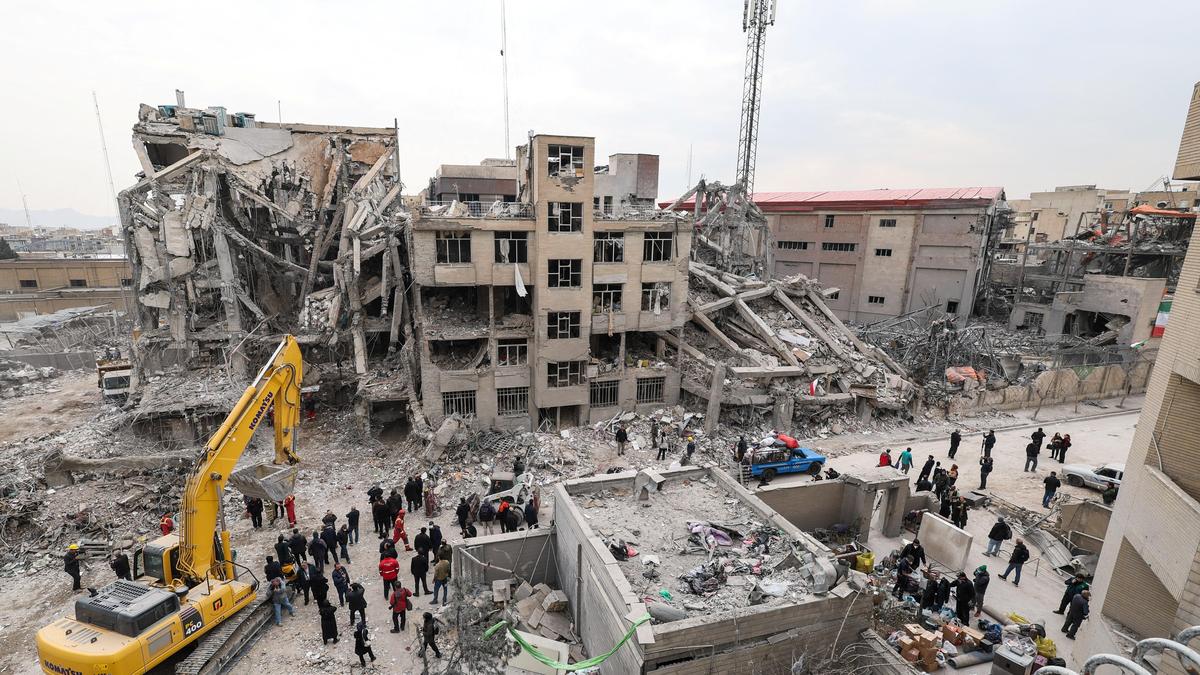
The global energy market is currently operating under a regime of "geopolitical arbitrage," where domestic economic incentives in the United States diverge sharply from traditional stability-seeking foreign policy. While conventional wisdom suggests that regional instability in the Middle East is an unmitigated risk, a structural analysis of the U.S. energy balance sheet reveals a more complex reality. The interplay between the escalating kinetic exchange between Israel and Iran and the stated preference of U.S. leadership for elevated crude prices creates a unique set of incentives for North American producers and federal revenue streams.
The Revenue Mechanics of High-Price Environments
The assertion that the United States "benefits" from high oil prices is not a rhetorical flourish; it is an acknowledgment of the shifted status of the U.S. from a net energy importer to a dominant global producer. The mechanism of benefit functions through three primary channels: If you enjoyed this article, you should look at: this related article.
- Capital Expenditure (CapEx) Justification: High spot prices lower the hurdle rate for unconventional shale projects. When Brent or WTI trades significantly above the marginal cost of production—currently estimated between $50 and $65 for many Permian Basin players—it triggers a surge in drilling activity, employment, and infrastructure investment.
- Fiscal Receipt Acceleration: Federal and state governments capture windfall gains through severance taxes, royalties on federal lands, and increased corporate tax receipts from the energy sector.
- Trade Balance Optimization: As a leading exporter of Liquefied Natural Gas (LNG) and crude, higher global prices improve the U.S. trade deficit, providing a macroeconomic cushion against inflationary pressures in other sectors.
However, this benefit is not linear. There is a "Point of Demand Destruction" where high energy costs begin to erode consumer discretionary spending and increase the input costs for the manufacturing and agricultural sectors. The strategic sweet spot lies in a price range that is high enough to incentivize domestic production but low enough to avoid a systemic inflationary spiral.
The Escalation Ladder: Israel, Iran, and the Risk Premium
The tactical exchanges between Israel and Iran represent a fundamental shift from "shadow war" to "direct kinetic engagement." This transition forces commodity markets to price in a permanent "Geopolitical Risk Premium" (GRP). This premium is the delta between the fundamental value of oil based on supply/demand and the market price driven by the probability of a supply disruption. For another angle on this story, check out the latest update from Reuters Business.
The logic of the current conflict can be mapped through a three-stage escalation ladder:
Level 1: Proxy Attrition and Cyber Interdiction
This stage involves low-level disruptions that create market noise but do not impact physical flows. The effect on oil prices is minimal, usually resulting in short-term volatility.
Level 2: Targeted Infrastructure Strikes
The transition to direct fire—missile barrages and drone strikes—targets high-value military or symbolic assets. While these do not always hit oil fields, they signal the capability to do so. The market responds by pricing in the possibility of a "Black Swan" event, such as a strike on the Kharg Island terminal in Iran or damage to Israeli offshore gas rigs like Leviathan or Tamar.
Level 3: The Strait of Hormuz Chokepoint
This is the ultimate escalation. Roughly 20% of the world's total oil consumption passes through this narrow waterway. Any credible threat to the freedom of navigation in the Strait would decouple oil prices from all historical benchmarks, potentially pushing crude into the $120-$150 range.
The Strategic Divergence of Interests
A critical friction point exists between the U.S. executive branch's desire for low gasoline prices (to maintain voter sentiment) and the broader economic benefits of a robust energy sector. This creates a policy paradox.
The "Strategic Petroleum Reserve (SPR) Lever" has been utilized to dampen price spikes, but this is a finite resource. When the SPR is depleted, the U.S. loses its primary tool for price suppression, leaving the market entirely dependent on private sector production speeds and OPEC+ decisions. Iran understands this vulnerability and uses its proxy network to create "managed instability"—enough to keep prices high and the West off-balance, but not enough to trigger a full-scale regional war that would destroy its own aging energy infrastructure.
Operational Constraints in the Permian Basin
Despite the financial incentives of high prices, the U.S. cannot instantly scale production to offset Middle Eastern volatility. The constraints are structural:
- Labor Shortages: Specialised petroleum engineers and field technicians are in short supply, limiting the rate of new well completions.
- Capital Discipline: Unlike previous cycles, investors are demanding dividends and share buybacks rather than "growth at any cost." This means companies are slower to deploy rigs even when prices are high.
- Midstream Bottlenecks: Even if production increases, the pipeline capacity to transport crude to export terminals on the Gulf Coast is often near its ceiling.
The Logic of Israeli Kinetic Strategy
Israel’s tactical objective is the degradation of Iranian "Forward Defense" capabilities. This includes neutralizing Hezbollah in Lebanon and the IRGC’s influence in Syria. By forcing Iran into a direct exchange, Israel aims to expose the limitations of Iranian air defenses and its inability to protect its domestic industrial base.
From an energy perspective, Israel has transitioned from an energy-poor nation to a regional exporter. Its security strategy now includes the protection of subsea pipelines and platforms. This necessitates a proactive military posture; any perceived weakness would invite attacks on its energy infrastructure, which is now a cornerstone of its national GDP.
Predictive Modeling: The Near-Term Equilibrium
The most likely scenario is not a total regional war, but a state of "High-Tension Equilibrium." In this state, Israel and Iran continue to exchange calibrated strikes designed to satisfy domestic audiences and project strength without crossing the threshold of total destruction.
This environment favors the U.S. energy sector in the short term. It maintains a floor for oil prices near $80, ensuring the viability of domestic shale while providing the U.S. with significant geopolitical leverage. The U.S. can offer "energy security" to European and Asian allies who are desperate to diversify away from Middle Eastern or Russian dependence.
The primary risk to this strategy is a miscalculation by either Tehran or Jerusalem. If a strike results in mass civilian casualties or the total loss of a major energy asset, the escalation becomes irreversible. For the global analyst, the metric to watch is not the rhetoric of leaders, but the insurance premiums for oil tankers in the Persian Gulf. When those rates spike, the transition from "beneficial high prices" to "global economic shock" has begun.
The strategic play for institutional investors and state actors is to hedge against the Level 3 escalation while capitalizing on the Level 2 volatility. This involves increasing positions in North American midstream infrastructure—the pipelines and terminals that are insulated from Middle Eastern kinetic risk—while maintaining a liquid posture to navigate the rapid price swings inherent in a multi-polar conflict zone.