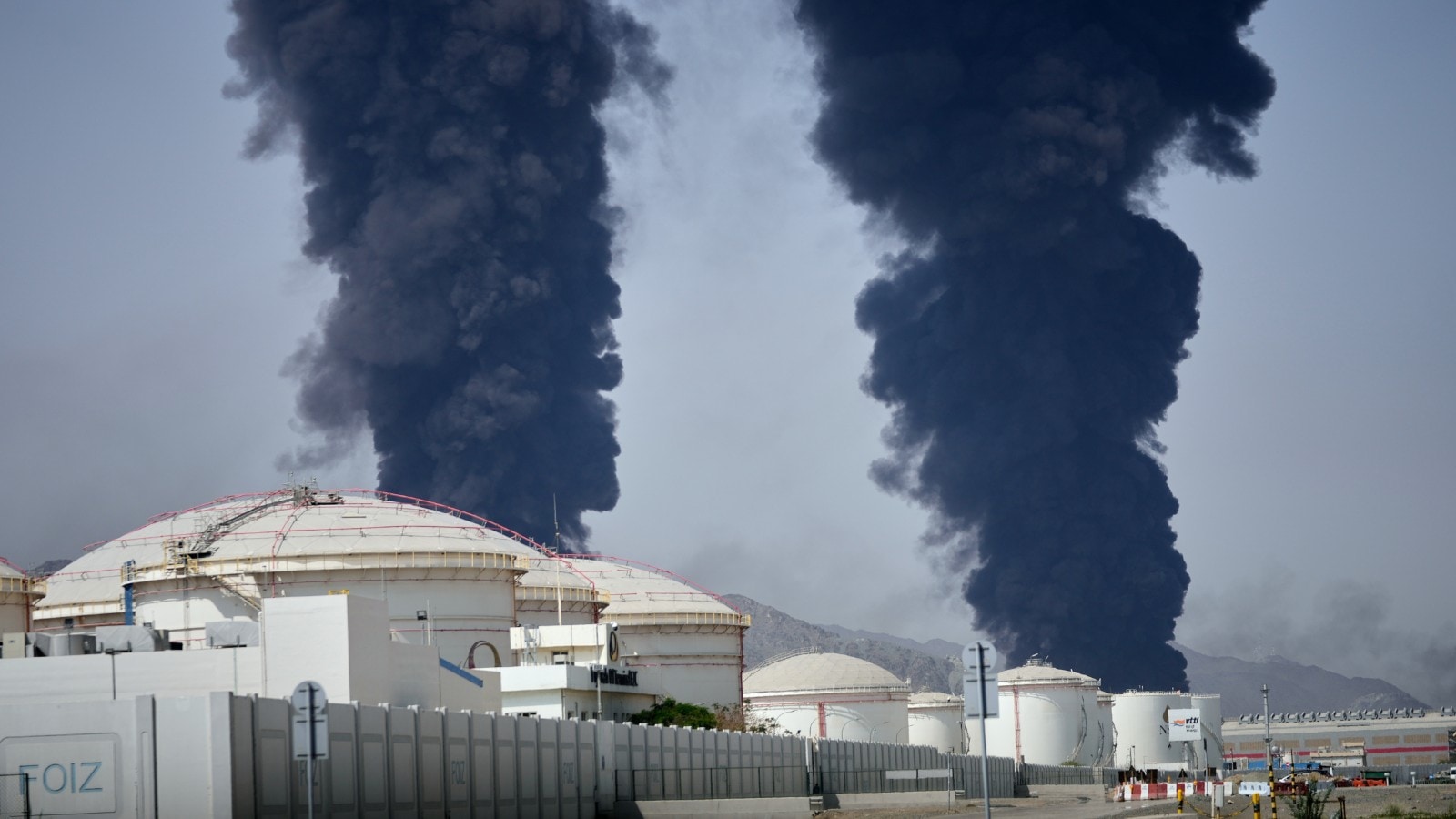
The synchronization of a fire at a UAE oil terminal following kinetic strikes on Iran’s Kharg Island suggests a shift from localized skirmishes to a systemic breakdown of regional maritime security. This is not merely a sequence of unfortunate events; it is the manifestation of a tit-for-tat escalation cycle that targets the physical bottlenecks of the global energy supply chain. When critical infrastructure—defined here as any node where the failure of a single asset results in a non-linear disruption of flow—is targeted, the market enters a phase of "risk-on" pricing that ignores traditional supply-and-demand fundamentals.
The Strategic Importance of the Kharg-Fujairah Axis
To understand the gravity of these events, one must map the geography of the Persian Gulf as a closed-loop system. Iran’s Kharg Island handles approximately 90% of the country’s crude exports. It is a concentrated vulnerability. Conversely, the UAE’s terminals, particularly those in Fujairah, serve as the primary bypass for the Strait of Hormuz.
The logic of targeting these specific nodes follows three distinct strategic imperatives:
- Economic Asymmetry: Striking Kharg Island removes Iran’s primary source of hard currency. Because the Iranian economy is heavily reliant on oil rents to fund internal stability and external proxies, the destruction of loading arms or storage tanks at Kharg is a direct strike at the state’s sovereign viability.
- Bypass Neutralization: The UAE’s Habshan-Fujairah pipeline was designed specifically to mitigate the threat of a Strait of Hormuz closure. By striking UAE terminals, an aggressor signals that even the "safe" bypass routes are within reach, effectively re-establishing the Strait as a total choke point.
- Insurance and Freight Escalation: Kinetic activity does not need to sink a tanker to be effective. The mere proximity of fire to loading zones triggers "War Risk" premiums. These costs are passed through the supply chain, acting as a functional tax on global energy consumers.
The Mechanics of Kinetic Contagion
The transition from a strike on Kharg to a fire in the UAE represents a "contagion of risk." In defensive security logic, this is analyzed through the lens of The Fragility of the Buffer.
A buffer, in this context, is the geographical and political space between two adversaries. When the US or its allies strike Iranian assets, the response is rarely a direct counter-strike against the US mainland. Instead, the response targets the closest economic proxies. The UAE terminal fire serves as a "kinetic signal"—a demonstration that for every unit of pressure applied to Iranian exports, a reciprocal unit of pressure will be applied to the global market’s bypass infrastructure.
This creates a Feedback Loop of Attribution Uncertainty. Unlike a missile strike, terminal fires can be caused by cyber-attacks, industrial sabotage, or drone swarms. By maintaining ambiguity, the perpetrator avoids a full-scale conventional war while achieving the same economic outcome as a declared blockade.
Quantifying the Vulnerability of Port Infrastructure
Modern oil terminals are masterpieces of engineering but nightmares of security. The vulnerability of a terminal like Fujairah or Kharg can be broken down into three critical components:
The Loading Arm Bottleneck
The most fragile part of an oil terminal is the loading arm—the mechanical link between the shore-side pipes and the tanker. These are precision instruments. While a storage tank can burn for days without stopping all operations, the destruction of loading arms halts the ability to monetize the product. Replacing these components requires specialized manufacturing that often involves lead times of six to twelve months.
The Storage Density Risk
Oil terminals optimize for density to minimize the footprint of the facility. This creates a "domino effect" hazard. Thermal radiation from one burning tank can cause the structural failure of adjacent tanks. If fire suppression systems—which rely on massive volumes of water and specialized foam—are compromised by the initial strike, the entire facility becomes a write-off.
The Cyber-Physical Interface
Modern terminals are managed by Industrial Control Systems (ICS). A kinetic strike is often preceded or accompanied by a cyber-attack designed to disable emergency shut-off valves or fire suppression pumps. If the digital "nervous system" of the terminal is blinded, the physical damage from a fire is multiplied by an order of magnitude.
The Failure of Deterrence Frameworks
The current escalation proves that traditional deterrence—the idea that the threat of overwhelming force will prevent an attack—is failing in the energy sector. This failure stems from a misalignment of "Cost Functions."
For a state actor under heavy sanctions, the cost of further escalation is low because their baseline economic reality is already catastrophic. For the global market, however, the cost of escalation is infinite. This creates a Deterrence Gap where the aggressor can take risks that the defender cannot afford to match.
The second limitation of current security strategies is the reliance on "Point Defense." Deploying Patriot missiles or C-RAM systems around a terminal provides a false sense of security. These systems are designed to intercept high-altitude or mid-range projectiles. They are significantly less effective against low-altitude "suicide drones" or "insider-threat" sabotage, which appear to be the preferred vectors in recent Persian Gulf incidents.
Measuring Market Volatility and the "Fear Barometer"
When news of the UAE fire broke, Brent Crude did not just rise; it experienced a "volatility spike." Traders utilize the Oil Volatility Index (OVX) to measure the market’s expectation of 30-day uncertainty.
The relationship between kinetic events and price action is governed by the Risk Premium Formula:
$$P_{total} = P_{fundamental} + P_{geopolitical}$$
In a stable environment, $P_{geopolitical}$ is near zero. When Kharg Island is hit, $P_{geopolitical}$ becomes the dominant driver. This creates a "decoupling" where the price of oil no longer reflects how much oil is in the ground, but rather how likely that oil is to reach a refinery.
The second-order effect is the Tanker Redirection Cost. As terminals in the UAE become high-risk zones, ship owners demand higher "demurrage" rates (the cost of a ship being delayed). If multiple terminals are affected, the available "bottoms" (ships) in the region shrink as captains refuse to enter the Gulf, creating a localized supply squeeze regardless of global production levels.
Structural Constraints on Rapid Recovery
If the damage to both Kharg and the UAE terminals is structural, the global energy market faces a prolonged period of "Inelastic Supply."
- Repair Lead Times: The global supply chain for high-pressure valves, pumps, and specialized steel for oil infrastructure is currently strained. A terminal cannot be "patched"; it must be rebuilt to rigorous safety standards.
- Environmental Remediation: An oil fire of this magnitude creates a massive ecological footprint. The soot and chemical runoff from firefighting foam can contaminate local desalination plants—the primary source of water for the UAE—turning an energy crisis into a humanitarian one.
- Political Deadlock: Reconstruction requires insurance payouts. Insurers will not pay out or provide new coverage while the threat of a secondary strike remains. This creates a "stagnation trap" where facilities remain charred ruins because the risk of rebuilding is too high.
Strategic Realignment of Global Energy Flows
The simultaneous targeting of Iranian and Emirati infrastructure signals the end of the "Hormuz Hegemony." For decades, the global economy assumed that the US Navy could guarantee the flow of oil through the Strait. This assumption is now obsolete.
The geographical concentration of energy production is being met with the geographical concentration of kinetic risk. This will force a shift toward Energy Regionalism. Nations like China and India, which are the primary buyers of Iranian and Gulf crude, will be forced to choose between providing their own maritime security or accelerating their transition away from Middle Eastern hydrocarbons.
The logistical reality is that there is no "quick fix" for a burning terminal. The fire in the UAE is a symptom of a systemic collapse in the rules-based order of maritime trade.
To mitigate the fallout from this specific escalation, stakeholders must immediately pivot from a "Defense" posture to a "Resilience" posture. This involves the decentralization of storage—moving away from massive "mega-terminals" toward smaller, distributed nodes that are harder to disable with a single strike. Furthermore, the integration of automated, independent fire-suppression systems that do not rely on a central ICS is a mandatory technical upgrade for any facility operating in a high-threat environment.
The immediate strategic play for energy-dependent economies is the aggressive filling of Strategic Petroleum Reserves (SPR) while the "bypass" routes are still partially operational. The window for pre-emptive stockpiling closes the moment the first loading arm at a secondary terminal is severed.
Wait-and-see approaches are no longer viable. The market is witnessing the weaponization of the supply chain in real-time. Organizations must quantify their exposure to "Hormuz-specific" supply and begin the costly but necessary process of diversifying their logistics toward the Atlantic or Arctic routes, where the kinetic risk-to-reward ratio remains manageable.
Would you like me to analyze the specific impact on insurance premiums for VLCC (Very Large Crude Carrier) classes following these strikes?
[/article]