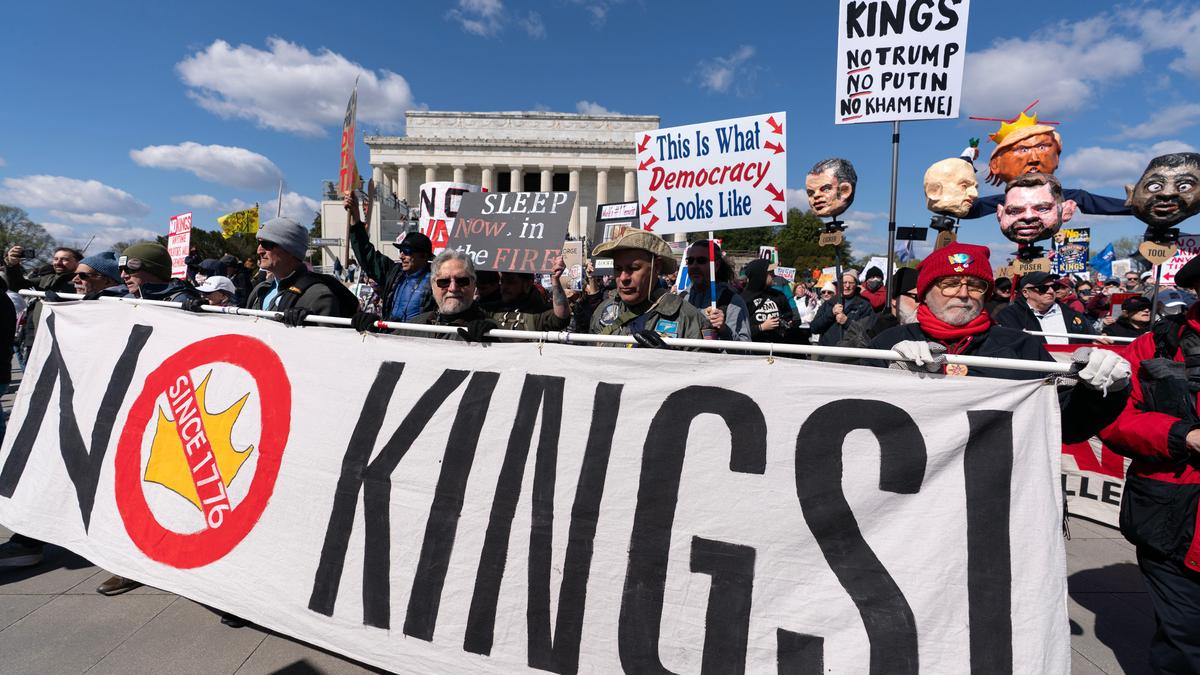
The largest single-day protest in the history of the United States did not happen in a vacuum, nor was it merely a reaction to a single man. On March 28, 2026, an estimated eight million people flooded the streets of 3,300 American cities under the "No Kings" banner. This was the third and most massive iteration of a movement that has fundamentally shifted from a progressive outcry to a broad-spectrum withdrawal of public consent. While the administration in Washington attempts to frame these gatherings as the "dying gasps of a radical left," the data and the faces in the crowd tell a different story.
This movement is no longer about the 2024 election results. It is about a structural collision between an executive branch that views its power as absolute and a citizenry that is rediscovering the power of refusal. The "No Kings" protests are the visible tip of an iceberg that includes general strikes, economic boycotts, and a breakdown in the traditional relationship between the federal government and the states. If you liked this post, you might want to check out: this related article.
The Trigger and the Tipping Point
The initial "No Kings" protest on June 14, 2025, was timed to coincide with the U.S. Army’s 250th anniversary parade—an event critics felt was less about military heritage and more about a personalized display of state power. That day saw five million people take to the streets. It was a warning shot.
By October 2025, the numbers climbed to seven million. The catalyst had shifted from symbolic concerns to the visceral reality of intensified immigration raids and the deployment of federal troops to cities like Los Angeles and Memphis. The administration’s rhetoric of "rebellion" and "insurrection" regarding local non-compliance only served to harden the resolve of those on the ground. For another look on this development, see the latest coverage from Associated Press.
The March 2026 mobilization reached the eight-million mark because the stakes became existential. The outbreak of conflict in Iran and the high-profile deaths of activists like Alex Pretti and Renée Good during federal operations turned a political protest into a national mourning period. When the 50501 movement and Indivisible called for a "national resistance to tyranny," they weren't just using a slogan. They were tapping into a profound sense that the constitutional guardrails had not just bent, but snapped.
The Strategy of Decentralization
Unlike the monolithic marches of the 1960s or even the Women's March of 2017, "No Kings" is intentionally leaderless and geographically diffuse. This is a tactical choice. By organizing in 3,300 different locations, the movement makes itself impossible to decapitate. There is no single headquarters for federal agents to raid, no single leader to discredit or arrest.
This decentralization serves a secondary purpose: it forces local law enforcement and municipal governments to choose a side. In cities like Minneapolis and Chicago, we have seen the emergence of a "dual power" dynamic. While federal agents attempt to execute "One Big Beautiful Bill" policies, local officials—backed by the massive turnout in their own town squares—are increasingly refusing to provide the logistical support necessary for those operations.
The 3.5% rule is the guiding light here. This political theory suggests that no government can withstand a challenge from 3.5% of its population if that group is active and non-violent. At eight million participants, the movement is approaching that threshold. It is a mathematical threat to the stability of the executive branch.
Beyond the Blue Bubble
The most significant development in 2026 is the changing demographic of the dissent. While early 2025 polling suggested that 90% of protesters were left-leaning, recent surveys indicate a slow but steady infiltration of independents and even disaffected conservatives.
Why the shift? It comes down to the economy and the war.
The 2026 Iran war has sparked a classic "anti-war" coalition that cuts across traditional party lines. Rural communities, which often provide a disproportionate number of service members, are seeing the human cost of a "kingly" executive making unilateral military decisions. Furthermore, the economic instability caused by federal government shutdowns and the 2026 general strike in Minnesota has started to alienate the business class. When the American Federation of Teachers and the Communications Workers of America join forces with local "Main Street" business owners who are tired of the chaos, the administration's "radical" label loses its stickiness.
The Limits of Street Power
We have to be honest about what a protest can and cannot do. A march, no matter how large, is not a law. It is a demonstration of potential energy. The Trump administration has shown a remarkable ability to ignore public sentiment, often dismissing the "No Kings" rallies as manufactured or irrelevant.
The real test of the movement isn't the number of people in the street on a Saturday. It is what those people do on Monday.
We are starting to see the transition from protest to "economic non-cooperation." This includes:
- Targeted boycotts of corporations with close ties to the administration.
- The rise of mutual aid networks that bypass federal social services.
- The "Know Your Rights" training sessions that have turned neighborhood blocks into legally fortified zones against ICE operations.
These are not the actions of people who are waiting for the next election. These are the actions of people who have decided that the current federal government is an obstacle to be navigated rather than a leadership to be followed.
The Coming Friction
The administration's response to the March 2026 protest was telling. By deploying the National Guard and using monarchical imagery on official social media channels, the White House has leaned into the very "king" persona that the protesters are rallying against. It is a feedback loop of escalation.
The federal government is currently testing the limits of the Insurrection Act and the judicial system's willingness to stay out of the way. Meanwhile, the "No Kings" coalition is testing the limits of civil disobedience.
This is no longer a question of policy. It is a question of who actually holds the mandate to govern. If the administration continues to treat eight million citizens as "enemies of the state," the friction will move from the streets into the very machinery of the American economy and legal system.
The "No Kings" movement has successfully redefined the second Trump term. It is no longer a period of unopposed executive expansion. It is a period of sustained, high-stakes domestic conflict where the definition of "American" is being fought over in every zip code in the country. The era of passive observation is over. The era of the general strike and the mass refusal has arrived.
Stop waiting for a central leader to emerge or a specific policy victory to be declared. The victory of the "No Kings" movement is its existence—the proof that even in an age of unprecedented executive power, the ultimate power remains the ability to say no in such numbers that the "king" has no choice but to hear it.



