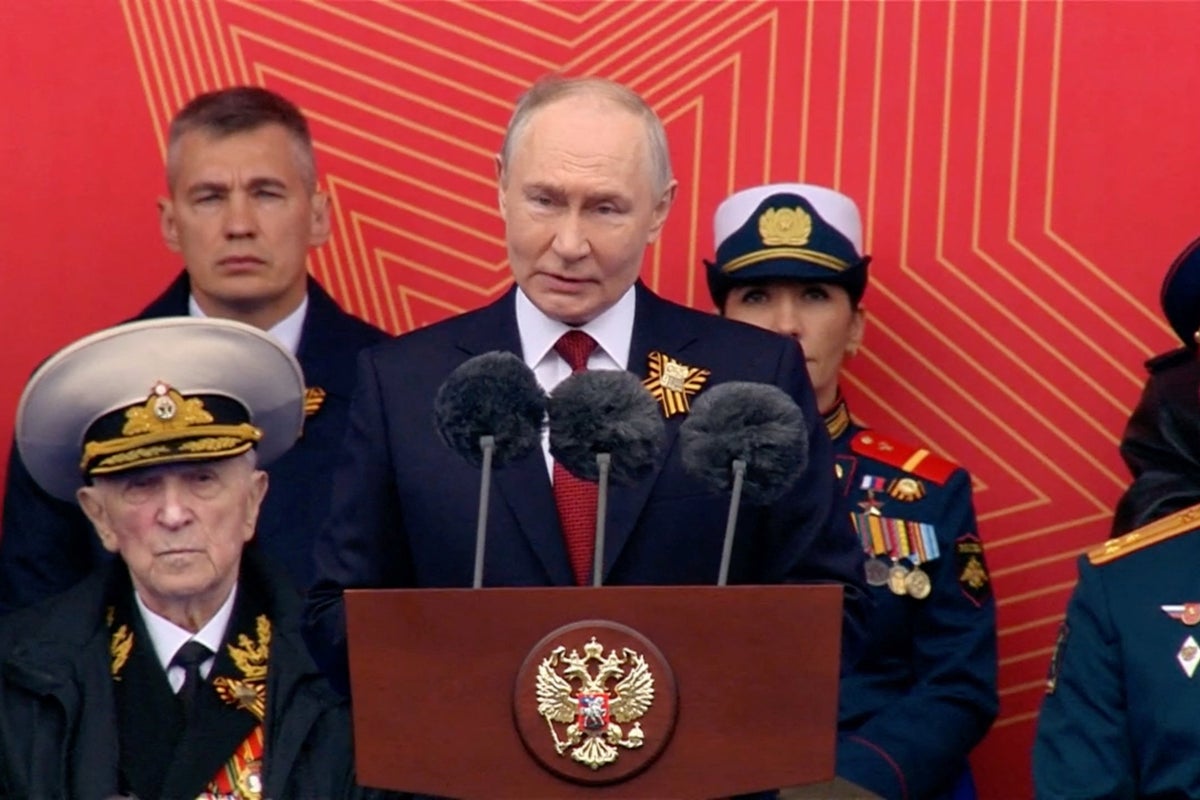
The cobblestones of Red Square usually groan under the weight of T-14 Armata tanks and Yars intercontinental ballistic missile launchers every May 9. This year, the silence was deafening. Vladimir Putin stood before a curated crowd for the 2026 Victory Day parade, but the usual display of raw metal and gasoline was missing. For the first time in nearly two decades, the mobile column of military technology was entirely absent, replaced by the rhythmic boots of marching cadets and the eerie hum of a curated ceasefire.
In the wake of this hollowed-out ceremony, Putin signaled that the war in Ukraine is "coming to an end." It is a statement that demands more than a cursory glance at the headlines. While the Russian President frames this as a looming victory against a NATO-backed "aggressive force," the reality on the ground and the optics of the parade suggest a different, more desperate calculus. This was not a victory lap; it was a security maneuver performed under the umbrella of a fragile, three-day truce brokered by Donald Trump.
The Ghost Parade
The absence of heavy hardware was not a stylistic choice. It was a concession to a new reality of warfare where a single Ukrainian drone, costing less than a used car, could turn a billion-dollar propaganda event into a televised disaster. For weeks leading up to the event, Moscow was a city under siege by its own security protocols. Airports were shuttered, and mobile signals were jammed to the point of rendering the capital’s digital infrastructure useless.
The Kremlin cited "the current operational situation" for the scale-back. In plain terms, they could not guarantee that the S-400 air defense systems and T-90 tanks would not be targeted by long-range drones that have recently reached as far as the Omsk and Murmansk regions. By removing the targets, Putin removed the risk of a public embarrassment, but in doing so, he signaled a profound vulnerability. A superpower that cannot secure its own capital for a forty-five-minute parade is a superpower facing an existential identity crisis.
The Trump Factor and the Prisoner Swap
The three-day ceasefire that allowed the parade to proceed at all was the result of high-stakes transactional diplomacy. Donald Trump, positioning himself as the only figure capable of halting the bloodshed, secured an agreement that included a one-for-one exchange of 1,000 prisoners of war.
Ukrainian President Volodymyr Zelenskyy’s response was a masterclass in psychological warfare. He signed a mocking decree "permitting" Russia to hold its parade, contingent on Red Square remaining a strike-free zone for a mere thirty-six hours. This maneuver effectively framed Putin as a leader who requires Kyiv’s permission to celebrate his own national holiday. The ceasefire held, mostly, but the "beginning of the end" that Putin alluded to feels less like a settled peace and more like a tactical pause for two exhausted combatants.
The Arithmetic of Exhaustion
Putin’s claim that the conflict is winding down is rooted in a grim statistical reality. Since February 2022, Russian casualties have surpassed 1.2 million. The Russian military is advancing at a pace measured in meters per day, a rate slower than the trench warfare of the first World War.
The economic toll is perhaps even more pressing than the human cost. While the Kremlin touts a resilient war economy, the cracks are widening.
- Refining Crisis: Ukrainian drone strikes have taken nearly 40% of Russia’s oil refining capacity offline at various points this year.
- Income Loss: Attacks on Baltic and Black Sea ports have slashed oil revenue by over $1 billion in some months.
- Infrastructure Decay: Western border regions like Belgorod have faced weeks-long power and water outages, pushing the domestic population’s patience to a breaking point.
When Putin says the war is ending, he is likely looking at a spreadsheet, not a map. The Russian state is burning through its liquid assets and its working-age population at a rate that cannot be sustained into 2027. The "peace" he is now signaling for is not a surrender, but a desperate bid to lock in current territorial gains before the domestic engine seizes up entirely.
The Unmanned Systems Pivot
The parade did offer one glimpse into the future of Russian doctrine. While the tanks were gone, the ceremony included a dedicated segment for the newly founded Unmanned Systems Forces. This is a quiet admission that the traditional "steel rain" doctrine of the Russian army has failed against modern decentralized defense.
The Kremlin is pivoting. They are trading the prestige of the main battle tank for the utility of the FPV drone and the loitering munition. This shift is practical, but it lacks the mythic resonance that Victory Day requires. You cannot build a national identity around a plastic drone controlled by a teenager in a basement.
The Third Country Gambit
The most concrete takeaway from Putin’s post-parade remarks was his willingness to meet Zelenskyy in a third country. However, the caveat was significant: the meeting would not be for negotiations, but for the signing of a "final deal" aimed at a "long-term historic perspective."
This is the language of an ultimatum disguised as an olive branch. Putin wants a frozen conflict on his terms, one that leaves Russia in control of the Donbas and Crimea while preventing Ukraine from ever joining NATO. Zelenskyy, bolstered by increasingly effective long-range strike capabilities and a shifting political tide in Washington, has little reason to accept such a deal unless the military situation collapses.
The 2026 Victory Day parade will be remembered as the moment the pageantry of the Russian military was stripped bare. The empty square was a testament to the fact that the "special military operation" has fundamentally altered the Russian state, leaving it smaller, more paranoid, and increasingly dependent on the whims of foreign mediators and the restraint of its neighbor. The war may be "coming to an end," but for the thousands of families on both sides of the front line, the end looks nothing like victory. It looks like a slow, painful slide into an uncertain silence.
The cobblestones are clear for now, but the drones are still in the sky.

