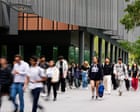
The coffee in the student union is too expensive, and today, nobody is buying it.
At 9:00 AM in Melbourne, a lecture hall built for three hundred souls holds barely a third. The air smells of dry carpet and stale ambition. Up front, a professor stands beside a glowing projector screen, pointing at a bar chart that resembles a jagged cliff dropping off into a canyon. The bars represent international tuition revenue. The drop is steep. It is silent.
Universities in Australia have long enjoyed a certain kind of gravitational pull. For decades, they sat perched at the edge of the southern hemisphere like beacons, drawing ambitious minds from Shanghai, New Delhi, Bogotá, and Jakarta. Young people packed suitcases with winter coats they didn't know how to wear, flew twenty hours across oceans, and rented cramped apartments in Sydney, Brisbane, and Perth. They came for degrees. They stayed for a shot at a different life.
And, quietly, they funded the entire enterprise.
To understand what is happening right now, you have to look past the academic senate minutes and the glossy recruitment brochures. You have to look at the ledger. For years, domestic tuition caps and flat government funding left Australian tertiary institutions hungry. International student fees became the quiet engine room keeping the lights on. They paid for cancer research laboratories, library acquisitions, adjunct faculty contracts, and the very brick-and-mortar expansions that made campuses look like corporate headquarters.
Now, the engine is stuttering.
Policy changes, stricter visa processing caps, rising cost-of-living pressures, and a shifting global diplomatic climate have slammed the brakes on inbound student numbers. Experts are issuing warnings. They use terms like structural deficit, liquidity strain, and revenue contraction.
Translation: The money is drying up. And when the money dries up, the people go.
Consider a hypothetical lecturer named Sarah. She has spent twelve years teaching economics at a mid-sized regional university. She is not a bureaucrat; she is someone who still gets a little thrill when a nineteen-year-old student finally grasps the concept of diminishing marginal utility. Last Tuesday, Sarah received an email marked urgent. It contained a restructuring proposal. Her department, small and specialized, is slated for consolidation. Three courses are being cut. Two junior colleagues are losing their contracts.
Why? Because the international enrollment targets for the upcoming semester missed their mark by forty percent.
This is the invisible geometry of the crisis. We talk about falling numbers as if they were weather patterns—cold fronts moving across economic charts, entirely natural, entirely impersonal. But numbers do not walk through customs. Students do.
When an international student chooses not to come to Australia, a chain reaction begins. The empty chair in Sarah’s lecture hall means fewer fees collected. Fewer fees mean tighter departmental budgets. Tighter budgets mean canceled classes, larger tutorial groups, and overworked professors who have less time to read an essay draft or offer a word of encouragement to a struggling kid who is six thousand miles away from home.
It also ripples outward into the streets.
Walk through the neighborhoods surrounding any major Australian campus on a Friday night. The noodle shops, the shared apartments, the corner laundromats, the public transit turnstiles—they all pulse to the rhythm of student life. Landlords who relied on steady rental demand are feeling the pinch. Small business owners who catered to late-night study groups are watching their profit margins thin out to nothing.
Australia built an economic model on the back of global education export, ranking it among its most valuable services. It was brilliant until it became fragile. When you pin the financial viability of public infrastructure on the geopolitical stability and visa policies of foreign nations, you are walking a tightrope in a gale-force wind.
And yet, the deeper tragedy is human, not financial.
Think of a student we will call Aarav, sitting in a living room in Mumbai three months ago. He spent two years preparing for his IELTS exam. He worked extra shifts at his uncle’s electronics shop. He and his parents pooled their savings, calculating the exchange rate down to the last rupee, believing that an Australian degree was the golden key to his future. When his visa application stalled, and then faced stricter financial threshold requirements that suddenly shifted the goalposts, the door slammed shut.
Aarav did not just lose a university placement. He lost a narrative he had written for his own life.
Universities are now scrambling. Administrators who once spent their days planning campus festivals are now locked in crisis meetings, trying to figure out how to trim fat without drawing blood. Some are eyeing domestic expansion. Others are looking at digital delivery models. But none of these pivots can replace the sheer economic weight of full-fee-paying global scholars in the short term.
The silence in the lecture hall is deafening if you listen closely enough.
It tells a story of an industry that grew accustomed to growth, mistaking a temporary boom for a permanent law of nature. It tells a story of policy shifts made in Canberra offices that echo directly into the lecture halls of Adelaide and the student flats of Carlton.
The semester marches on. The projector hums. Sarah erases a demand curve and draws a new one, trying to explain to the remaining students how markets correct themselves when equilibrium fails. Outside, the rain starts to fall over the quadrangle, slicking the pavement where hundreds of footsteps used to echo.
The numbers on the chart will change again next quarter. Whether they rise or fall depends entirely on whether we remember what those numbers actually are. Not statistics. Not line items.
People.