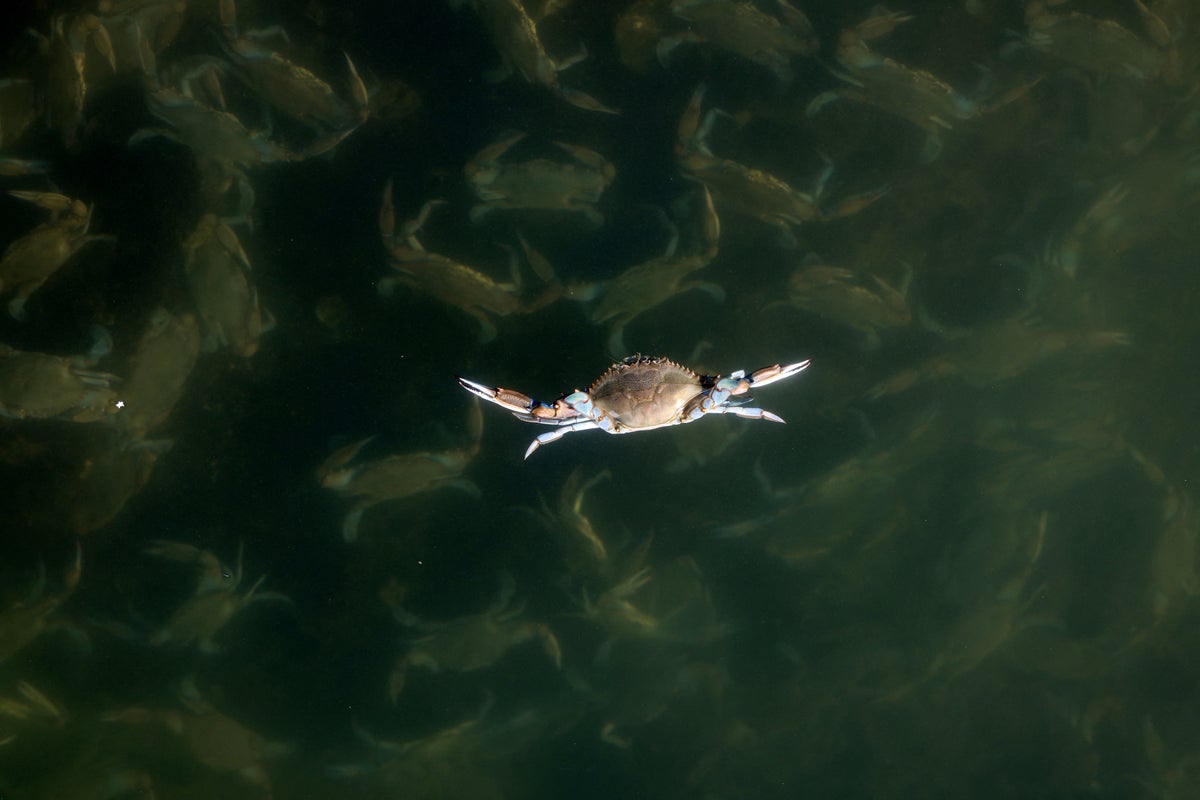
The water in the bay used to taste like iron and salt, dark and thick with life. Standing on the weathered timber of the dock at dawn, you could watch the shadows move beneath the surface—not fish, but armor. Blue crabs. Millions of them, scuttling across the muddy floor, tearing through eelgrass, and turning a once-thriving coastal ecosystem into a monoculture of hunger.
For years, commercial fishers watched their nets come up heavy with them, but not the kind you want. Too many small ones. Too aggressive. They chased out the oysters, outcompeted the local flounder, and left behind empty, bleached shells like tiny tombstones. We tried traps. We tried heavier regulations. We even tried simply eating our way out of the crisis, ordering crab cakes by the dozen at local diners until our cholesterol spiked.
None of it worked. The math was simple: a single female blue crab can release millions of eggs in a single season. Humans with wire cages stood no chance against that kind of biological persistence.
Then came the eight-legged cavalry.
The Silence Below
To understand why scientists turned to cephalopods, you have to spend an hour hauling traps in thirty-foot water when the wind is coming off the north. Your hands go numb. The rope burns your palms through the canvas of your gloves. Marine biologists don't talk about these things in white-paper journals, but out on the water, desperation smells like wet rust and diesel fuel.
Dr. Aris Thorne, a coastal ecologist who has spent twenty years watching the bay's benthic layer unravel, remembers the breaking point. It was late autumn, and the oxygen levels in the deeper channels had plummeted because the blue crab population had grazed the filtering vegetation down to bare dirt. Without plants to oxygenate the water, the bay was suffocating.
"We were fighting a math problem with a broom," Thorne says, his voice carrying the gravelly fatigue of someone who has argued with state budget committees too many times. "Every crab we pulled out left a vacuum. And nature hates a vacuum. Something else was going to rush in, or the crabs were simply going to bounce back threefold."
They needed a predator. Not just any predator, but one smart enough to navigate the complex maze of marsh grass, patient enough to wait out a hiding crustacean, and hungry enough to make a real dent in the numbers.
They needed octopuses.
Meeting the New Residents
(Note: To illustrate how this biological intervention plays out on the ground, imagine a research station on the edge of the salt marsh, where marine biologists track individual cephalopods using acoustic telemetry tags no larger than a grain of rice.)
In the tanks at the marine station, the local species of octopus—Octopus vulgaris variants adapted to temperate coastal waters—do not look like monsters. They look like liquid silk. Their skin ripples, shifting from sandy beige to the dark, mottled brown of a submerged log in milliseconds.
Watch one for five minutes and you realize why they are uniquely suited for this war. A blue crab uses its lateral spines and sharp claws to deter fish and birds. It faces forward, ready to fight anything that approaches head-on. But an octopus does not fight head-on.
An octopus solves problems.
When researchers introduced tagged octopuses into controlled tidal enclosures heavily populated by invasive crabs, the strategy became clear. The octopus does not wrestle the crab. It flows over it. Eight flexible arms, lined with hundreds of independent suction cups, wrap around the carapace like a wet blanket. The crab's defensive claws are pinned uselessly to its sides. In the final, decisive moment, the octopus drives its beak—hard as a parrot's—through the thin membrane at the base of the crab's eyes, injecting a paralyzing venom.
It is clinical. It is silent. And it is remarkably efficient.
The Ripple Effect
Critics worried about introduction. History is littered with ecological blunders where scientists brought in one animal to fix a problem, only to create a much worse one. Think of cane toads in Australia or starlings in North America. When you mess with a food web, you usually pull the wrong thread and watch the sweater unravel entirely.
Thorne and his team knew this. That is why the octopus deployment is not a permanent occupation; it is a surgical strike. These particular cephalopods have short lifespans, typically living only one to two years. They do not build permanent colonies that overrun the ecosystem. Once their job is done—once the dense populations of invasive blue crabs are thinned back to historical, manageable baselines—the octopus population naturally recedes with the seasonal shifts in water temperature and food availability.
The results, tracked over the past eighteen months, have surprised even the skeptics.
In test zones where the cephalopods were active, submerged aquatic vegetation has begun to return. The water clarity has improved because fewer crabs are stirring up the bottom sediment in frantic searches for food. Oyster spat, previously devoured before they could anchor to hard substrates, are forming new reefs.
Walk down to that same dock at dawn today. The water isn't quite what it was a century ago. It may never be. But the iron taste of stagnation is gone, replaced by the sharp, clean scent of a living tide.
Beneath the surface, invisible in the green gloom, an intelligence older than bones is holding the line.