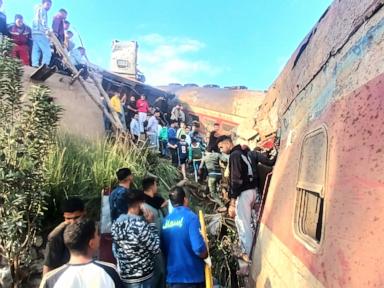
Two trains smash into each other in the Nile Delta. Two people die. Over a hundred end up in hospital beds.
The standard media coverage reads like a copy-paste template. Wire services report the body count. Officials promise an urgent investigation. Prosecutors detain a handful of low-level signal operators or train drivers. Everyone shakes their head at another tragic "accident" on Egypt’s aging rail network.
Stop calling these events accidents. An accident is a freak bolt of lightning striking a moving locomotive. When two passenger trains occupy the exact same stretch of track in Zagazig, Sharqia province—or Sohag, or Qalyubia—that is not bad luck. It is the inevitable mathematical output of a broken operational architecture.
Conventional reporting treats every collision as an isolated failure of human vigilance. That framing is lazy, dangerous, and factually wrong. By obsessing over who pulled which lever five minutes before impact, mainstream coverage lets systemic incompetence off the hook.
The Myth of "Human Error" in Rail Disasters
Whenever steel meets steel on Egyptian tracks, the immediate scapegoat is the guy in the cab or the man in the signal box. Within hours of the Zagazig crash, prosecutors routinely order the detention of drivers and traffic controllers for questioning.
Blaming frontline workers is the oldest trick in infrastructure management. It creates the illusion of accountability without requiring a single structural change.
In railway engineering, human error is never the root cause of a mainline collision. It is a symptom of absent safeguards. Modern rail networks operate on a foundational principle: fail-safe redundancy. Humans get tired. Humans misread faded flags. Humans mishear radio transmissions over the roar of a diesel engine. Therefore, a competent rail system is designed so that a single human mistake cannot physically cause two trains to collide.
When a network relies on manual block signaling, paper logbooks, and verbal confirmations over patchy radio frequencies, human error is baked into the daily schedule. You do not arrest a driver for crashing a car that was built without brakes. Yet that is precisely how Egyptian rail disasters are prosecuted and reported.
How Legacy Signaling Guarantees Collisions
To understand why these crashes keep happening, look at how track territory is divided and controlled.
- Manual Block Systems: On un-modernized stretches of track, station masters still rely on mechanical levers, physical tokens, or telephone calls to confirm a section of track is clear before waving the next train through. If one station master writes down the wrong train number, two locomotives enter a single-track bottleneck from opposite directions—or one slams into the rear of another.
- Lack of Automatic Train Protection (ATP): In properly equipped systems, transponders on the tracks communicate directly with the locomotive’s onboard computer. If a driver misses a red signal or exceeds the speed limit, the train automatically applies its emergency brakes. Without active ATP, a red light is merely a suggestion.
- Mixed-Traffic Congestion: Egypt’s network moves hundreds of millions of passengers annually alongside heavy freight on corridors built over a century ago. High-speed express trains share tracks with slow local commuter services making frequent stops. The margin for scheduling error is razor-thin.
I have spent years auditing legacy transport infrastructure across emerging markets, and the pattern never varies. Ministries love buying shiny new rolling stock because gleaming locomotives look great in press photos. Meanwhile, the unglamorous, buried cabling and electronic interlocking systems that actually keep those trains apart get starved of capital or bogged down in procurement delays.
Why Billions in Spending Haven't Stopped the Bleeding
If you ask the Egyptian Ministry of Transport about rail safety, they will bury you in impressive-sounding capital expenditure figures. Over the past decade, Cairo has allocated tens of billions of Egyptian pounds toward overhauling the Egyptian National Railways (ENR). They have partnered with international giants like Siemens, Thales, and Alstom to modernize signaling corridors and import hundreds of new locomotives and passenger coaches.
So why are people still getting pulled from twisted metal?
Because upgrading a live, heavily congested railway is like trying to perform open-heart surgery on a marathon runner mid-race.
The Danger of Partial Modernization
When you modernize a rail network in piecemeal segments, you create interface friction. A driver operates for fifty kilometers on a newly upgraded corridor with electronic signaling, then transitions onto a legacy stretch governed by nineteenth-century mechanical semaphores.
Cognitive overload spikes at these transition zones. Different braking curves, different communication protocols, and inconsistent track conditions turn every shift into a high-wire act.
Furthermore, throwing money at hardware fails when maintenance culture remains broken. Advanced electronic interlocking systems require pristine power supplies, climate-controlled relay rooms, and technicians trained in software diagnostics rather than sledgehammers and wrenches. When high-tech sensors fail due to dust, heat, or skipped maintenance cycles, operators revert to "degraded mode"—bypassing safety locks just to keep trains moving and avoid angry crowds on the platforms.
Once safety overrides become routine operational shortcuts, a crash is simply waiting for a date on the calendar.
What Everyone Gets Wrong About Rail Safety in Egypt
When news breaks of another collision, search engines light up with the same predictable questions. Most of them miss the real problem entirely.
"Why are there so many train crashes in Egypt?"
People assume it is purely a matter of poverty or age. It isn't. Egypt possesses one of the oldest rail networks in the world—second only to the United Kingdom—and operates at brutal capacity. The true culprit is deferred maintenance paired with political pressure for uninterrupted service. Shutting down major lines completely to rip out and replace signaling infrastructure causes immediate commuter chaos and economic backlash. Keeping the lines open while patching them together keeps the trains rolling—right into each other.
"Is it safe to take the train in Egypt?"
Statistically, per passenger-kilometer traveled, riding a train in Egypt remains safer than driving on the country’s highways, where road fatalities claim thousands of lives every year. However, that statistic offers zero comfort when systemic risks are concentrated on specific un-upgraded branch lines and suburban bottlenecks. High-profile tourist corridors like Cairo to Luxor receive the lion's share of security and upgraded rolling stock, while regional commuter lines absorb the brunt of infrastructure decay.
"Will arresting the train drivers prevent the next crash?"
No. Punitive justice actually makes railways less safe. Aviation achieved its extraordinary safety record by adopting a Just Culture—encouraging pilots and mechanics to report near-misses and system flaws without fear of immediate incarceration. When railway workers know that any mistake lands them in a prison cell, they hide mechanical defects, falsify maintenance logs, and cover up near-misses. Management remains blind to systemic hazards until metal bends and people die.
The Uncomfortable Trade-Off Nobody Wants to Admit
Fixing Egypt’s railways requires confronting a brutal reality that politicians hate admitting. You cannot simultaneously maximize passenger volume, keep ticket prices artificially low, maintain full schedules during construction, and guarantee zero collisions.
Something has to give.
For decades, the state subsidized rail fares to appease a massive working-class population that depends on trains to commute between the Nile Delta and major urban centers. Artificially cheap tickets starved ENR of operational revenue, forcing the authority to rely on state bailouts while running equipment into the ground. When management finally raised fares and aggressively pursued foreign loans to rebuild the network, they still refused to accept the short-term pain of aggressive service reductions during upgrades.
Imagine a scenario where the Ministry of Transport announced tomorrow that rail capacity across the Delta would be cut by forty percent for eighteen months. Commuters would riot. Buses would gridlock the highways. Business leaders would scream about supply chain disruptions.
Yet that exact capacity reduction is what safety engineering demands when track circuits are compromised and signaling upgrades remain incomplete. Running fewer trains at wider intervals with strict speed restrictions across un-modernized blocks would slash collision risks overnight. It is operationally simple and politically toxic.
The Hard Truth About Real Reform
There is a catch to demanding aggressive infrastructure overhauls and strict safety shutdowns. Modernization is wildly expensive, slows down transit times in the short term, and inevitably drives up ticket prices for millions of low-income riders who have no affordable alternative. Forcing strict safety compliance means stranding commuters on platforms when a signal box malfunctions rather than waving the train through on a verbal promise.
Accepting those friction points is the price of survival.
Until authorities stop treating rail disasters as criminal anomalies caused by careless workers—and start treating them as engineering failures caused by running maximum capacity on incomplete safety architecture—the headlines will keep repeating themselves. Only the town names and casualty counts will change.
Every time a station master waves a green flag over an unverified block of track, the dice roll again.


