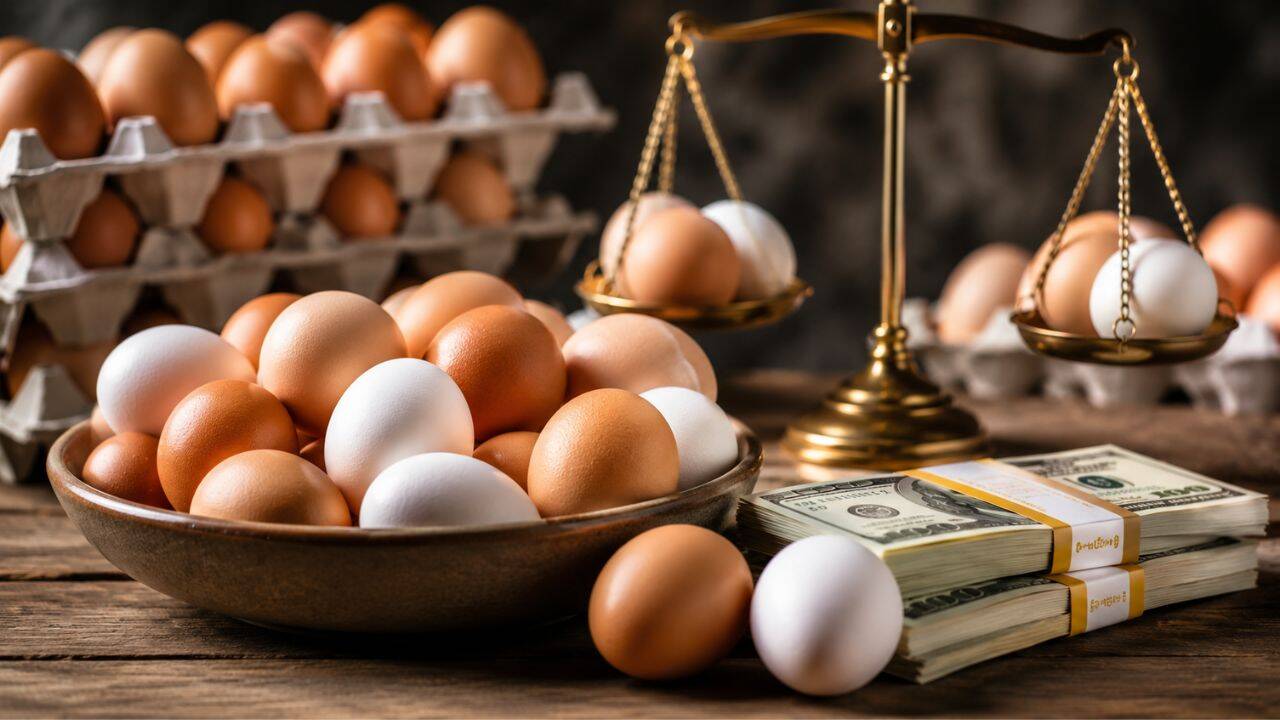
The public loves a good corporate villain, and the agricultural sector just handed them one on a silver platter. The headlines practically write themselves. Big Egg colludes to choke supply, drives prices past $6 a dozen, rakes in over a billion dollars in windfall profits, and finally gets dragged kicking and screaming to justice by the Department of Justice, forcing a massive 53 million egg donation to food banks.
It is a neat, comforting narrative of corporate greed punished. It is also completely wrong.
The lazy consensus across mainstream financial media assumes that the massive spike in egg prices was a simple byproduct of illegal price-fixing and corporate strong-arming. This perspective ignores the fundamental mechanics of commodities, supply shocks, and how corporate litigation actually functions. What the public sees as a triumph of justice is actually a textbook lesson in market dynamics wrapped in a masterclass of public relations damage control.
The Mirage of Price-Fixing in a Biological Crisis
To understand why the price-fixing narrative collapses under scrutiny, you have to look at the numbers the media ignored. In 2022 and 2023, the United States suffered the most devastating outbreak of Highly Pathogenic Avian Influenza (HPAI) in history. This was not a minor cold going through the chicken coops; it was a biological scorched-earth event.
Over 58 million birds were culled to contain the spread.
When you eliminate tens of millions of egg-laying hens from the supply chain overnight, price hikes are not an options; they are an economic certainty. Eggs are a highly inelastic commodity. Consumers do not immediately stop baking, cooking, or buying breakfast because the price goes up by a dollar. When supply drops sharply and demand remains flat, prices skyrocket exponentially.
Critics point to the record-breaking profits of major producers during this period as definitive proof of collusion. "How could they make $1.22 billion if they weren't cheating?" the argument goes.
I have spent decades analyzing supply chains and corporate financial structures, and this is where amateur commentators always trip up. In a commodity market hit by a localized supply shock, the producers whose flocks survive do not just make a normal profit—they make an absolute killing. If Producer A loses their entire flock to avian flu, their supply drops to zero. If Producer B manages to keep their facilities biosecure, they suddenly control a massive chunk of a severely depleted market. Producer B does not need to collude with anyone to charge $6 a dozen; the desperate market forces bid the price up for them.
Charging what the market will bear during a shortage is not a conspiracy. It is the basic law of supply and demand.
Demolishing the 53 Million Egg Settlement Illusion
Let us look at the supposed punishment: a settlement requiring the donation of 53 million eggs to food banks across the country. The media presents this as a profound act of corporate penance.
Let us run the actual math.
The United States consumes roughly 95 billion eggs per year. That breaks down to about 260 million eggs every single day. A settlement of 53 million eggs represents less than five hours of total U.S. egg consumption. For a multi-billion-dollar industry, donating five hours' worth of product is not a devastating financial blow. It is a rounding error in their quarterly logistics budget.
Furthermore, from a tax and operational standpoint, a product donation settlement is a brilliant corporate maneuver.
- Wholesale vs. Retail Value: The industry evaluates the cost of this donation based on production and wholesale costs, not the inflated $6 retail price consumers paid.
- Tax Write-offs: These donations frequently qualify for substantial corporate tax deductions, effectively allowing Uncle Sam to subsidize a portion of the penalty.
- Supply Stabilization: Dumping millions of eggs into non-commercial channels (like food banks) ensures that these eggs do not enter the retail market, preventing a sudden oversupply that would crash wholesale prices.
The Department of Justice gets a high-profile victory to show they are fighting for the working class. The egg producers get to clear a lingering legal headache without admitting fault, write off the expenses, and look like philanthropists in the evening news. The only entity that loses is the consumer, who still paid inflated prices at the grocery store and now gets to celebrate a meaningless symbolic gesture.
Why the Anti-Trust Playbook Fails in Modern Agriculture
The core flaw in the current legal approach to agriculture is the assumption that structural consolidation is identical to criminal collusion.
The modern agricultural landscape is undeniably consolidated. A handful of massive conglomerates control the vast majority of egg production, processing, and distribution. When a market is highly consolidated, companies do not need to sit in smoke-filled rooms to fix prices. They practice parallel pricing.
When input costs—like corn and soy feed, diesel fuel for transport, and packaging materials—skyrocket across the entire economy, every major producer reacts simultaneously. When one producer raises prices to cover rising logistics costs, the others follow suit because the market allows it. It looks like collusion to the untrained eye, but it is actually just rational actors responding to identical macroeconomic pressures.
If the government genuinely wanted to prevent these wild price swings, they would stop chasing the ghost of price-fixing agreements and address the structural vulnerability of the supply chain itself. Centralizing millions of hens in a few massive, hyper-efficient facilities makes eggs incredibly cheap during normal times. But it also means that a single biological outbreak can take out 10% of the national supply in a matter of weeks.
We have traded supply chain resilience for low everyday prices, and when the system breaks, we blame corporate greed instead of our own structural design.
The Brutal Reality for Consumers
If you want to protect your wallet from the next commodity spike, stop waiting for antitrust lawsuits to save you. They will not. The legal system is built to settle disputes between massive entities, not to micromanage supermarket shelves.
The next time a major commodity spikes—whether it is eggs, beef, or dairy—ignore the political grandstanding and the inevitable promises of investigations. Understand that a biological or geopolitical event has constricted the pipeline. The high price is the market's brutal, efficient way of rationing a scarce resource.
The only actionable response is to adapt your own consumption patterns. Switch to alternative proteins, adjust your shopping habits, and let the market correct itself as production capacity recovers. Relying on government intervention to lower the price of breakfast is a fool's errand.
The system worked exactly how it was designed to work. The producers survived a biological disaster, the market cleared the shortage through high prices, and the lawyers took their cut via a symbolic settlement that changes absolutely nothing about the underlying reality of corporate agriculture.
Stop buying into the theater. The house always wins, and the settlement was just the closing act.