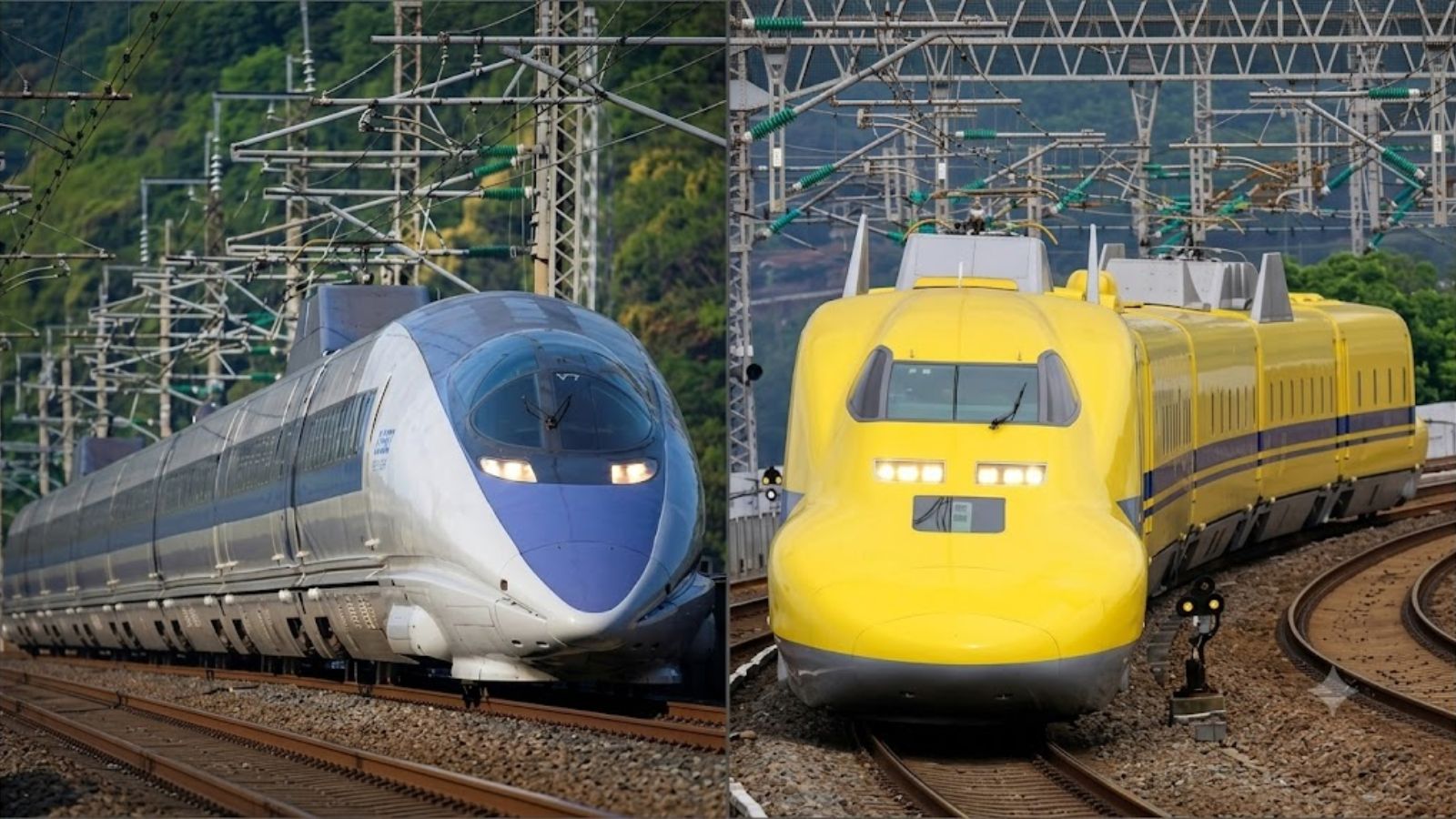
High-speed rail networks maximize profitability and operational resilience through strict standardization. The announcement by West Japan Railway Company (JR West) regarding the retirement of the 500 Series Shinkansen and the Class 923 "Doctor Yellow" inspection train by July 2027 marks the resolution of a multi-decade operational compromise. While both trainsets represent peak engineering achievements of the late twentieth and early twenty-first centuries, their continued operation introduces severe inefficiencies into contemporary rail logistics. The decision to phase out these models is driven by structural cost functions, infrastructure maintenance evolution, and passenger capacity optimization.
Understanding this fleet transition requires analyzing the underlying technical debt and economic variables that govern modern high-speed rail networks.
The Cost Function of Aerodynamic Extremes
The 500 Series Shinkansen entered commercial service in 1997, designed specifically to achieve a top speed of 300 km/h on the Sanyo Line while complying with strict environmental regulations regarding tunnel micro-pressure waves. To mitigate the sonic boom effect created when entering tunnels at high velocities, the lead cars feature a 15-meter pointed nose, and the entire train body utilizes a distinct circular cross-section.
While this geometry solved the immediate physics challenge of aerodynamic drag and noise pollution, it created severe operational constraints that degraded the long-term economic utility of the rolling stock:
- Volumetric Inefficiency: The circular cross-section reduces interior cabin volume, particularly in the upper corners of the passenger cabin. This design forced a reduction in luggage rack capacity and compressed the window-seat clearance, rendering the passenger experience inferior to contemporary flat-walled models.
- Atypical Door Configuration: The severe taper of the front cars eliminated space for passenger doors at the extreme ends of Cars 1 and 16. This created an asymmetrical door layout across the fleet. In a high-throughput rail system, non-uniform door placement breaks platform screen door alignment and lengthens passenger boarding and alighting cycles, known as dwell time.
- Component Obsolescence: Manufacturing unique components for a small fleet of specialized trains creates a sub-optimal supply chain. As the 500 Series aged, sourcing replacement parts for its bespoke propulsion and suspension systems increased maintenance costs per kilometer far beyond the baseline of standardized fleets.
High-speed rail profitability depends heavily on minimizing dwell time at major transport hubs. The asymmetric door layout of the 500 Series prevented it from operating seamlessly on the highly congested Tokaido line, leading to its reassignment to lower-tier Kodama services in 2010. By replacing the remaining 8-car 500 Series variants with shortened N700 series trainsets, JR West establishes absolute geometric uniformity across its fleet.
The Shift from Bespoke Inspection to Continuous Passenger-Fleet Monitoring
The retirement of the Class 923 Doctor Yellow T5 formation represents a fundamental paradigm shift in infrastructure asset management. Historically, specialized diagnostic trains were required to run intervals between scheduled commercial services to monitor overhead catenary wear, signaling alignment, and track geometry. Doctor Yellow performed these comprehensive diagnostics roughly once every ten days.
This diagnostic framework possesses two critical limitations:
- Temporal Sampling Gaps: A track defect that develops on day two of a ten-day cycle remains undetected by the dedicated diagnostic train for eight subsequent days, increasing the risk of structural degradation or unscheduled emergency speed restrictions.
- Capacity Cannibalization: Operating a non-revenue-generating trainset during daylight hours consumes a valuable path on a high-density line, directly reducing the maximum potential passenger revenue of the rail corridor.
To overcome these limitations, Central Japan Railway Company (JR Central) and JR West are decentralizing infrastructure diagnosis. Instead of relying on a singular dedicated train, specialized, compact sensor packages are integrated directly into standard commercial N700S trainsets.
$$\text{Diagnostic Frequency} = \frac{\text{Total Fleet Track Occupancy}}{\text{Dedicated Inspection Runs}}$$
By distributing monitoring hardware across multiple active passenger trains, the frequency of data collection increases from a bi-weekly snapshot to a continuous real-time data stream. Track geometry and catenary health are assessed multiple times per day during revenue-generating operations. This transition enables predictive maintenance schedules, where anomalies are flagged via edge-computing arrays and addressed during the standard nightly maintenance window before escalating into mechanical failures.
Fleet Interchangeability and Revenue Resilience
The primary economic driver for modern rail operators is the optimization of the seat-map matrix. The N700, N700A, and N700S series utilize an identical seating configuration across their 16-car variations, maintaining a total capacity of exactly 1,323 passengers. This absolute standardization creates a highly resilient system.
If a specific trainset experiences a mechanical fault before departure at Tokyo Station, air traffic control style dispatchers can substitute any available N700 variant without altering the passenger reservation architecture. Every ticket holder retains their exact seat assignment, preventing customer friction and boarding delays.
The 500 Series, with its unique seating capacity and interior layout, defied this interchangeability. A breakdown of a 500 Series train necessitated manual re-seating of passengers, causing systemic compounding delays across intersecting lines.
Furthermore, the replacement strategy relies on repurposing existing N700 series stock. By shortening surplus 16-car N700 sets into 8-car configurations for the Sanyo Line, JR West minimizes the capital expenditure required for new fleet acquisition while upgrading the baseline technology of local services.
Long-Term Capital Allocation in High-Speed Rail Infrastructure
The retirement of these iconic trainsets illustrates the maturity curve of high-speed rail systems. In the pioneering phases of high-speed transit, competitive advantage was derived from raw mechanical speed and highly specialized vehicle profiles. In a mature market, competitive advantage is dictated by asset utilization rates, energy conservation metrics, and automated data collection.
The financial trade-offs are explicit:
| Metric | Legacy Specialized Fleets (500 Series / Doctor Yellow) | Standardized Autonomous Platforms (N700S / Passenger Diagnostic Hybrid) |
|---|---|---|
| Diagnostic Real-Time Coverage | Low (Every 10 days) | High (Multiple times daily) |
| Fleet Substitution Friction | High (Bespoke seat configurations) | Zero (Identical seating architecture) |
| Supply Chain Efficiency | Low (Custom low-volume components) | High (Mass-produced standardized parts) |
| Track Path Utilization | Dedicated path consumption | Revenue-integrated |
By phasing out legacy platforms in 2027, JR West and JR Central align their operational infrastructure with modern industrial data models. The physical loss of distinct rolling stock is compensated by a substantial increase in network reliability, lower structural overhead, and a highly predictable capital reinvestment cycle. Fleet optimization requires removing sentimental exceptions in favor of mathematical and spatial uniformity.