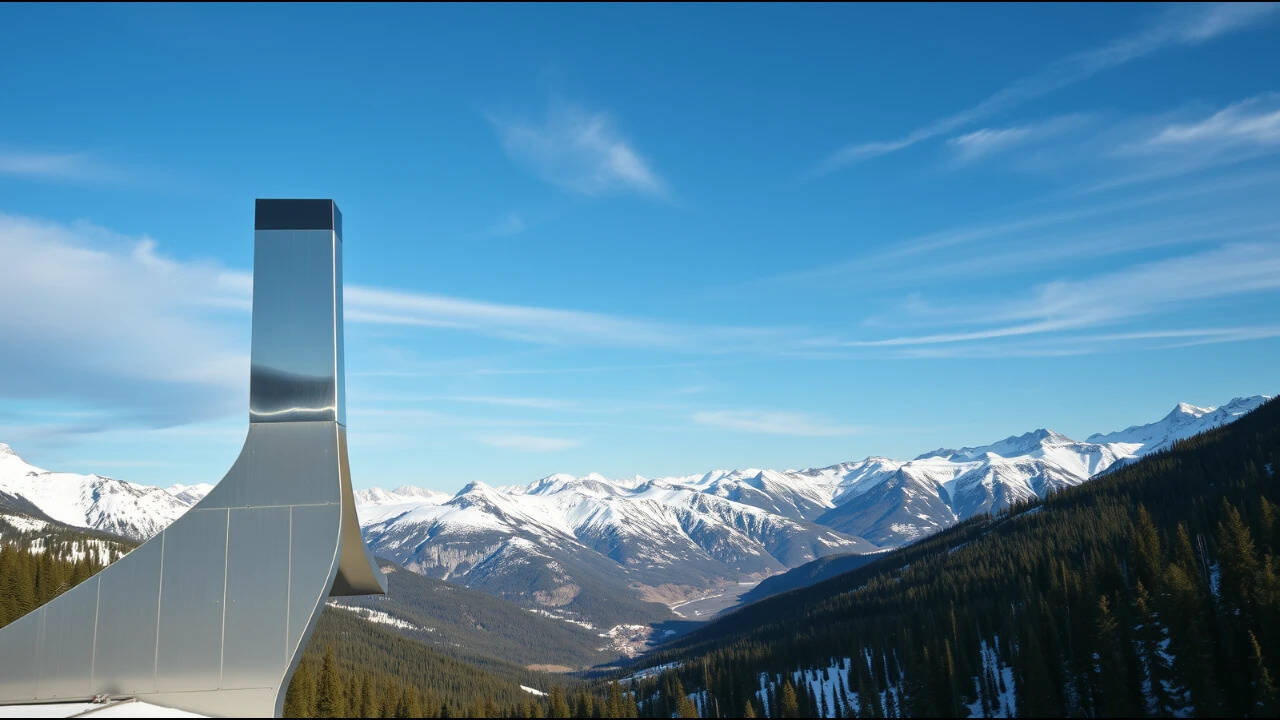
When the International Olympic Committee awarded the 1960 Winter Games to an undeveloped basin in California's Sierra Nevada, state planners confronted a classical economic bottleneck. Mega-projects require centralized spatial control, yet private property rights create decentralized veto points holdouts can leverage. The ensuing collision between state expansion and private land ownership at Squaw Valley offers a clear case study in valuation asymmetries, transaction costs, and strategic bargaining failures in public infrastructure development.
The structural tension centered on Wayne and Sandy Poulsen, landowners who held thousands of acres in the valley through the Squaw Valley Land and Livestock Company. State planners targeted a specific 150-acre meadow owned by the Poulsens to serve as core municipal infrastructure, specifically designating the parcel for event parking and an open sewage treatment plant.
This valuation clash emerged from fundamentally divergent pricing models between state acquisition agents and asset holders. According to the 1958 Congressional Record, the State of California valued the target acreage at one hundred three thousand dollars, relying on standard agricultural or undeveloped land appraisals. Conversely, the Poulsens demanded four hundred forty thousand dollars, pricing the asset based on its critical path utility to an international multi-million dollar sporting exhibition.
This pricing gap illustrates the holdout problem in property economics. When an individual parcel becomes uniquely essential to a larger network project, the owner's marginal value of the land diverges sharply from its baseline market value. Because relocating the parking matrix or sewage facility would impose catastrophic redesign costs on the state, the Poulsens held absolute leverage over the project's critical path.
Resolution of such deadlocks typically relies on two mechanisms: statutory expropriation or negotiated settlement. Rather than conceding to the four hundred forty thousand dollar valuation or engaging in protracted eminent domain litigation that could delay the fixed Olympic construction timeline, the planning apparatus altered its spatial layout. The state and Olympic organizers abandoned plans to pave the meadow for primary infrastructure, forcing engineering teams to decentralize parking and redesign wastewater management systems.
The Poulsen family deployed their personal capital to fund the legal defense of the meadow, absorbing significant financial friction to protect the landscape from permanent industrial alteration. While Alexander Cushing managed the corporate development of the resort through the Squaw Valley Development Corporation, the Poulsens retained control of the contested acreage, effectively capping the physical footprint of the Olympic expansion in that sector.
This episode highlights the limits of state coercive power when constrained by strict operational deadlines. When time-to-market is fixed by an unmovable global deadline like the Winter Olympics, the cost of delay through legal challenges outweighs the acquisition cost differential. Planners must calculate the elasticity of project scope against the elasticity of holdout demands. When a landowner's reservation price exceeds the marginal cost of redesigning the infrastructure network, the optimal strategy for the central planner shifts from acquisition to substitution.