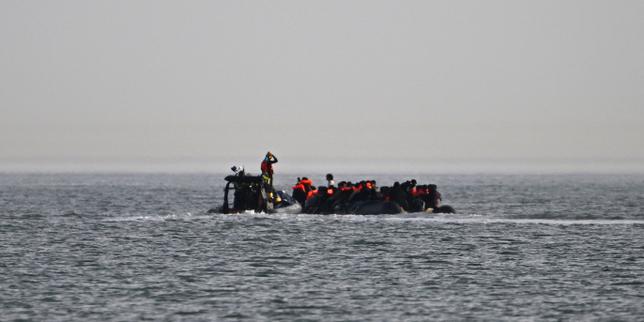
The British judicial system recently established a critical precedent by sentencing two individuals to minimum two-year prison terms for facilitating dangerous crossings in the English Channel. While traditional media frameworks treat these judicial outcomes as isolated punitive victories, an economic and operational analysis reveals that standard sentencing models fail to address the core supply-and-demand dynamics driving human smuggling networks. To disrupt these illicit supply chains permanently, enforcement strategies must shift from reactive prosecution to a systemic inflation of the operator's cost function.
The Channel crossing crisis is fundamentally a low-capex, high-margin logistics problem. Understanding the failure of current deterrence requires breaking down the operational mechanics, the legal bottlenecks, and the structural economic asymmetry that allows smuggling networks to absorb current judicial penalties as standard business overhead.
The Asymmetrical Risk-Reward Matrix of Small Boat Operations
The persistence of maritime smuggling across the Strait of Dover stems from an imbalance between capital expenditure (CapEx) and operational revenue. Smuggling syndicates operate on a decentralized, platform-as-a-service model. The physical assets utilized—primarily low-grade inflatable craft and low-horsepower outboard motors—are treated as disposable, single-use capital inputs.
The Revenue Model
A single crossing utilizing a ten-meter rigid-hulled inflatable boat (RHIB) can accommodate between 40 and 60 individuals. With per-seat pricing fluctuating between £2,000 and £5,000 depending on the perceived safety and speed of the transit, a single successful voyage generates gross revenues between £80,000 and £300,000.
The Cost Structure
The procurement cost of the vessel, fuel, and rudimentary life preservation equipment rarely exceeds £15,000. Because the syndicates do not risk their high-level coordinators on the water, they outsource the actual piloting of the vessel to low-level operatives or the migrants themselves, often in exchange for a waived transit fee.
[Gross Revenue: £80k - £300k]
       │
       ▼
[Minus CapEx/OpEx: ~£15k] ──► [Net Margin per Transit: 80% - 95%]
       │
       ▼
[Absorbed Risk: 2-Year Sentence for Low-Level Pilot] ──► Zero Impact on Syndicate Core Capital
The sentencing of two operators to two years in prison represents a negligible variable cost to the larger criminal enterprise. The individuals convicted are functionally line-level labor. Their removal from the supply chain does not degrade the syndicate's logistical infrastructure, procurement channels, or capital reserves. The network simply replaces the human asset, treating the judicial penalty as a minor friction coefficient rather than a systemic deterrent.
The Legal Bottleneck: Endangering vs. Facilitating
The prosecution of channel smugglers frequently stalls due to the friction between two distinct legal thresholds: the proof of financial gain (facilitation) and the proof of creating immediate physical peril (endangerment).
Legal Strategy A: Prove Financial Gain (Facilitation)
├── Requirement: Trace complex, cross-border hawala banking networks.
└── Result: High evidentiary threshold, prolonged investigation times, low conviction rates for on-the-water pilots.

Legal Strategy B: Prove Immediate Peril (Endangerment)
├── Requirement: Document vessel overcrowding, lack of navigation gear, and absence of safety equipment.
└── Result: Low evidentiary threshold, rapid deployment of maritime law enforcement data, swift conviction.
The recent convictions relied heavily on the endangerment framework. By focusing on the structural unseaworthiness of the vessels and the deliberate bypass of maritime safety protocols, prosecutors bypassed the complex requirement of tracing cross-border cash flows or proving a direct commercial tie to organized crime syndicates.
The strategic limitation of this approach is its inability to scale. Documenting endangerment requires real-time, high-fidelity surveillance during the launch or transit phase. It depends on maritime asset interception and the collection of forensic data at sea, which limits prosecutions to cases where law enforcement makes direct, physical contact with the vessel while operational.
Border Enforcement as a Market Stabilizer
An unintended consequence of standard state-level intervention is the stabilization of the smuggling market. When the UK and French governments increase naval patrols and search-and-rescue (SAR) deployments in the Channel, they inadvertently de-risk the most hazardous leg of the journey for the smuggling syndicates.
The operational reality is that smuggling networks do not design their vessels to successfully navigate the entire distance to the British coastline; they design them to reach international waters where they can trigger a mandatory SAR response under the International Convention for the Safety of Life at Sea (SOLAS). Once the vessel enters a state of distress, state assets are legally obligated to intervene and transport the occupants to land.
This dynamic alters the smuggler's cost function in two ways:
- Asset Optimization: Syndicates can use cheaper, less reliable vessels because the craft only needs to survive a fraction of the total journey before intervention occurs.
- Guaranteed Delivery: The state effectively completes the final mile of the logistics chain, ensuring the customer reaches the destination, which preserves the syndicate's reputation and future demand pool.
To counteract this market stabilization, the cost of deployment must be artificially inflated at the point of origin rather than mitigated in transit.
Framework for Systemic Supply Chain Disruption
To transition from symbolic judicial victories to a functional dismantling of the Channel crossing market, enforcement strategy must execute a multi-layered intervention that targets the structural vulnerabilities of the smuggling business model.
       [Supply Chain Interdiction: Raw Material Seizure]
                               │
                               ▼
        [Financial Decoupling: Hawala/Crypto Seizure]
                               │
                               ▼
[Judicial Escalation: Asymmetric Liability for Syndicate Executives]
1. Upstream Supply Chain Interdiction
The primary vulnerability of the small-boat model is its dependence on a continuous supply of specific, non-standard maritime equipment. Ten-meter inflatables and 40-horsepower outboard motors are not manufactured in mass quantities within refugee transit zones; they are imported via established European commercial transport routes.
Enforcement agencies must implement a strict regulatory and tracking regime on the sale, transit, and storage of large-scale inflatable hulls and marine propulsion systems across the Schengen zone. Treating these items as dual-use goods requires buyers to provide verified commercial credentials, effectively choking the syndicates' physical inventory before it reaches the French coastline.
2. Digital and Financial Asset Forfeiture
While prosecuting on-water pilots provides public accountability, it leaves the syndicate's capital reserves intact. Disruption efforts must focus on the digital infrastructure used to coordinate logistics and aggregate capital. This requires:
- The systematic infiltration and teardown of encrypted communication channels used to advertise departure windows.
- The coordination of cross-border financial intelligence units to seize assets held within informal value transfer systems (like hawala) and localized cryptocurrency nodes.
3. Asymmetric Judicial Liability
The current sentencing model treats small-boat organization as a standard immigration offense. It must be reclassified under a corporate liability framework, wherein any individual participating in the logistics chain—including component suppliers and local transport providers—shares joint and several liability for the systemic outcomes of the enterprise, including maritime fatalities. Elevating the legal risk for secondary and tertiary actors strips the primary syndicates of their local support networks, inflating their operational friction to unsustainable levels.
The strategic play cannot rely on the expectation that two-year sentences will deter an endless supply of low-level pilots. The state must instead aggressively weaponize the supply chain vulnerabilities of the trade, turning a highly profitable, de-risked logistics operation into an unstable, capital-intensive liability. Only when the capital expenditure required to execute a transit systematically exceeds the projected net revenue will the market collapse. Target the infrastructure, restrict the physical assets, and remove the state-funded safety net that guarantees the final mile delivery.