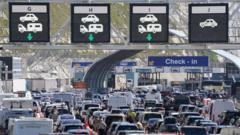
The Bank Holiday getaway was always going to be a headache. But nobody expected the French border police to throw in the towel before the weekend even peaked.
By Friday morning, the roads leading to the Port of Dover looked more like parking lots. Families heading off for the late May break found themselves staring at brake lights for over two hours just to reach the check-in booths. The culprit wasn't a sudden surge in traffic or a broken-down vessel. It was the messy, manual trial run of the European Union's upcoming Entry-Exit System (EES). In related news, read about: How the Nile River saved an ancient African city by moving its own path.
With the queue length threatening to spin out of control, the Port of Dover escalated the crisis to the Police Aux Frontières. The French authorities made a swift, pragmatic, and highly revealing decision. They suspended the extra EES border checks entirely to keep the traffic moving.
It's a temporary victory for holidaymakers this weekend, but it exposes a glaring reality. The technology meant to secure Europe’s borders can't handle real-world pressure. Condé Nast Traveler has also covered this fascinating issue in great detail.
The Reality of Dover's Manual Data Mess
The current breakdown comes down to a classic logistical bottleneck. The full EES framework requires non-EU passengers—including British citizens post-Brexit—to register biometric data like fingerprints and facial scans.
But there's a catch. The Port of Dover doesn't actually have the necessary French digital kiosks installed yet for car passengers. The port is still waiting for the delivery and setup of the physical French technology.
Because the hardware isn't ready, French border officials have been forced to create traveler records manually at the eastern docks. Instead of a quick passport swipe, officers are typing in data by hand. It's an agonizingly slow process. When you're trying to process 18,000 travelers over a single holiday weekend, adding just sixty seconds to each vehicle causes an immediate, compounding traffic backup.
Once the backlog reached critical mass, the French authorities realized that sticking to the new protocol would completely paralyze Kent's roads. They reverted to conventional border passport checks. The extra data collection is on pause, but the underlying issue hasn't gone away.
Why the Tech Is Flawed
Cross-Channel travel relies entirely on speed. The Port of Dover handles up to 8,000 travelers on its peak days, making it one of the most intensely used transit points in Europe. Unlike a spacious airport terminal where passengers can line up indoors for an hour without blocking a runway, Dover operates on juxtaposed controls. You clear French immigration on British soil before boarding the ferry.
If the border booths slow down, cars back up onto the A2 and A20. The moment a queue forms outside the port gates, it triggers a domino effect across the regional transport network.
Port officials previously estimated that car inspections could take up to six times longer once the biometric rules take full effect. What we saw this weekend wasn't even the full system—it was just the manual precursor. If manual record creation causes a two-hour delay on a standard sunny Friday, the prospect of forcing entire families to step out of their vehicles for facial scans and fingerprinting during peak summer looks disastrous.
What This Means for Your Travel Plans
If you're booked on a ferry over the next few days, you aren't completely in the clear. While the extra EES tracking is suspended for now, the volume of cars means regular holiday congestion is still high.
Ferry operators like P&O Ferries and DFDS are trying to manage the fallout. If you get caught in the approach queues and miss your scheduled departure, operators are currently moving passengers onto the next available sailing without charging an amendment fee.
Don't use that as an excuse to turn up late. The port is advising travelers to arrive exactly two hours before their scheduled departure. Arriving four or five hours early doesn't help—it actually worsens the gridlock by mixing up the departure lanes.
Pack the essentials in the main cabin of the car, not deep in the boot. Keep plenty of water, snacks, and any necessary medications within arm's reach. If you're traveling with kids or pets, assume you will spend some time idling on the tarmac. Ensure your passports are out of their protective jackets before you hit the front of the line to save those vital seconds at the window.
The suspension of the checks shows that authorities will prioritize traffic flow over rigid enforcement when push comes to shove. But until the permanent infrastructure is delivered, installed, and thoroughly stress-tested, crossing the Channel will remain a gamble.