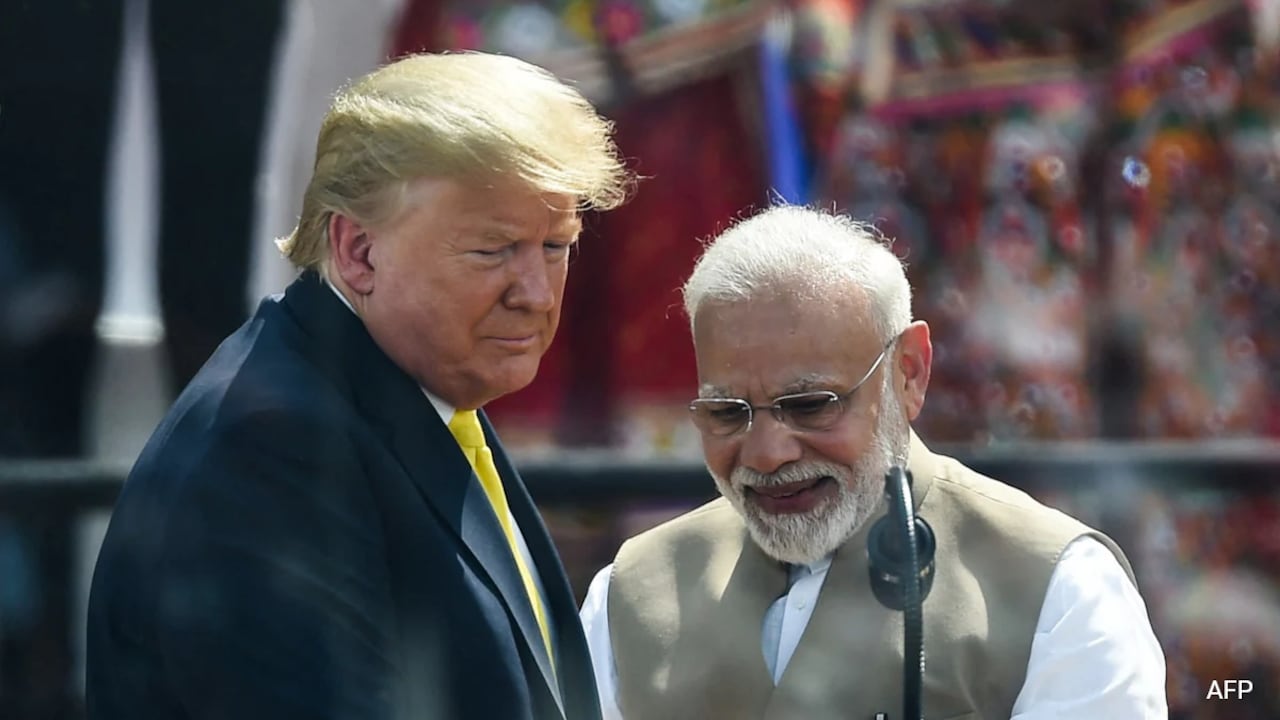
Diplomatic flattery rarely changes statutory paperwork in Washington. Donald Trump recently applauded Prime Minister Narendra Modi for cracking down on illicit opium production, yet the United States government continues to classify India as a major illicit drug-producing and drug-transit country. The contradiction looks glaring on paper. In reality, it reflects the rigid mechanics of federal narcotics law colliding with high-stakes geopolitical courtship between Washington and New Delhi.
To understand how a nation can receive public applause from the White House while simultaneously sitting on an official federal watchlist, you have to look past the podium remarks and examine the Foreign Relations Authorization Act. Every September, the US President is legally required to send Congress a list of nations deemed major hubs for drug cultivation or trafficking. Inclusion on this list—formally known as the Majors List—is not a subjective insult. It is an automatic trigger based on raw acreage, seizure volumes, and transit patterns.
The Mechanics of the US Drug Watchlist
Washington does not put countries on the Majors List purely out of spite, nor does it remove them as a reward for good behavior. Under US law, a country lands on the list if it cultivates a specific threshold of opium poppy, coca leaf, or cannabis, or if its geographic location makes it a significant transit corridor for narcotics bound for American streets.
India meets both criteria by sheer scale and geography.
On one hand, India is one of the few countries authorized by the United Nations to legally cultivate opium poppy for the global pharmaceutical market. Farmers in states like Madhya Pradesh, Rajasthan, and Uttar Pradesh grow vast fields of poppies under strict government licensing to supply morphine and codeine for legitimate medicine. Where there is massive legal cultivation, however, diversion becomes an inevitable headache. Even a tiny percentage of crop siphoned off into the black market amounts to tons of raw opium.
On the other hand, India sits directly between two of the world's most notorious narcotics factories. To its west lies the Golden Crescent—Afghanistan, Iran, and Pakistan. To its east sits the Golden Triangle—Myanmar, Laos, and Thailand. Syndicate networks routinely use Indian ports, porous land borders, and commercial shipping lanes to move heroin and synthetic precursors toward Europe and North America.
Because the statutory threshold relies on volume and transit reality rather than political intent, India remains locked onto the list year after year alongside nations like Afghanistan, Colombia, Mexico, and Myanmar.
What Trump Actually Praised and Why It Matters
When Trump singled out Modi's enforcement efforts, he was pointing to a genuine shift in how New Delhi polices its domestic narcotics trade and chemical manufacturing sector. Over the past several years, Indian federal agencies—most notably the Narcotics Control Bureau (NCB)—have ramped up satellite surveillance of illicit poppy fields in remote northeastern states like Manipur and Arunachal Pradesh, destroying thousands of acres of illegal crops.
More importantly for Washington, New Delhi has tightened oversight on precursor chemicals.
The American overdose crisis is no longer driven primarily by traditional plant-based heroin from Asian poppy fields. It is driven by synthetic opioids like fentanyl. While Mexican cartels press the pills and smuggle them across the southern border, the raw chemical building blocks frequently originate in chemical plants across Asia. As US pressure squeezed Chinese chemical suppliers, traffickers began looking toward India's massive, sophisticated pharmaceutical and chemical industries to source dual-use precursors.
Modi's government responded to American intelligence sharing with high-profile joint operations, indictments of Indian chemical executives, and stricter export controls on specific fentanyl precursors. For Trump, whose political brand leans heavily on aggressive border enforcement and punishing foreign suppliers of American street drugs, highlighting Modi's cooperation serves a clear strategic purpose. It rewards an essential Indo-Pacific partner while signaling to other nations—particularly China and Mexico—that bilateral cooperation yields public praise rather than tariff threats.
The Legal Trap of Certification and Waivers
The disconnect between presidential praise and the Majors List comes down to a two-step bureaucratic process that confuses most outside observers.
First comes designation. Putting India on the list simply acknowledges the physical reality that massive amounts of drugs and precursors pass through or originate within its borders.
Second comes certification. Once a country is on the list, the US President must determine whether that government has "failed demonstrably" to uphold international counter-narcotics agreements. If a country fails that test—a fate regularly reserved for nations like Venezuela or Bolivia—it faces severe US sanctions, including the cutoff of foreign assistance and American opposition to loans from international development banks.
India has never been decertified.
Washington consistently certifies that New Delhi is cooperating in good faith. In the language of American diplomacy, staying on the Majors List while retaining full certification is a recognition of effort amid overwhelming structural challenges. Removing India from the list entirely would require proving that illicit poppy cultivation and international trafficking through Indian ports have dropped below strict statutory minimums—a standard neither government can honestly claim has been met.
India's Domestic Opium Dilemma
To understand why New Delhi cannot simply eradicate its way off the US watchlist overnight, you have to look at the ground reality inside India's agricultural belt and its northeastern frontier.
In the central licensed growing regions, the government sets strict minimum qualifying yields for poppy farmers. If a farmer's harvest falls short due to bad weather or pests, they risk losing their lucrative license. Historically, this system created a perverse incentive: farmers would hold back surplus opium during bumper harvests to insure themselves against future bad years, creating a gray-market stockpile vulnerable to criminal syndicates. While the Indian government has modernized licensing and introduced concentrate of poppy straw (CPS) processing to reduce raw opium gum diversion, policing tens of thousands of small plots remains a monumental task.
Meanwhile, in the northeast, illicit poppy cultivation is tangled up in ethnic insurgency, poverty, and cross-border conflict. Following the military coup in Myanmar, instability along the Indo-Myanmar border surged. Armed groups on both sides of the frontier rely on illicit opium and methamphetamine trafficking to fund weapons purchases. When Indian security forces burn poppy fields in the hills of Manipur, they are not just fighting drug dealers; they are wading into volatile local conflicts where alternative livelihoods barely exist.
The Synthetic Shift Changing the Enforcement Game
Focusing exclusively on traditional opium misses the bigger threat keeping both Washington and New Delhi awake at night.
The global narcotics trade has undergone a structural transformation. Plant-based drugs require months of cultivation, favorable weather, vast acreage, and complex smuggling routes. Synthetic drugs require a warehouse, industrial glassware, and access to common industrial chemicals.
India is known globally as the "pharmacy of the developing world," producing roughly 20 percent of the world's generic drugs. That industrial capacity is an economic triumph, yet it presents a regulatory nightmare for counter-narcotics officials. Thousands of legitimate chemical brokers operate across Gujarat, Maharashtra, and Telangana. Distinguishing between a routine export order for a legitimate pharmaceutical manufacturer and a shell company ordering precursors for a cartel lab in Sinaloa requires forensic financial tracking, not crop eradication.
US agencies like the Drug Enforcement Administration (DEA) have expanded their footprint in New Delhi precisely because stopping a shipping container of precursor chemicals at the Port of Mundra saves far more American lives than burning an acre of poppies in the Himalayas.
Geopolitics Over Bureaucratic Labels
Indian officials have long bristled at seeing their country lumped onto the same annual list as narco-states and geopolitical adversaries. Behind closed doors, diplomats in New Delhi have repeatedly lobbied Washington to drop the designation, arguing that it tarnishes India's international standing and ignores its strict domestic anti-drug laws.
Washington's refusal to budge has nothing to do with hostility toward Modi and everything to do with institutional credibility. If the State Department and the White House begin scrubbing major transit hubs off the Majors List as a diplomatic favor, the entire statutory framework collapses. Congress would immediately accuse the administration of politicizing intelligence assessments, undermining the leverage Washington holds over genuinely uncooperative governments.
Instead, both sides have settled into a pragmatic arrangement. The US keeps India on the statutory watchlist to satisfy congressional oversight and maintain legal accuracy, while the President uses the bully pulpit to validate Modi's enforcement record and cement strategic ties.
Public praise costs nothing in Washington, whereas rewriting federal narcotics statutes requires an act of Congress—and until the cargo ships and chemical brokers stop moving illicit precursors through the Indian Ocean, that statutory label is not going anywhere.