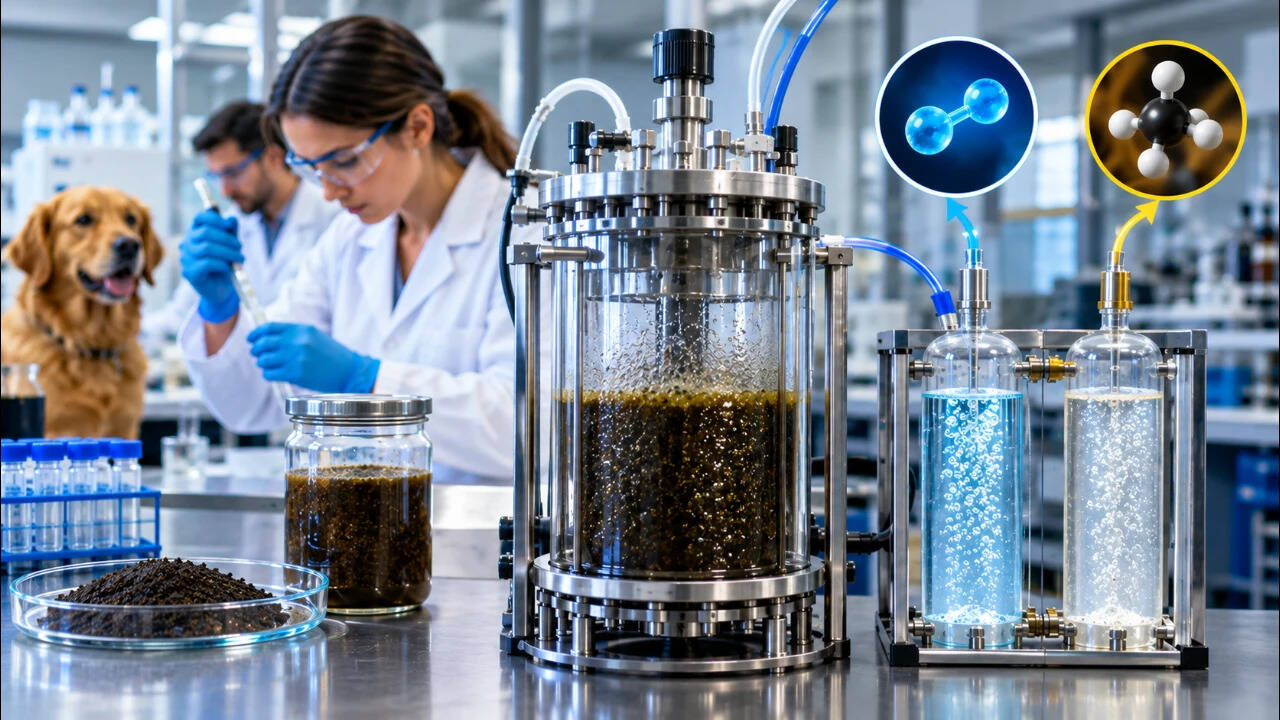
Every morning, millions of people walk their neighborhoods with plastic bags in hand. It is a quiet, universal ritual of modern pet ownership. We scoop, we tie, and we toss. We rarely think about where that little green sack goes next. It simply vanishes from our daily lives.
Multiply that small plastic bag by ninety million dogs in the United States alone. Add billions more worldwide. The math becomes staggering. We are generating millions of tons of biological waste every single year. For decades, urban planners and environmental scientists have stared at this mountain of refuse with a mixture of dread and fascination. It smells. It fills landfills. It leaks pathogens into our groundwater.
Yet, beneath our shoes lies an untapped power source.
For years, the conversation around biological waste and renewable energy fixated on hydrogen. Laboratories buzzed with excitement. Scientists dreamed of cracking water molecules and organic compounds to power the cars of tomorrow using the remnants of yesterday's walks. Hydrogen sounded clean. It sounded futuristic. It sounded like the kind of high-tech fix that modern society craves.
Reality, as it often does, had other plans.
Recent scientific studies have quietly turned that assumption on its head. When researchers look closely at what actually happens when dog waste breaks down, the grand hydrogen dream fades. In its place, a far more mundane, yet radically effective, winner emerges.
Methane.
Stop for a moment and consider what that means. Methane is the primary component of natural gas. It is the fuel that heats stoves and generates electricity across the globe. For years, we have treated methane as a villain. In the context of cow burps and melting permafrost, it is a potent greenhouse gas that accelerates climate change. But when captured systematically from controlled organic breakdown, it transforms from an atmospheric threat into a closed-loop energy asset.
(Note: This comparison relies on thermodynamic conversion efficiency models studied in recent waste-to-energy academic literature.)
The Chemistry of the Sidewalk
To understand why methane wins the race against hydrogen in this specific arena, we have to look past the shiny marketing of green technology and look at the actual muck.
Dog waste is a chaotic chemical soup. It contains proteins, fats, fibers, and a thriving microbiome of bacteria. When scientists try to extract clean hydrogen from this material, they run into a wall of thermodynamic inefficiencies. The energy required to strip hydrogen atoms away from complex organic molecules often outweighs the energy the hydrogen ultimately yields. It is an expensive, fragile process that requires pristine conditions.
Methane, however, wants to exist here.
Anaerobic bacteria do not need a pristine laboratory. They thrive in the dark, oxygen-free environments of sealed digesters. Given the right temperature and time, these microscopic workers feast on the organic matter found in pet waste. As they digest, they naturally exhale biogas, which is rich in methane.
Nature does the heavy lifting. We simply need to catch the breath.
Imagine a municipal facility on the outskirts of a dense city. Trucks arrive carrying tons of organic waste, including sorted pet refuse. Instead of sitting in a traditional landfill where gases escape freely into the atmosphere, the material enters massive, sealed steel tanks. Inside, the temperature stays warm. The bacteria multiply. Within weeks, the mixture begins to bubble.
The resulting biogas is captured, scrubbed of impurities, and funneled directly into local energy grids. It can heat homes. It can generate electricity. It turns a neighborhood nuisance into municipal power.
Why We Got It Backward
Human beings love a narrative of purity. Hydrogen feels pure because its combustion byproduct is water. It feels clean to imagine cars running on water vapor and the byproducts of our pets.
Methane carries baggage. We associate it with gas leaks, stove emissions, and ancient fossil fuels. Admitting that a pile of dog waste is best utilized by producing methane feels like a step backward into the dirty reality of the nineteenth century.
This psychological hurdle has slowed innovation. Local governments hesitate to build pet-waste-to-methane infrastructure because residents recoil at the word methane. They want hydrogen. They want lasers and futuristic fuel cells. They do not want to heat their morning coffee with processed dog poop gas.
Progress demands that we drop our romantic illusions.
Energy policy cannot run on aesthetics. It must run on efficiency. When researchers calculate the net energy balance—subtracting the energy spent processing the waste from the energy generated—methane generation blows hydrogen out of the water. The equipment is simpler. The biological pathways are robust. The infrastructure required to process methane already exists in the form of thousands of anaerobic digesters currently operating at wastewater treatment plants around the world.
The Invisible Infrastructure
We rarely see the machinery that keeps our civilizations running. Water treatment plants hum behind chain-link fences. Power substations hide behind concrete walls.
Integrating pet waste into this hidden grid requires a shift in how we think about waste sorting. Right now, most municipal composting facilities reject dog waste. The pathogens are too risky for garden compost, and standard aerobic composting does not reach high enough temperatures to kill parasites safely. Throwing it in the regular trash remains the default choice.
That is a missed opportunity on a grand scale.
If cities designated specific collection streams for pet waste, channeling it directly into anaerobic digesters alongside human wastewater sludge, the math changes instantly. The high temperatures and microbial competition inside a sealed digester neutralize pathogens effectively while maximizing gas yield.
Consider what happens next in a progressive municipality. Residents use biodegradable bags designed to break down rapidly in anaerobic conditions. They drop these bags into specialized neighborhood bins. Fleets of electric trucks transport the material not to distant landfills, but to regional energy centers.
The waste enters the tanks. The bacteria go to work. The gas rises.
A few blocks away, a public library stays warm through the dead of winter, fueled entirely by the morning walks of the neighborhood's golden retrievers and poodles.
The Weight of Our Choices
There is something deeply poetic about this cycle. For millennia, humanity lived in close proximity to its waste. We understood the circle of fertility and decay. We knew that what goes in must come out, and that ignoring the back end of the biological equation always leads to disaster.
Modern civilization allowed us to forget. We invented flush toilets and plastic bags, outsourcing our filth to invisible places out of sight and out of mind. We created a disconnect between our daily consumption and our environmental impact.
Confronting the reality of dog waste forces us to reconnect with that physical chain of cause and effect. Every choice we make leaves a residue. Every pet we love adds to the collective weight of our urban footprint.
The recent scientific consensus does not offer a magical escape from this reality. It does not promise a world where our waste disappears into a pristine, glowing vapor of pure hydrogen. Instead, it offers a pragmatic, grounded partnership with the oldest chemistry on Earth.
It tells us to stop chasing impossible purity and start harnessing the messy, organic power of the world as it actually is.
The next time you tie off that little green bag, pause for a second. Look down at the pavement. Feel the quiet weight of the choice in your hand. Underneath the ordinary inconvenience of the moment lies a choice about what kind of future we are building—one built on impossible fantasies, or one powered by the quiet, unglamorous truth of what we leave behind.