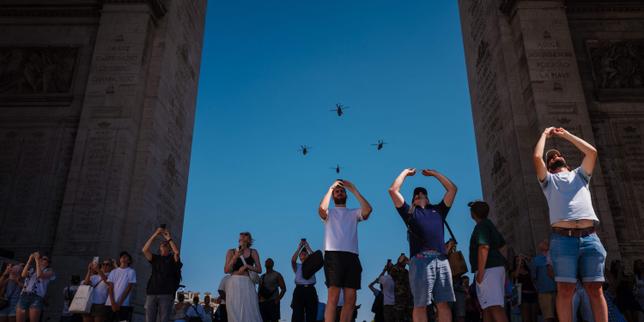
The cobblestones of the Champs-Élysées have held the weight of revolutions, liberation marches, and the thundering boots of military parades for generations. Every year on the Fourteenth of July, Bastille Day, this historic avenue transforms into the beating heart of France. It is a sensory overload. The smell of aviation fuel lingers in the crisp morning air as the Patrouille de France paints the sky in blue, white, and red smoke. The crowd stands shoulder-to-shoulder, a sea of families, tourists, and veterans waiting for the tanks to rumble past.
But traditional celebrations are meeting a modern reality. The open, spontaneous gathering that once defined this national holiday now requires something entirely un-traditional. For a different perspective, consider: this related article.
A pixelated square on a smartphone screen.
Consider a hypothetical spectator named Marc. For twenty years, Marc has caught the first metro from the Paris suburbs, securing a spot near the Arc de Triomphe by dawn. He knows exactly where the light hits the tanks first. This year, however, Marc cannot simply turn up with a flask of coffee and an optimistic spirit. He must stand before a security perimeter, hold aloft his phone, and wait for a laser to chirp against a QR code. Without it, the avenue is a fortress he cannot enter. Similar insight on the subject has been published by The New York Times.
This is no longer just a military parade. It is a massive digital logistics operation.
The Evolution of the Barrier
Security at major public events has always existed, but it used to be tangible. It looked like steel barricades, bag checks, and the watchful eyes of the Police Nationale. If you arrived early enough and stood in line long enough, you got in. The system was democratic in its grueling, exhausting way.
The introduction of mandatory QR codes changes the geometry of public space.
To secure a spot on the Champs-Élysées, attendees must register well in advance through a dedicated online platform. They must provide personal identification documents, full names, and dates of birth. The digital platform processes this information, cross-references it with security databases, and issues a unique digital pass.
On the morning of July 14, the traditional checkpoints are replaced by digital gates. Security personnel are armed with smartphones and scanners instead of just metal detectors. If the code flashes green, you walk through. If it flashes red, or if the network fails, or if your phone battery dies from the cold morning air, you are left on the outside looking in.
This shift is not merely a change in protocol. It is an entirely new philosophy of public safety. Security is no longer reactive; it is predictive and pre-screened. The crowd is vetted before a single footstep touches the avenue.
The Logistics of a Locked-Down Celebration
The mechanics behind this digital screening are immense. Scaling a registration platform to handle hundreds of thousands of requests simultaneously requires a robust infrastructure. The government must balance absolute security with the chaotic reality of a massive public holiday.
- Pre-registration Windows: The online portal opens weeks in advance. Spectators must select specific zones they wish to access, limiting crowd density in high-risk areas.
- Identity Verification: Uploaded identity cards or passports are verified to ensure the digital pass matches a real person.
- Zone Segmentation: The Champs-Élysées is carved into distinct sectors. A QR code for the lower avenue will not grant access to the upper sections near the Arc de Triomphe.
This division of space alters how the city feels. Paris on Bastille Day has historically been fluid. People drifted from the parade to the cafes, from the Tuileries to the banks of the Seine. Now, the city is compartmentalized. It is a network of secure bubbles, linked by digital permissions.
For the international traveler, this introduces a layer of anxiety. Imagine navigating a foreign registration system in a language you don't fully speak, wondering if your passport scan will pass an automated validation process before your flight even lands. The spontaneous joy of travel is replaced by administrative precision.
The Friction of Progress
Technology promises efficiency, but human life is inherently messy. The implementation of digital tracking at national celebrations exposes the deep friction between safety and freedom.
We accept these digital gates because the alternative—unchecked vulnerability in an unpredictable world—feels too dangerous. Yet, there is a quiet melancholy in the loss of the unplanned. The teenager who decides on a whim to catch the parade with friends is locked out. The elderly resident who does not own a smartphone or understand the complexities of an online portal is excluded.
The digital divide becomes a physical barrier on the streets of the capital.
The authorities argue that these measures are essential to manage flow, prevent overcrowding, and mitigate threats. They are undoubtedly correct. Managing a crowd of that scale without digital tools in the modern era is a logistical nightmare. The data gathered allows emergency services to know exactly how many people are in each sector, optimizing response times and preventing dangerous bottlenecks.
But as the scanners beep and the crowds filter through the gates in perfect, orderly lines, the atmosphere changes. The raw, unpredictable energy of a national celebration is tamed. It becomes a ticketed event, a managed experience.
Marc finally passes through the gate. His code flashed green. He walks onto the avenue, the historic stones beneath his feet exactly as they have always been. The sky overhead is clear. The jet engines begin to roar in the distance, a sound that shakes the windows of the grand buildings. The spectacle remains magnificent, but the journey to get here has fundamentally changed. The avenue is safe, orderly, and watched over by an invisible grid of data.