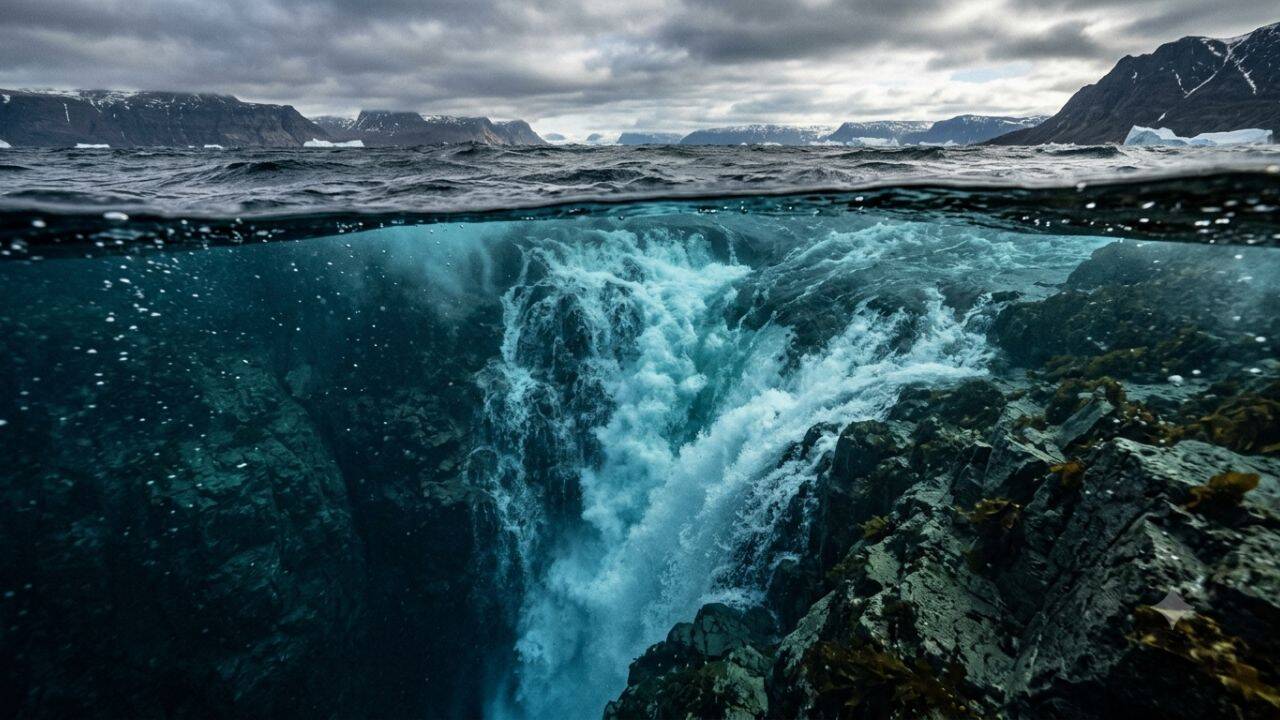
Pop-science clickbait loves a grand illusion. For years, digital publishers and lazy copywriters have recycled the same breathless headline: "The world's largest waterfall isn't on land—it's hidden beneath the ocean!" They point their fingers at the Denmark Strait, the stretch of ocean between Iceland and Greenland, claiming a colossal cataract plunges $3.5$ kilometers down the seafloor, moving billions of liters of water per second.
It is a beautiful, evocative image. It is also entirely wrong.
If you charter a boat to the Denmark Strait expecting to witness a majestic, roaring precipice subverted by the sea, you will be staring at flat, gray water while your pockets drain. I have spent years tracking oceanographic data and pulling apart the sensationalized framing of marine geography, and it is time to dismantle the lazy consensus. The Denmark Strait cataract is not a waterfall. Calling it one misrepresents basic fluid dynamics, fundamentally misunderstands how the ocean moves, and robs the planet of its actual, far more fascinating reality.
The Physics of a Lie
The mainstream narrative treats the Denmark Strait as a subterranean Niagara. The visual they sell you is a distinct, clean stream of water breaking over a cliff, falling through empty space—or at least through a different medium—to crash violently into the abyss below.
That is not what happens.
What is actually occurring is an overflow, driven by simple baroclinic instability and density differentials. To understand why the "waterfall" label is a farce, look at the mechanics:
- The Density Matrix: The Nordic Seas to the north are frigid and salty. The Irminger Sea to the south is warmer and lighter. When that dense, northern water reaches the submarine ridge known as the Greenland-Iceland Rise, it does not "fall." It sinks.
- The Horizontal Crawl: A real waterfall features a vertical or near-vertical drop where gravity overpowers lateral momentum. In the Denmark Strait, the fluid does not drop off a cliff; it hugs the seabed. It slides down a gradual, sloping continental incline.
- The Glacial Pace: If you stood on the ocean floor at the strait, you would not be swept away by a roaring torrent. Because the flow spreads across a massive width of roughly 160 kilometers, the actual velocity of the descending water is roughly 50 centimeters per second. That is just over one mile per hour. You are not looking at a cataclysmic plunge; you are looking at water moving at the speed of a walking toddler.
To call a slow, bottom-hugging, one-mile-per-hour crawl a "waterfall" is like calling a marble rolling down a wheelchair ramp a "high-speed collision." It is a linguistic trick designed to generate clicks from people who prefer fantasy over fluid mechanics.
Dismantling the Volume Deception
"But the volume!" the consensus defenders cry. They love to quote the figure: 3.5 million cubic meters per second, or 3.5 Sverdrups. They tell you it dwarfs the Amazon River by a factor of twenty.
This comparison is deliberately misleading.
A river emptying into the sea represents a net addition of fresh water to a basin. The Denmark Strait overflow is not an external body of water entering the ocean; it is the ocean moving within itself. It is a continuous, closed-loop circulation system.
Furthermore, the water does not remain pure as it descends. Through a process oceanographers call entrainment, the descending cold plume experiences immense friction with the seabed and violently drags the surrounding, warmer Atlantic water into its mass. By the time the current reaches the bottom of the Irminger Basin, its temperature has climbed, its density has dropped, and its volume has altered. It is a massive, chaotic mixing zone, not an isolated column of water hitting a pool.
The Real Mechanism: The Global Conveyor Belt
When we reduce this phenomenon to a trivia fact about "big waterfalls," we miss the actual, systemic genius of the planet. The Denmark Strait overflow is the heavy engine room of the Atlantic Meridional Overturning Circulation (AMOC).
Imagine a massive, global thermodynamic pump. When the cold, dense water pushes over the ridge and slowly slides down the Greenland slope, it acts as the primary downward limb of the ocean's conveyor belt. By sinking and pushing south along the deep ocean floor, it creates a pressure deficit behind it. This deficit is what pulls the warm, shallow waters of the Gulf Stream northward.
Without this density-driven slide, the climate of Western Europe collapses into an ice box. The overflow isn't a spectacle; it's a thermodynamic regulator.
The downside to viewing the ocean through this hyper-realistic lens, of course, is that it strips away the easy romance. You cannot take a selfie with a density gradient. You cannot paint a picture of a baroclinic flow. But clinging to the "waterfall" myth keeps us scientifically illiterate, expecting localized, dramatic spectacles from an ecosystem that operates on vast, invisible scales.
Stop looking for a hidden waterfall in the North Atlantic. It does not exist. Instead, look at a planet that uses subtle shifts in temperature and salt to move entire oceans across hemispheres, quietly keeping the world habitable while we scan the horizon for a splash that will never come.