The marble corridors of the federal courthouse in Lower Manhattan have a specific smell. It is a mix of industrial floor wax, damp wool from rain-soaked overcoats, and the invisible, crushing weight of human anxiety. If you sit on the wooden benches outside the courtrooms long enough, you watch a repeating play. High-stakes white-collar defendants walk in with their heads held high, flanked by lawyers costing a thousand dollars an hour. They usually walk out looking decades older, stripped of their armor by the slow, indifferent gears of the Department of Justice.
For months, Todd Blanche lived in those corridors.
He was not there as a prosecutor, though he used to be one. He was there as the shield. As the lead defense attorney for Donald Trump during the grueling New York hush-money trial, Blanche’s daily existence was a masterclass in high-pressure navigation. He sat at the defense table, whispering into the ear of a former president, enduring scathing cross-examinations, and watching the jury’s faces for any sign of a crack in the prosecution's armor. He lost that case. The jury returned thirty-four guilty verdicts. In the traditional narrative of legal careers, such a defeat is a devastating blow.
But Washington is no longer operating under the traditional narrative.
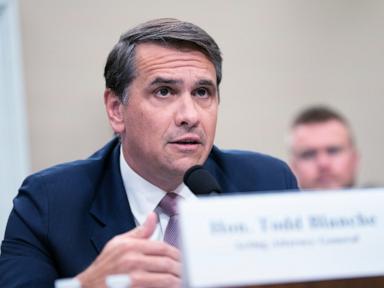
In a move that shattered the expectations of the capital's legal establishment, Trump announced his intention to nominate Blanche as the next Attorney General of the United States. The man who just months ago was fighting the federal government from the defense table is now poised to run the entire apparatus. It is a cinematic twist that feels less like standard political maneuvering and more like a profound realignment of American power.
To understand what this means, we have to look past the cable news chyrons and look at the sheer friction of the human trajectory involved.
From the Line to the Shield
The Department of Justice is an institution built on a secular religion of precedent and hierarchy. For decades, the path to the top spot followed a predictable script. You were a federal judge, a senator, a long-serving Washington insider, or a career prosecutor who climbed the institutional ladder rung by painful rung. You independent-minded institutionalists believed the building itself held a sacred neutrality.
Blanche knows that building intimately, but from a perspective that complicates the narrative.
Long before he represented the most polarizing political figure of the century, Blanche was an insider. He spent years as an Assistant U.S. Attorney in the Southern District of New York—the legendary "Sovereign District" known for its fierce independence and aggressive prosecution of Wall Street executives, mob bosses, and corrupt politicians. He knew how the machine worked because he helped turn the cranks. He understood the quiet thrill of standing up in a courtroom, looking at a jury, and saying, "The United States represents..."
Then, he chose to step outside.
He left the government, eventually founding his own defense firm. When Trump came looking for a fighter who understood the specific, sharp-elbowed culture of New York prosecution, Blanche stepped up. He didn't just take a case; he altered his entire orbit. He walked away from a lucrative partnership at an elite white-collar law firm because he recognized that history was shifting, and the real action was at the epicenter of the storm.
Consider the psychological whiplash of this journey. A man spends his youth learning how to build cages for the state. He spends his middle years learning how to pick the locks. Now, he is being handed the keys to the entire prison system.
The View from the Defense Table
There is a fundamental difference in worldview between those who prosecute and those who defend. A prosecutor looks at the law as a sword to carve out order from chaos. A defense attorney looks at the law as a shield to protect an individual from the terrifying, limitless resources of the state.
When you sit at the defense table next to a target of a federal investigation, the world shrinks. You realize that the Department of Justice possesses an almost infinite capacity to dig into a human life. They can access your emails, track your finances, interview your childhood friends, and squeeze your associates until they sing whatever tune the government wants to hear. It is an asymmetric warfare that favors the house.
Blanche spent the last few years looking at the Department of Justice through that specific, adversarial lens. He watched his client face multiple federal indictments, state charges, and relentless public scrutiny. He argued that the system was being weaponized, that the norms were being twisted for political ends, and that the line between prosecution and persecution had been erased.
Whether you agree with that assessment or find it deeply cynical, the crucial point is that Blanche believes it. Or, at the very least, he has lived the reality of fighting it.
When a person with that lived experience is suddenly placed at the helm of the Main Justice building on Pennsylvania Avenue, the institutional culture faces an existential shock. The career attorneys inside the building—the thousands of line prosecutors who view themselves as the guardians of the rule of law—are suddenly looking at a boss who spent the recent past calling their work corrupt.
The tension is not just political. It is visceral.
The Machinery of Realignment
What happens when the shield becomes the sword?
The Attorney General possesses immense, almost unchecked discretion. They decide which cases to pursue, which investigations to drop, and which legal theories to advance. They set the tone for every federal prosecutor from Seattle to Miami.
If confirmed, Blanche will inherit a Department of Justice that his benefactor has promised to fundamentally reform. The mandate is clear: dismantle what the incoming administration views as a politicized "deep state" bureaucracy and redirect the power of the federal government toward new priorities.
But executing that mandate is not as simple as signing an executive order. The Department of Justice is a massive, slow-moving supertanker. It is staffed by career civil servants who possess a deep institutional memory and a sophisticated ability to engage in passive resistance. They know how to drag their feet, how to leak to the press, and how to use the bureaucracy itself to slow down directives they believe are unlawful or unethical.
Blanche’s unique qualification, in the eyes of the Trump team, is that he knows exactly where the bureaucratic tripwires are buried. Because he was an insider, he knows how the office politics work. Because he was an outsider, he has no loyalty to the old guard.
He is an insider-outsider. A hybrid creature born from the unique chaos of this political era.
The Invisible Stakes
We often talk about the rule of law as if it is a physical structure, like the Supreme Court building or the Washington Monument. It isn't. It is a fragile, collective hallucination. It only exists because we all agree to believe in it. We agree that the law applies equally to the powerful and the powerless, and that the people enforcing the law are doing so without malice or favor.
When that belief crumbles, the system collapses into raw power.
The nomination of Todd Blanche is a direct challenge to the old consensus. To his supporters, it is a necessary correction—a way to bring accountability to a department that has run wild. To his critics, it is the ultimate fox-in-the-henhouse scenario, a reward for personal loyalty that threatens to turn the justice system into a tool for personal grievance.
The true stakes, however, lie in the quiet corners of the country where regular people interact with federal law. It is the civil rights divisions investigating police departments. It is the antitrust lawyers looking at corporate monopolies. It is the environmental prosecutors tracking corporate polluters. What happens to those efforts when the leadership is entirely focused on a top-down ideological overhaul?
Blanche will have to decide whether he is the Attorney General for Donald Trump or the Attorney General for the United States. It is a distinction that sounds simple in a civics textbook but becomes agonizingly complex when your office phone rings and the President is on the other end of the line.
The Weight of the Great Hall
Imagine walking into the Attorney General’s office on your first day. The walls are lined with portraits of the giants who came before. Robert F. Kennedy. Edward Levi. Men who faced profound national crises and had to decide where their ultimate loyalty lay—to the constitution, to the president who appointed them, or to their own conscience.
Blanche will sit at that desk knowing that his every move will be scrutinized with unprecedented intensity. Every dropped case will be viewed as a favor; every new investigation will be viewed as a vendetta. The nuance that he practiced as a defense attorney—the ability to find the grey areas in the law—will be swallowed whole by the black-and-white lens of modern politics.
He is no longer just defending a man in a courtroom. He is defending the legitimacy of the American legal system itself.
The courtroom drama is over. The trial of the institution has begun.