Thirty-sept people are dead because a drone smashed into a warehouse tucked right against civilian neighborhoods. This wasn't just another tragic entry in a long war chronicle. It forced a brutal reckoning across Ukraine about why military and logistics hubs are still operating dangerously close to homes, schools, and crowded streets.
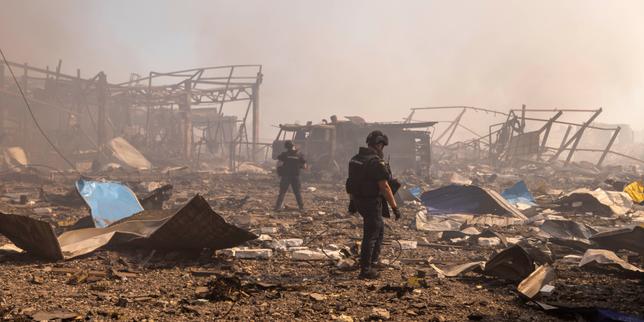
When a Russian drone slammed into the facility in Myla, near Kyiv, the resulting explosions tore through nearby residential buildings. The blast didn't just destroy a logistics point; it shattered lives and instantly reignited a bitter political fight over urban safety. Among the dead was Taras Didych, the mayor of the local village of Dmitrivka. When local leaders and mayors become casualties of rear-guard logistical failures, the crisis hits a completely different threshold.
Government officials are pointing fingers. Prime Minister denounces what he calls criminal negligence, demanding to know why sensitive inventory was stored within reach of civilian populations four years into a full-scale invasion. Citizens are asking the same thing with growing fury.
The Cost of Urban Proximity
Stashing munitions, heavy supply depots, or equipment hubs inside or immediately adjacent to towns makes administrative sense on paper. Transport networks are there, roads are paved, and workforce access is simple. But during an active aerial campaign where drone swarms and missiles track coordinates daily, proximity to civilians turns a storage site into an active hazard zone.
When the depot in Myla detonated, the secondary blasts proved far more destructive than the initial drone impact. Homes collapsed. Windows shattered for blocks. People who thought they were far enough from the frontline found themselves in the epicenter of an ammunition detonation.
- Warehouses housing tactical or military-adjacent supplies sit near municipal boundaries across several oblasts.
- Local zoning laws written decades ago never accounted for modern, long-range loitering munitions.
- Decentralization efforts moved slowly, bogged down by bureaucratic inertia and the massive cost of relocating heavy infrastructure.
Accountability and the Political Fallout
President Volodymyr Zelenskyy ordered an immediate investigation into professional negligence. Heads are going to roll, but firings won't bring back the thirty-sept victims. The investigation forces a hard look at military logistics management and civilian protection protocols.
Commanders argue that supply lines must stay close to distribution nodes to feed the front efficiently. Logistics officers face an impossible choice: spread assets out into empty fields where they lack infrastructure and face mud, or keep them near urban networks where transport is fast.
Yet, public tolerance for administrative shortcuts is entirely gone. You can't ask civilians to shelter in basements while storing high-risk inventory down the street from an apartment complex.
What Needs to Change Right Now
Fixing this vulnerability requires an aggressive, immediate overhaul of internal security zones. Ukraine cannot afford to treat rear-area logistics as business as usual.
First, military and civilian administrations need to map every single sensitive storage site relative to population density within 48 hours. Second, high-risk depots must face forced decentralization or deep subterranean fortification, regardless of the logistical friction it causes. Third, local municipal leaders must be given real authority to veto military storage placements within city limits.
The strike near Kyiv serves as a horrific wake-up call. Protecting the home front means keeping the war's most volatile targets as far away from everyday citizens as humanly possible.