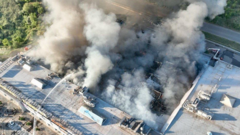
When a shopping mall in Kryvyi Rih took a direct hit from a Russian drone, the horror didn't stop with the initial explosion. Half an hour later, while firefighters and paramedics scrambled through the wreckage to pull survivors from the rubble, a second drone slammed into the exact same location. This tactic—known as a double-tap strike—is designed for one explicit purpose: maximizing casualties by targeting the first responders who rush to save lives.
At least 15 people lost their lives in this brutal daytime assault on the central Ukrainian city, which happens to be President Volodymyr Zelenskyy's hometown. More than 130 others sustained injuries, with hospitals reporting dozens in critical condition, including multiple children. The psychological and physical toll of these calculated follow-up strikes exposes a grim evolution in how aerial campaigns are conducted, stripping away any remaining safety margins for emergency services.
The Mechanics of a Calculated Secondary Hit
Double-tap tactics are hardly new in global conflicts, but their integration into mass-scale drone warfare represents a terrifying escalation. Instead of a single coordinated barrage, operators space out projectiles or send sequential waves specifically timed to coincide with rescue operations.
When the first explosion tore through the shopping center, it ignited raging fires and threw thick black smoke into the afternoon sky. Standard emergency protocol dictates an immediate rush toward the scene to suppress flames and triage the wounded. By weaponizing that exact humanitarian reflex, the secondary strike turned medical personnel, firefighters, and bystanders into direct targets.
Regional governor Oleksandr Hanzha confirmed that the wounded toll rapidly climbed past 130, including over 20 children, highlighting the indiscriminate nature of urban aerial warfare. Emergency crews now face an impossible dilemma: delay entering a burning building to wait out potential secondary threats, or rush in immediately and risk becoming the next casualty.
A Relentless Summer Campaign Across Ukraine
This tragedy in Kryvyi Rih didn't happen in a vacuum. It arrived amid a punishing surge in Russian aerial bombardments as the war grinds past its four-and-a-half-year mark. Just a day prior, a massive wave of ballistic missiles and drones pounded the capital city of Kyiv, leaving 17 dead. Separate strikes in the Mykolaiv region claimed additional lives, including three children.
Air defense systems across Ukraine are stretched to their absolute breaking point. While the Ukrainian air force successfully intercepted or suppressed over a hundred incoming drones in a single 24-hour window, the sheer volume of projectiles ensures that devastating breakthroughs still occur.
The Broader Strategic Stalemate
On the ground, front lines stretching over a thousand kilometers remain largely deadlocked. Heavy concentrations of infantry-hunting drones and automated ground systems make conventional troop maneuvers nearly impossible. Because neither military can achieve a decisive breakthrough on the physical battlefield, the conflict has increasingly shifted into the skies and industrial centers.
Ukraine has answered this air campaign by scaling up its own long-range drone strikes, targeting oil refineries and logistics nodes deep inside Russian territory. Kyiv's strategy aims to bring the economic reality of the war home to the Russian public. Yet, for civilians living in cities like Kryvyi Rih, Kyiv, and Mykolaiv, the immediate danger remains the relentless rain of high-explosive ordnance.
As international leaders debate further sanctions and air defense packages, the reality on the ground remains brutally simple. Every civic space, every market, and every rescue operation now operates under the constant, looming threat of a second wave.