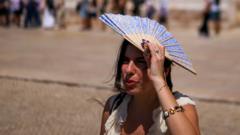
The air in Évora does not move. It presses.
By three o'clock in the afternoon, the cobblestones of the old Alentejo capital cease to be mere infrastructure; they become a vast, horizontal radiator, pumping trapped solar energy back up through the soles of your shoes. This is a dry, ancient heat, the kind that smells of baked clay, parched eucalyptus, and the faint, sweet panic of wilting wild geraniums. On a normal May afternoon, the locals would be drifting toward the shade of the arcades, moving with a deliberate, slow-motion grace honed over generations of brutal summers.
But this is not a normal May. This is a rupture.
When the mercury in Portugal surged past previous records to hit a staggering 40°C—over 104°F—in the shade, it wasn't just a data point on a meteorologist’s computer screen in Lisbon. It was a physical blow. For context, May in Portugal usually hovers around a comfortable, breezy 22°C. A jump of this magnitude so early in the year is not a seasonal variation. It is an uninvited guest breaking down the front door while everyone is still asleep.
Across Western Europe, a massive high-pressure system, acting like a giant atmospheric magnifying glass, has pinned a mass of blistering air from the Sahara directly over the Iberian Peninsula. The continent is sweltering in a heatwave that should not exist for another two months. And inside this invisible oven, the fabric of daily life is beginning to warp.
The Invisible Stakes at the Café Counter
Consider Senhor João. He is seventy-two, with hands like knotted olive wood and a permanent squint from a lifetime of working the cork oak forests outside Beja. Every afternoon for thirty years, João has walked to his local pastelaria for a single espresso and a chat about football.
Today, he stays inside. His blinds are drawn tight against the white glare of the street.
To understand the true weight of a record-breaking heatwave, you have to look past the statistics and look at João's thermometer. In many Portuguese homes, especially the older, thick-walled stone houses or the poorly insulated post-war apartment blocks, there is no air conditioning. AC is a luxury, a line item on an energy bill that many on fixed pensions simply cannot afford. Instead, survival is a game of strategy: shutter the windows at dawn, trap the cool night air inside, and pray the brickwork doesn't heat up before sundown.
But when the nighttime temperature refuses to drop below 25°C, the strategy fails. The heat accumulates. The walls begin to radiate inward.
For the elderly, the vulnerable, and the isolated, an early heatwave like this is not an inconvenience; it is a cardiovascular marathon. The heart must pump faster, dilating blood vessels to push heat to the skin’s surface to cool the body. When that cooling mechanism fails because the ambient air is as hot as a furnace, the body’s internal thermostat begins to shatter.
The emergency rooms in Lisbon and Porto know this rhythm all too well. They aren't just seeing cases of heatstroke. They are seeing the quiet failures of kidneys, the sudden strokes, the respiratory collapses aggravated by the stagnant, dust-laden air blowing in from the North African desert.
When the Soil Turns to Powder
The true danger of a record-breaking May lies in what it steals from the future.
Step away from the tourist-filled plazas of the Algarve and into the agricultural heartland. Late spring is supposed to be a time of lingering moisture. It is the crucial window when winter rains have soaked deep into the earth, giving olives, vines, and wheat the foundational strength to survive the inevitable July drought.
Now, look at the soil. It doesn't look like earth anymore; it looks like ash.
When a heatwave hits in May, it triggers an accelerated evaporation cycle. The moisture in the topsoil is yanked into the atmosphere at double the normal rate. The young crops, their root systems not yet deep enough to chase the receding water table, begin to experience early stress.
- The Grapevines: In the Douro Valley, the delicate flowers of the vines—the precursors to the autumn harvest—can burn under a 40°C sun, drastically reducing the potential yield before the grapes have even formed.
- The Water Reserves: Reservoirs that should be at peak capacity heading into the dry season are already showing ringed scars of dry earth around their perimeters.
- The Fire Risk: The undergrowth, lush from spring rains, dries out in a matter of days, transforming into millions of acres of volatile kindling.
The memory of the 2017 wildfires in Pedrógão Grande still haunts the Portuguese psyche like an open wound. That disaster, which claimed over sixty lives, was fueled by a similar cocktail of extreme heat, low humidity, and tinder-dry vegetation. Seeing these exact conditions manifest in May, rather than August, sends a chill through rural communities that no ambient temperature can warm.
The Illusion of the Endless Summer
Along the coast, the perspective shifts dramatically, revealing a strange, modern paradox.
In Cascais and Lagos, the beaches are packed. Tourists from northern Europe, chasing the promise of early sunshine, splash in the Atlantic shallows, celebrating what looks like an absolute jackpot of a holiday. The outdoor seafood restaurants are bustling. The crisp vinho verde flows freely.
This is the seductive trap of the changing climate. It wears the mask of a perpetual vacation.
But talk to the lifeguards, the local fishermen, or the municipal workers who have to maintain the infrastructure under this sudden strain. The infrastructure of a city—much like the human body—is designed around predictable thresholds. When those thresholds are shattered unexpectedly, things break.
Power grids groan under the sudden, massive demand from commercial cooling systems. Water pressure drops as consumption spikes. Tourists, unaccustomed to the ferocity of the Iberian sun, overwhelm local clinics with severe dehydration and sun poisoning.
There is a palpable cognitive dissonance walking through a coastal town during an anomalous heatwave. On one side of the street, there is festive music and sunscreen; on the other, an anxious glance at a smartphone weather app showing a red alert warning from the national meteorological institute. It feels like dancing on the deck of a ship that has just brushed against an iceberg, convinced that the ice is just a refreshing addition to the cocktail glass.
The Physics of a New Normal
It is easy to get lost in the vocabulary of climate science. We hear terms like "blocking highs," "jet stream fragmentation," and "thermal anomalies." But the physics can be understood through a much simpler analogy.
Imagine a bathtub filled to the absolute brim with water. If you gently rock back and forth, the water sloshes predictably. But if you violently agitate the water, the waves become erratic, splashing over the sides in places you didn't expect, at times you couldn't predict.
By pumping greenhouse gases into the global atmosphere, we have agitated the tub.
The baseline temperature of the planet has risen. Therefore, when a completely natural high-pressure system moves over Europe, it is no longer working with a cool, stable atmospheric foundation. It is building upon an already warmed base. The peaks of the heatwaves become higher, sharper, and much more frequent. What would have been a warm, lovely 30°C May day thirty years ago is compressed and magnified into a dangerous 40°C spike today.
This is the reality that Europe is waking up to. The continent is warming faster than any other region on earth, a stark truth that makes these early-season heatwaves an inevitable preview of the decades to come. Spain, France, and Italy are all watching Portugal’s thermometer with a sense of collective dread. They know they are next in line.
The Sound of the Evening
As night finally falls on Évora, the sky turns a deep, bruised purple, but the relief is an illusion. The air remains thick, heavy, and hot to the touch.
The tourists have gone back to their air-conditioned hotel rooms. But on the steps of a small, whitewashed church, an old man sits alone, fanning himself slowly with a folded piece of cardboard. The birds are completely silent, too exhausted to sing their usual twilight chorus.
The historic record has been broken, yes. The news reports will move on tomorrow to another headline, another anomaly, another crisis in another corner of the globe. But here, on the ground, the heat remains trapped in the ancient stones, waiting for the morning sun to wake it up again.