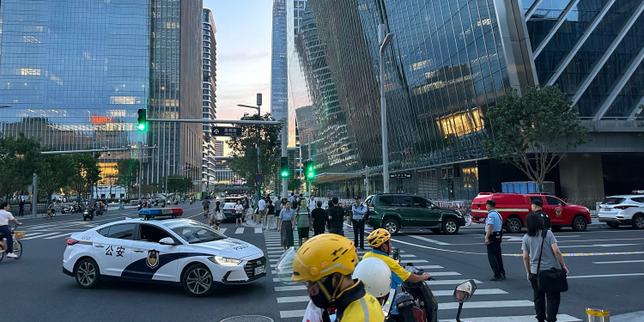
The air above Beijing does not normally carry the scent of aviation fuel. On a crisp afternoon, the capital breathes its usual cocktail of urban dust, exhaust, and the faint, sweet aroma of roasted chestnuts from street carts far below. But at precisely 2:47 PM, the rhythm of the city shattered.
Gravity is a patient master. We build upward, stacking steel and glass into the clouds, pretending we have conquered it. The China Zun tower, formally known as the CITIC Tower, stands as the ultimate expression of that defiance. It rises 528 meters into the smog, a giant vase of shimmering glass mimicking an ancient bronze vessel. It is a symbol of absolute stability. Until something small, fast, and entirely out of place comes tearing out of the haze.
The sound came first. Not the deep, rumbling thud of a commercial airliner, but a high-pitched, frantic whine. It sounded like a chainsaw operating at an impossible altitude.
Then came the impact.
The Fragility of Glass
Imagine sitting on the 80th floor. The world below is a miniature grid of silent, creeping traffic. You are reviewing a spreadsheet, or perhaps staring blankly at a coffee cup. Suddenly, the entire horizon shifts. A light, twin-engine aircraft, looking absurdly fragile against the monolithic backdrop of the skyscraper, slams directly into the upper tiers of the structure.
The glass did not just break. It atomized.
A shockwave traveled down the core of the building, a dull shudder that vibrated through the soles of thousands of shoes. For a second, nobody breathed. In a metropolis of over twenty million people, safety is an unspoken contract. We trust the architecture. We trust the flight paths. We trust that the sky is managed by invisible, infallible hands.
When that contract breaks, the realization is physical. It catches in the throat.
Emergency sirens began their chorus within ninety seconds, a rising wail that rippled outward from the Central Business District. On the ground, people stopped walking. Thousands of faces, illuminated by the harsh glare of smartphone screens, tilted upward in unison. Above them, a plume of dark, oily smoke was unspooling from the side of the tallest building in Beijing, a black ribbon cutting through the grey sky.
The immediate reaction to any modern disaster is a frantic scramble for context. Is it an act of terror? Is the building going to collapse? The mind leaps to the worst historical ghosts. But the reality of this event was defined not by malice, but by a sudden, terrifying failure of human or mechanical precision.
The Machine in the Maze
The aircraft involved was not a commercial giant, but a small, privately operated light plane. To understand how such a machine ends up embedded in the facade of a mega-tall skyscraper, you have to understand the invisible labyrinth of Beijing’s airspace.
The sky above the capital is one of the most tightly controlled patches of atmosphere on earth. Military zones, commercial corridors, and strict no-fly sectors overlap like a complex threedimensional puzzle. Navigating it requires absolute concentration and flawless equipment. When a small plane enters this space, it is like a bicycle wandering onto an eight-lane highway during rush hour.
Consider the mechanics of a modern flight deck. Even in a small aircraft, a pilot is bombarded with data. Altimeters, transponders, GPS displays, and radio chatter from air traffic control create a dense wall of information. If a single instrument falters—if the altimeter miscalculates pressure, or if a sudden electrical short blanks out the navigation screen—the pilot is suddenly flying blind in a canyon of steel.
Worse still is the phenomenon of spatial disorientation.
When low cloud cover or heavy haze rolls across Beijing, the boundaries between earth and sky blur. A pilot trapped in this grey soup can easily lose the horizon. Up becomes down. Left becomes right. The towering geometry of the Central Business District, usually visible from miles away, becomes a series of lethal shadows hidden behind a curtain of mist. You do not see the building until it fills the windshield.
The Human Cost Inside the Tower
While investigators began parsing the radar data, the immediate crisis was human. Inside the CITIC Tower, the evacuation was not a cinematic stampede, but a tense, orderly descent fueled by raw adrenaline.
Lifts were instantly deactivated. The only way out was down.
Think about the physical reality of walking down eighty flights of stairs. The air inside the concrete stairwells grows thick and hot. The sound of thousands of footsteps echoes off the walls, a rhythmic, terrifying drumbeat. Every flight looks exactly like the last. Leg muscles begin to burn after twenty floors. By forty, they shake uncontrollably.
Among the evacuees was a young financial analyst, who later recounted the experience with a voice that still trembled. She remembered the smell most vividly—not the fire itself, but the chemically pungent odor of scorched insulation and melted plastic drifting through the ventilation shafts. It was the smell of a modern workplace being violently undone.
"Nobody spoke," she said. "We just watched the heels of the shoes of the person in front of us. Every time a door slammed somewhere in the core, everyone flinched."
Outside, the perimeter was a sea of red flashing lights. Fire crews, specialized high-rise rescue units, and medical teams deployed with a speed that spoke to years of rigorous contingency planning. The response was a massive show of force, an attempt to reassert control over a situation that felt profoundly chaotic.
The Autopsy of an Accident
As the smoke cleared and the initial panic subsided into a grim curiosity, the focus shifted to the wreckage. The structural integrity of the China Zun tower was never truly in jeopardy. Mega-tall buildings are engineered to withstand immense lateral forces, from typhoons to seismic shifts. A light aircraft, weighing less than a fraction of a commercial airliner, lacks the mass to compromise a core built from reinforced concrete and high-strength steel.
But the vulnerability was structural in a different way. It exposed the gaps in our technological safety nets.
Every year, the sky grows more crowded. The democratization of flight—through private aviation, commercial drones, and expanding regional routes—means that the space above our heads is no longer an empty void. It is infrastructure. And like any infrastructure, it suffers from friction.
When we look at the data from the flight recorder, the story usually changes from one of sudden catastrophe to one of compounding errors. A minor mechanical glitch leads to a misunderstood instruction from the tower. A slight correction in altitude puts the plane directly in the path of a building that shouldn't have been there according to the outdated visual reference. A single second of hesitation seals a fate.
It is a sobering reminder that our grandest architectural achievements remain at the mercy of the smallest human frailties. We can build to the heavens, but we cannot engineer away the possibility of a mistake.
The Quiet Aftermath
By midnight, the area surrounding the tower was eerily quiet. The emergency spotlights cast long, dramatic shadows across the pavement, illuminating the debris that had rained down during the afternoon. Shards of glass, bits of twisted aluminum, and papers from disrupted offices lay scattered like confetti after a dark celebration.
The hole in the side of the skyscraper remained visible, a jagged black tooth in the building’s otherwise perfect smile. Inside, investigators worked under the glare of portable work lights, cataloging the remnants of the aircraft, searching for the definitive answer to why.
The city below had already begun to move on. The subway trains rumbled beneath the streets, carrying commuters home. The neon signs of neighboring buildings blinked rhythmically, reflecting off the damp asphalt.
But if you looked closely at the pedestrians crossing the intersection at Guomao, you noticed a change in behavior. They were no longer looking at their phones. Their heads were tilted back, their eyes scanning the dark upper reaches of the towers, watching the spot where the sky had briefly torn open, wondering how something so solid could feel suddenly so fragile.


