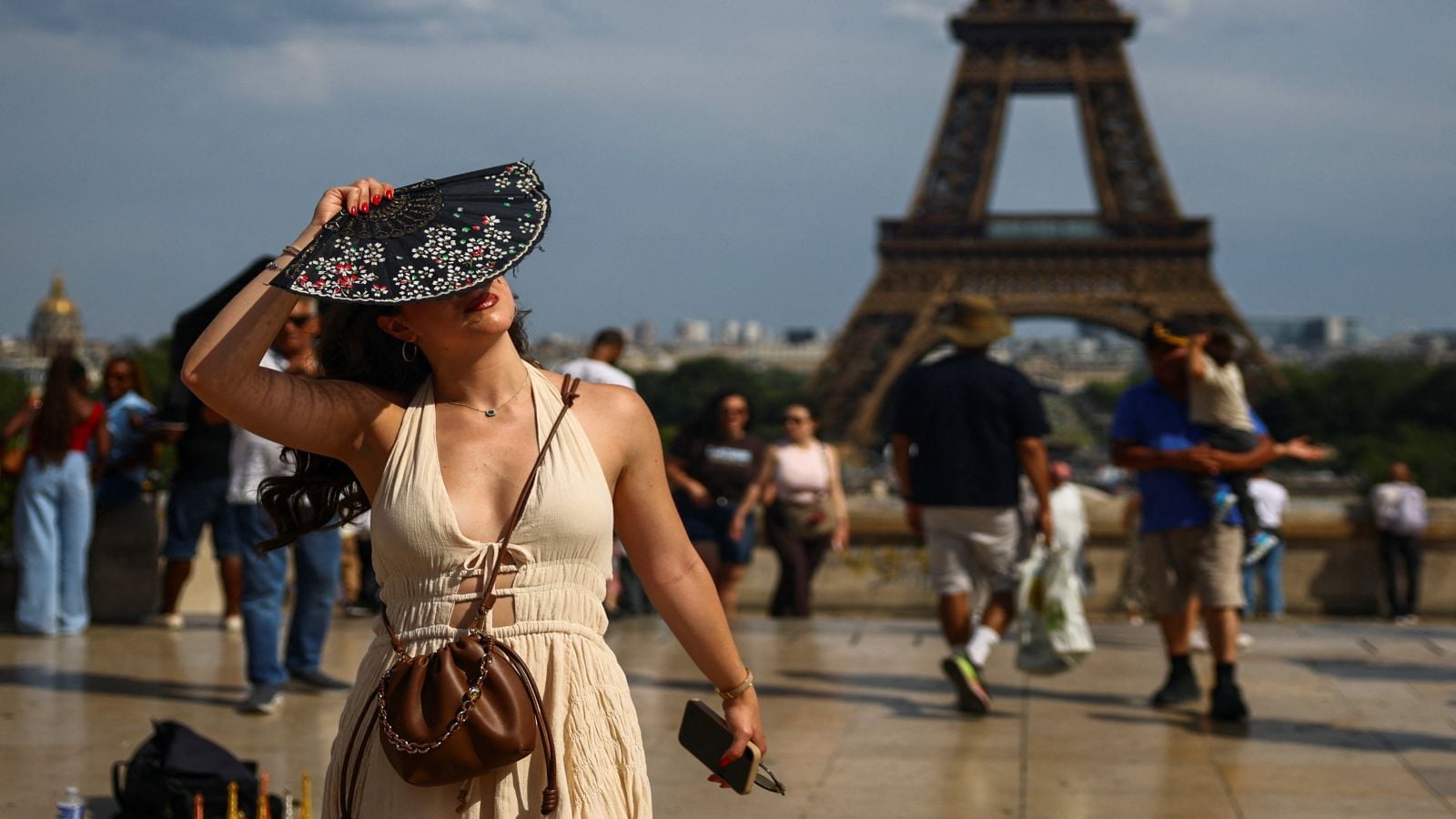
The heat does not arrive with a roar. It settles like a wet wool blanket over the stone shoulders of Paris, quiet and suffocating. By noon, the air in the Rue de Rivoli doesn’t feel like air at all; it feels like soup.
We are used to summer postcard versions of this city—the crisp clink of rosė glasses on sidewalks, the dappled shade of chestnut trees along the Seine. But when the thermometer creeps past 40°C, the postcard melts. The romance evaporates, replaced by the heavy, metallic smell of baking asphalt and the collective friction of millions of bodies trying to find a breath of wind that does not exist. Don't forget to check out our recent article on this related article.
To understand what happens to a modern European capital when the climate breaks its promises, you have to look at the iron.
The Stretching Giant
Consider a hypothetical traveler named Elena. She had saved for three years to bring her daughter to see the Eiffel Tower. They stood in the dust of the Champ de Mars, squinting up at the sky, only to find the gates barred early. The monument was closing. Not because of a labor strike or a security threat, but because the structure itself was physically changing shape. If you want more about the context here, Associated Press provides an informative breakdown.
This is not a metaphor. It is basic physics.
The Eiffel Tower is made of puddle iron, a highly responsive material. When temperatures cross that brutal 40°C threshold, thermal expansion takes over. The kinetic energy within the metal increases, forcing the atoms to push further apart. On days like this, the tower actually grows. It tilts away from the sun, shifting its massive weight by several inches as the exposed iron swells. The engineers know the limits of the old iron. When the heat threatens the integrity of the lift cables and forces the metal to its structural boundaries, the only safe option is to lock the gates and wait for nightfall.
For the thousands of tourists holding useless paper tickets, the closure feels like a bureaucratic insult. For the city, it is a warning flare. When the symbol of your nation’s permanence begins to warp under the sheer weight of the sky, the reality of a warming world stops being an abstract policy debate. It becomes an immediate, tactile crisis.
Steel Ribbons and Stalled Dreams
A few miles away, at the Gare du Nord, the situation turns from disappointing to dangerous.
The heat does not care about train schedules. Across France, rail operators are forced to slash services, cutting speeds and canceling routes. To the stranded commuter, it looks like administrative failure. The truth is far more mechanical, and far more terrifying.
Standard railway tracks are made of steel, laid down in long, continuous welded ribbons. They are designed to withstand tension and compression within a specific, historical temperature range. But when solar radiation beats down on the dark metal of the tracks for eight hours straight, the steel can easily reach 50°C or higher—far hotter than the surrounding air.
Imagine pushing the two ends of a plastic ruler together. For a while, it resists. Then, suddenly, it snaps outward into an arc.
That is track buckling. Under extreme heat, the expanding steel has nowhere to go. It breaks free from its concrete ties and stone ballast, twisting into useless, jagged waves. A train hitting a buckled track at 300 kilometers per hour would result in catastrophe. To prevent this, train operators enforce speed restrictions, slowing locomotives down to minimize the dynamic forces exerted on the fragile infrastructure.
It is a slow-motion paralysis. The veins of Europe, built to move millions of people with precision, clog and stall because the physical world can no longer tolerate our assumptions about the weather.
The Invisible Stakes on the Sidewalk
We tend to measure crises by what shuts down—the monuments, the trains, the stock exchanges. But the real toll of a 40°C afternoon is paid in smaller, quieter currency.
Step away from the train stations and look into the courtyards of the residential arrondissements. Paris is a city built of Haussmann-era limestone. These beautiful, zinc-roofed buildings were designed in the 19th century to trap heat during the brutal winters. They possess no central air conditioning. The thick stone walls act like storage heaters, absorbing the sun’s energy all day and radiating it back into the tiny apartments long after the sun has set.
Inside these upper-floor rooms, the air turns into an oven. It is here that the true vulnerability hides. The elderly neighbor who hasn't been seen at the bakery all morning. The delivery rider navigating the blistering asphalt on a scooter, their livelihood dependent on moving fast through an environment that demands stillness.
There is a psychological exhaustion that accompanies this kind of heat. It strips away patience. It turns simple human interactions sour. The city's famous cafe culture retreats indoors behind heavy curtains, seeking refuge anywhere a fan might be blowing stagnant air across a room.
The Architecture of Tomorrow
We are engineering our lives for a world that no longer exists.
Our bridges, our tracks, our electrical grids, and our homes were all constructed based on historical averages—the comfortable baseline of the 20th century. We assumed the environment would remain a stable backdrop to our progress. Now, the backdrop is moving. It is pushing back against the iron and steel we used to tame it.
Fixing this is not a matter of simply installing more air conditioning units, which only dump more heat back onto the crowded streets while straining an already overburdened power grid. It requires a fundamental rewrite of how we live in urban spaces. It means planting urban forests to break up the heat islands created by concrete, using reflective white coatings on old zinc roofs, and engineering new alloys for our transport systems that can handle the violent swings of a changing thermostat.
Until then, we adapt by retreating. We close the gates of our monuments. We slow our trains to a crawl. We hide in the shadows of stone buildings, waiting for the sun to lose its teeth.
As twilight finally comes to Paris, the sky turns a bruised, dusty violet. The air remains thick, refusing to cool. On the Champ de Mars, the great iron tower stands dark and empty, its metal slowly contracting in the dark, settling back into its joints with faint, metallic groans. It is a massive, beautiful structure, but tonight it feels remarkably fragile—a giant monument built for a different era, waiting to see what tomorrow's sun will bring.