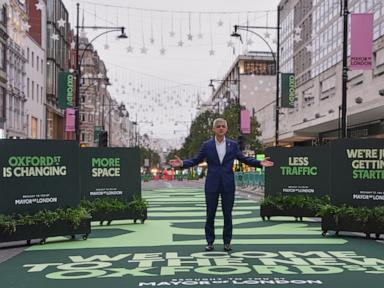
The air always tasted like diesel and burnt toast.
If you stood on the pavement of London’s Oxford Street on a rainy Tuesday afternoon in November, you didn't just hear the city; you breathed it. A symphony of roaring double-deckers, impatient delivery vans, and the constant, low-frequency hum of thousands of idling engines waiting for a light to change. Tourists clutched shopping bags like shields, dodging side-mirror swipes from black cabs while navigating a sea of elbows and umbrellas.
It was a place designed for commerce, yet nobody actually wanted to linger.
You walked fast because you had to. You survived Oxford Street. You didn't experience it.
Then came the quiet.
The Anatomy of a Concrete River
For decades, the arterial route of central London functioned as a high-pressure pipe for vehicular traffic. Millions of pounds worth of retail goods flowed down it daily, flanked by frantic pedestrians squeezed onto narrow concrete margins. The math was simple, brutal, and entirely unsustainable. More than half a million daily visitors crowded pavements built for a fraction of that number, while private cars, taxis, and buses choked the asphalt core.
Urban planners called it congestion. Regular people called it exhausting.
Retail districts live and die by footfall, but footfall requires oxygen. When the Mayor of London and local authorities finally pushed forward with aggressive plans to ban traffic and pedestrianise major stretches of Oxford Street, it wasn't just an infrastructure update. It was an admission of failure. The historic shopping district was suffocating under its own weight, losing
The Death of the Pavement Shuffle and the Soul of Oxford Street
lifestyle, news, travel
The air on Oxford Street has always tasted faintly of diesel, roasted chestnuts, and the collective anxiety of forty thousand people trying to walk at four different speeds.
Step off the curb on a rainy Tuesday evening near Oxford Circus, and you immediately feel the choreography. It is an unwritten, brutal dance. You dodge the tourist frozen mid-stride to capture a double-decker bus on an iPhone. You squeeze past the flyer-distributor whose plastic smile has long since fractured. You shoulder-check the commuter moving with the singular, terrifying purpose of someone who has missed their train and hates everyone in a three-mile radius.
For a century, this famous mile-and-a-half stretch of London concrete has operated under a simple, punishing premise: cars and commerce must share the same narrow throat.
Yellow cabs creep along like impatient yellow jackets. Delivery vans idle against the curb, coughing blue smoke into the damp British air. Pedestrians are relegated to the margins, squeezed onto narrow concrete strips like toothpaste bursting from a crushed tube. We accepted this because we thought it was the price of a capital city. We assumed that noise, congestion, and the constant threat of a wing mirror clipping your coat were just what ambition sounded like.
We were wrong.
The decision to ban traffic from Oxford Street—to finally sever the artery that feeds central London's chaotic car culture—is not merely an urban planning bullet point. It is a quiet revolution. It is an admission that we built our cities for machines that do not care about poetry, history, or the simple joy of walking without looking over your shoulder.
Consider what actually happens when you take the metal away.
Imagine, for a moment, a hypothetical family visiting from outside the city—let us call them the Millers. In the old world, getting off the tube meant instantly entering a sensory war zone. Dad has his hand clamped around a child’s wrist, terrified a rogue cyclist or an impatient delivery truck will mount the curb. Mum is dodging a rain puddle splashed by a passing bus. Conversation is impossible over the roar of engines. You do not shop to browse; you shop to escape. You grab the discounted sweater, you endure the crowded queue, and you flee back underground, vowing never to return.
Now, picture the alternative.
The physical geography remains the same. The grand Victorian facades still loom overhead, dark brick and Portland stone catching the late afternoon sun. Selfridges still anchors the western view with its stoic, window-dressed elegance. But the soundscape has shifted. Instead of the continuous, abrasive drone of combustion engines, there is the rising hum of human voices.
Without the barrier of traffic, the street widens. Psychologically, at least. The road surface, once polished slick by thousands of tires and coated in a thin film of oil, becomes an open plaza. People stop. They actually stop. They lean against newly planted benches or watch a busker play a cello without worrying about an oncoming van forcing them back onto the pavement.
This transformation is rooted in a brutal economic reality. High streets across the globe are bleeding. The rise of digital shopping didn't just change where we buy things; it changed why we go out. Nobody travels across a continent to stand on a cramped, diesel-choked sidewalk just to pick up a shirt they could have ordered from their sofa in their pajamas.
If physical retail is going to survive, it cannot compete on convenience. It has to compete on experience.
For years, London watched its premier shopping district lose its luster. Foot traffic drifted toward gleaming, controlled-environment behemoths like Westfield, or vanished entirely into the ether of e-commerce. Storefronts blinked out, replaced by flashing souvenir shops peddling cheap Union Jack paraphernalia of dubious origin. The great boulevard of British retail was turning into a tacky highway.
Closing the street to traffic is an attempt to reclaim the soul of the place.
Of course, change of this magnitude is never clean. Critics point to the displacement. If you ban cars from Oxford Street, where do the delivery vans go? Where do the black cabs drop off the elderly or disabled passengers who cannot walk the length of three tube stations? These are not trivial concerns. They are the messy, logistical nightmares that keep urban planners awake at night, staring at spreadsheets until their eyes water.
Urban life is a series of friction points. Every solution creates a new problem. Push traffic off Oxford Street, and you risk spilling congestion onto the residential side streets running parallel to it. You force bus routes to reroute, twisting the daily commutes of thousands of people who rely on public transit to cross the city.
Yet, history suggests that cities adapt to pedestrianization with a stubborn, organic grace. When major European capitals—from the grand plazas of Madrid to the pedestrianized cores of Copenhagen—pushed cars out, the initial panic invariably gave way to a strange, collective amnesia. Within five years, residents look back and ask how they ever tolerated the exhaust fumes and the danger.
The pedestrian is fragile, but persistent.
When you remove the car, you restore the human scale. You remember that cities were originally built for walking, for talking, for bumping into an old friend outside a bookshop, for pausing to watch a street artist sketch charcoal portraits in the damp evening mist.
The transformation of Oxford Street is a test case for the future of urban living. It asks a fundamental question: What is a city street actually for? Is it a conduit to move metal boxes from point A to point B as quickly as possible? Or is it a public living room, a place where a diverse society rubs shoulders and remembers how to inhabit the same physical space?
The asphalt is cooling. The barriers are going up.
Walk down the center of the road tomorrow, where the buses used to roar, and look up at the sky unblocked by double-decker roofs. The noise fades. The space opens. The city breathes out for the first time in a hundred years.


