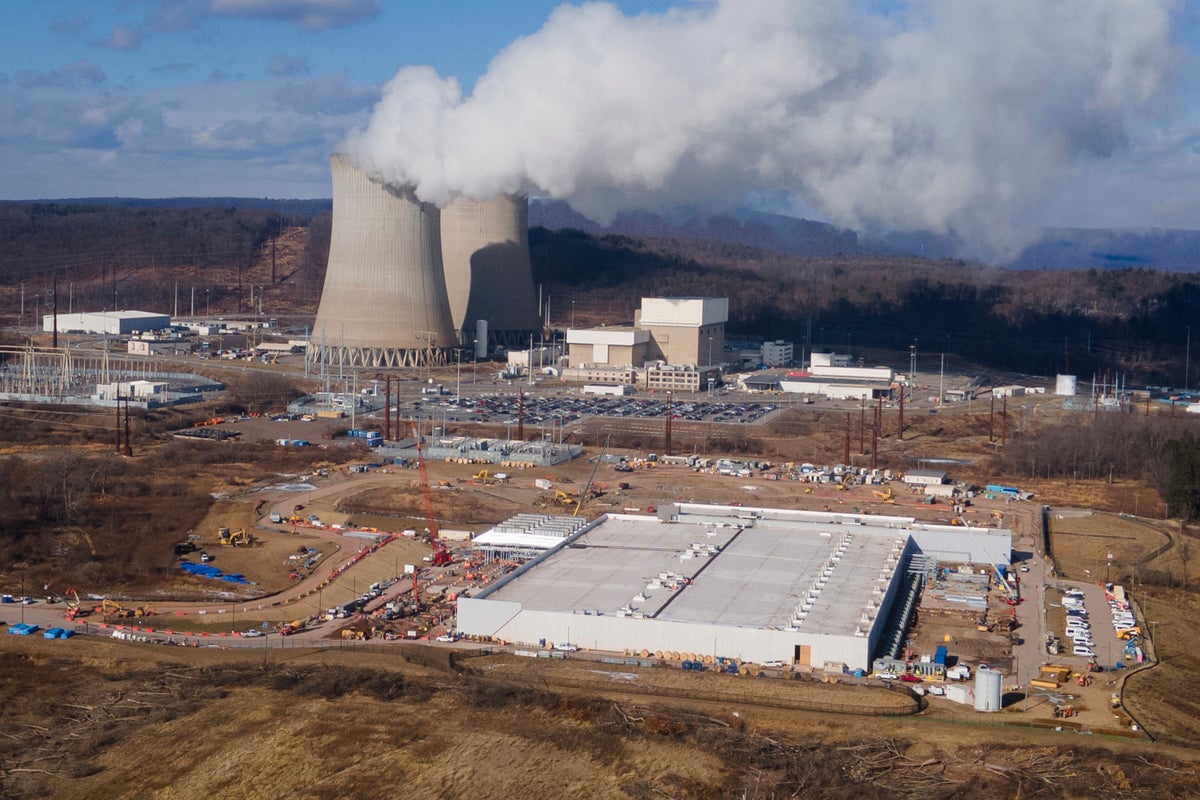
Building trades unions think they’ve found a gold mine in the silicon desert. They see the massive, windowless monoliths rising across Northern Virginia, Ohio, and Arizona and see decades of guaranteed "man-hours." They see the tech giants—Microsoft, Google, Meta, Amazon—as the deep-pocketed benefactors who will save the blue-collar middle class.
The media loves this narrative. It’s clean. It’s hopeful. It suggests a grand bargain where the high-tech future finally shakes hands with the industrial past.
It’s also a total fantasy.
The current alliance between organized labor and Big Tech over AI data centers isn't a partnership of equals. It’s a temporary marriage of convenience where the unions are providing the political cover for a land grab that will eventually leave them behind. While trade leaders celebrate Project Labor Agreements (PLAs) for $100 billion campuses, they are ignoring a hard truth: you can only build a shell once, but code runs forever.
The Construction Cliff No One Mentions
The math used to justify these partnerships is intentionally misleading. When a tech giant announces a "ten-year investment" in a region, they lead with the construction jobs. They cite thousands of workers needed for electrical, HVAC, and steelwork.
But look at the lifecycle of a data center.
Unlike a manufacturing plant or an automotive factory, a data center is a ghost ship. Once the concrete is poured and the liquid cooling systems are piped in, the labor demand drops off a cliff. A $5 billion facility might require 2,000 workers to build, but it only takes 50 to 100 people to run. Most of those permanent roles aren't unionized trades; they are site reliability engineers and security contractors.
By tying their political capital to the build-out phase, unions are chasing a "one-and-done" stimulus. They are helping tech companies bypass local zoning laws and environmental hurdles in exchange for a few years of high-intensity work. Once the "Go Live" button is pressed, the union presence evaporates.
I’ve watched local councils get steamrolled by this logic. The tech company promises "community investment," the union provides the muscle to silence the "Not In My Backyard" (NIMBY) crowd, and three years later, the town is left with a massive humming box that pays minimal property taxes due to state-level subsidies and employs fewer locals than the hardware store down the street.
The Power Paradox
Let’s talk about the grid.
The "lazy consensus" argues that data centers are a boon for utility infrastructure. The theory is that the massive demand for power will force much-needed upgrades to our aging electrical grid, paid for by the tech companies.
In reality, AI data centers are parasitic to local infrastructure.
A standard hyperscale data center can pull as much power as a small city. When you add the compute requirements for Large Language Models (LLMs), that demand doubles. We are seeing a scenario where "AI-ready" facilities are cannibalizing the power capacity intended for actual industrial growth.
If a unionized steel mill wants to expand, it now has to compete for grid priority against an Amazon server farm. The server farm will always win because its margins are higher and its political "green" optics are better managed. By fast-tracking these data centers, building trades are effectively voting to starve the very heavy industries that provide long-term, multi-generational maintenance work.
We are trading the "Industrial Heart" for a "Digital Brain" that doesn't need us.
The Greenwashing Shell Game
The competitor narrative suggests that unions are helping tech companies meet their carbon-neutral goals through "green construction."
This is the most egregious lie in the industry.
There is nothing "green" about a facility that requires millions of gallons of water per day for evaporative cooling in a drought-stricken state like Arizona. There is nothing "sustainable" about 24/7 power draws that keep coal plants running longer than planned because renewable offsets can’t handle the base load.
When unions put their logo next to a tech company’s "sustainability report," they are lending their hard-earned credibility to a marketing exercise. Tech companies aren't building in these locations to be "green"; they are building there because of tax abatements and cheap land. The moment those incentives expire, or the water runs out, they will move. A data center is just a warehouse with better air conditioning. It is the most mobile form of "heavy" industry in history. You can’t move a blast furnace. You can certainly move a server rack.
Skilled Labor or Just Rent-a-Crowd?
There is a cynical layer to this alliance that most industry insiders refuse to discuss in public. Tech companies don't actually like unions. They hate the "friction" of collective bargaining.
So why the sudden embrace of the building trades?
Because Big Tech has a PR problem. They are being investigated for antitrust violations, their AI products are under fire for copyright theft, and they are viewed as elitist coastal entities. They need "salt-of-the-earth" allies. They are buying political legitimacy.
By signing PLAs, tech companies aren't just buying construction labor; they are buying a lobby. They are buying the ability to send hundreds of men and women in high-vis vests to city hall meetings to demand that a project be approved. It is an effective tactic. It’s also a temporary one.
Once the data centers are built and the "AI arms race" moves into its next phase, these companies will pivot to automation in construction. We are already seeing the emergence of prefabricated, modular data centers. These are built in non-union shops, shipped in containers, and "snapped together" on-site like Lego sets.
The "key ally" status the unions think they hold is a depreciating asset.
The Maintenance Myth
Some argue that the complexity of AI cooling systems will create a new class of high-end maintenance work for union pipefitters and electricians.
While the systems are complex, the trend is toward "lights-out" operations. Companies like Google are already using AI to manage the cooling of their own data centers, optimizing energy use in real-time far better than a human operator could. The goal of every hyperscaler is to remove human intervention from the loop.
The building trades are currently helping build the very systems that will eventually automate the management of the physical world. It’s a recursive loop of obsolescence.
Stop Asking For Jobs, Start Asking For Equity
If unions want to survive the AI era, they need to stop groveling for "man-hours" and start demanding a stake in the digital infrastructure they are building.
The current model is a flat fee: you build it, we pay you, you leave. That is a loser’s game in a world where the value is in the data, not the dirt.
Imagine a scenario where unions negotiated for "digital royalties" or infrastructure stakes. If a data center is going to strain the local grid and use local labor to facilitate trillions of dollars in AI-driven profit, the compensation shouldn't be limited to an hourly wage for a three-year build.
Why aren't we seeing union pension funds taking direct equity stakes in these facilities? Why aren't the trades demanding that a percentage of the compute power be dedicated to local industrial innovation?
Instead, we see leadership taking the "lazy win." They get a spike in their dues-paying membership for a few years, the politicians get a ribbon-cutting ceremony, and the tech giants get their tax-subsidized fortresses.
The High Cost of Easy Wins
The "bold alliance" between Big Tech and Big Labor is a sugar high.
It feels good right now because the checks are clearing and the cranes are in the air. But we are setting ourselves up for a massive structural hangover. When the construction boom ends—and it will, as soon as the hardware catches up to the software—the building trades will realize they helped build a world that has no place for them.
They are currently the "useful idiots" of the AI revolution. They are providing the sweat and the political cover for a class of companies that would replace every single one of them with a robot or a line of code if it saved them 2% on the quarterly earnings report.
The building trades shouldn't be celebrating their "partnership" with tech giants. They should be terrified of it. They are building the gallows for the traditional labor market, and they’re doing it on a 1099.
Stop calling this an "economic engine." It’s an extraction. It’s taking local land, local water, and local political capital, and it’s turning it into offshore shareholder value. If the unions don't change the terms of the deal—moving from "builders" to "owners"—they will find themselves standing outside the fences of the very facilities they built, wondering where all the work went.
The silicon giants aren't your allies. They are your new landlords. And they don't plan on renewing your lease.