Curfews after riots feel decisive. They look tough on a television broadcast. They let a minister stand before a bank of microphones, project iron resolve, and promise calm by midnight.
They also routinely fail at their stated job.
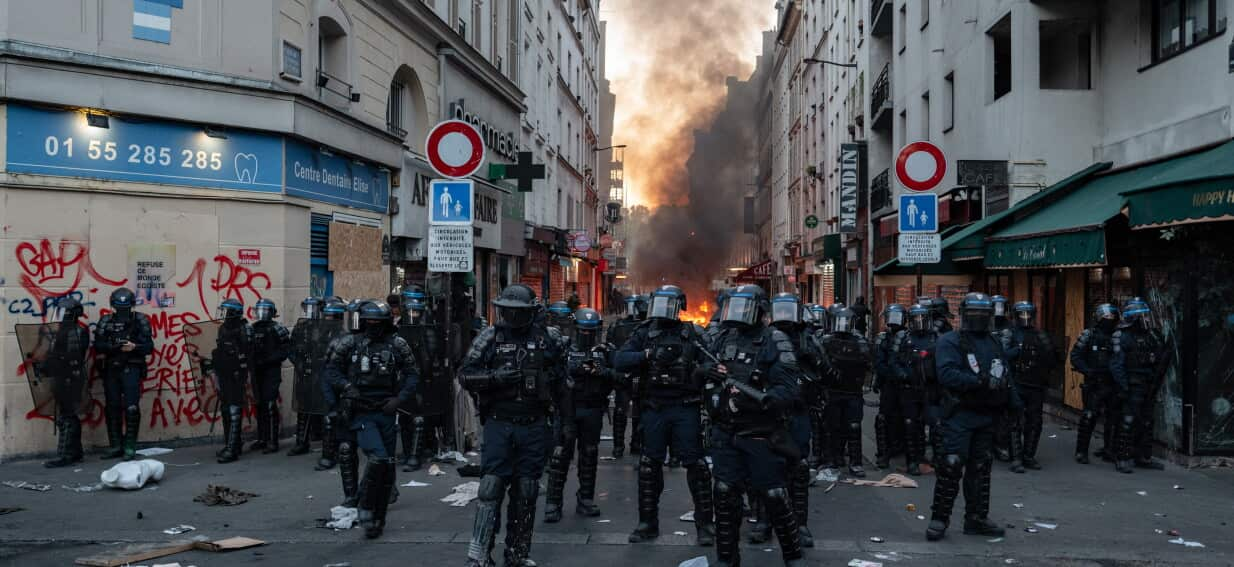
Whenever civil unrest flares in France, the script barely changes. Windows break. Buses burn. Police lines stretch thin in outer banlieues or city centers. Within hours, the lazy consensus settles in across newsrooms and political salons: bring out the decrees, set the clock, clear the streets after dark, and let security forces sweep what remains. It is an old reflex, rooted in the 1955 state-of-emergency law expanded during the 2005 riots and dusted off again during emergencies like the 2023 unrest and pandemic lockdowns.
Calling a curfew "restoring order" confuses visibility with control. A quiet street at 11:00 p.m. is not the same thing as a resolved grievance, a contained flashpoint, or a safer neighborhood at 11:05 p.m. when a patrol car pulls up to enforce a blanket ban on movement.
The Lazy Consensus Around Post-Riot Curfews
Standard coverage treats curfews as a straightforward lever: disorder goes up, curfew goes down, calm returns. That framing rests on three assumptions that rarely survive contact with urban policing on the ground.
First, it assumes riots are simply crowds staying out too late. Real civil unrest rarely respects bedtime. Flashpoints shift by hour, wind direction, social media rumors, and police tactics. A strict nighttime boundary can compress activity into earlier windows, displace it into adjacent districts not covered by the order, or turn routine evening errands into confrontations.
Second, it assumes police capacity expands when a curfew is signed. It does not. Every checkpoint, identity check, and street sweep consumes officers, vehicles, and command attention. When resources get spread thin enforcing broad movement restrictions across entire municipalities, targeted investigations into arsonists, organizers, or looters lose bandwidth.
Third, it assumes a curfew signals strength to everyone in the same way. To anxious shopkeepers or exhausted commuters, it looks like action. To young residents who already view local policing as heavy-handed or discriminatory, a blanket restriction on stepping outside can read as collective punishment. Collective punishment is fuel, not water.
A curfew clears the easiest people off the sidewalk first—neighbors walking dogs, shift workers heading home, teenagers lingering outside an apartment block—while the most determined agitators already know how to slip through side alleys.
Defining the Terms Before Judging the Tool
Before arguing over whether tough measures work, precision matters. Crowd control, public order policing, and curfews are distinct concepts, even though pundits lump them together.
Public order is the baseline predictability of daily life: transit runs, emergency vehicles pass without obstruction, businesses open, and residents can move safely without intimidation. Crowd control refers to managing gatherings—whether peaceful protests, sports celebrations, or volatile street assemblies—so they do not cross into violence or property destruction. A curfew is a legal restriction prohibiting people from being in public spaces during specified hours unless they meet narrow exemptions.
Notice the difference. A curfew does not stop a Molotov cocktail from being thrown at 9:30 p.m. It does not de-escalate a tense stand-off at a housing estate entrance. All a curfew does on its own is criminalize presence after a set hour and give authorities a broad pretext to stop, question, fine, or detain people who might otherwise have had nothing to do with the violence.
Criminologists and policing scholars have studied curfew effects for decades, particularly in municipal and crisis settings. Researchers such as David Weisburd and Anthony Braga have consistently shown in broader policing research that concentrated, targeted interventions tied to specific crime places and specific offenders outperform broad, indiscriminate sweeps. When enforcement becomes wide rather than precise, legitimacy drops, cooperation dries up, and friction rises between officers and residents.
In France, that legitimacy gap is already a central fault line in urban unrest. Decades of concentrated housing policy in outer suburbs, high youth unemployment in certain districts, strained relationships between municipal authorities and residents, and intense scrutiny over police stops and use of force shape how every order lands. Treating a structural and operational crisis with a blunt geographic clock ignores how unrest actually spreads.
Why People Ask the Wrong Questions After Unrest
When riots erupt, public debate locks onto predictable questions. Most of them point in the wrong direction.
"Are authorities tough enough to impose curfews?"
That question mistakes bluster for competence. Imposing a curfew takes a signature and a press release. Making it work without sparking fresh clashes requires manpower, clear legal rules, accurate intelligence, and restraint under pressure. Toughness is easy to announce; operational discipline is hard to execute.
"Don't residents want peace and quiet at night?"
Of course they do. Ask anyone living above a burned-out car or a shattered storefront if they want calm, and the answer is yes. That misses the real trade-off. Residents want lasting safety, not a temporary hush enforced by a powder-keg standoff outside their building. If a curfew lowers visible movement tonight while planting resentment for next week, it hasn't delivered real peace.
"If curfews aren't the answer, should the state just do nothing?"
Nobody serious argues for doing nothing when arson, looting, and assaults occur. Arsonists endanger lives. Attacks on firefighters, buses, schools, and town halls destroy community lifelines. Rejecting ineffective curfew theater is not a vote for passivity; it is a demand for tactics that actually stop violence instead of manufacturing new friction.
Battle Scars From High-Stakes Crisis Response
I have spent years advising and working alongside teams dealing with high-pressure operational crises, public communications, and security logistics when events spiral faster than leadership plans. The same failure pattern shows up repeatedly across boardrooms, city halls, and command centers: leaders reach for visible control because invisible problems feel harder to explain.
I have watched organizations burn enormous time and credibility enforcing rigid rules that looked commanding on paper and backfired ten minutes after rollout. When a rule is too broad to police fairly, enforcement becomes selective. When enforcement looks selective in an already polarized environment, every stop turns into a symbol.
Consider a thought experiment. Imagine a scenario where a city mayor faces two nights of property damage and clashes near a transit hub and declares a blanket 8:00 p.m. to 6:00 a.m. curfew across four districts. By 8:15 p.m., dozens of teenagers who live in those buildings are still outside because their apartments are cramped, hot, or noisy, or because they are meeting family members. Patrol units now have to decide whether to clear dozens of youths at once—risking a brawl on camera—or ignore the rule they just announced, making the order look hollow within an hour. Neither option improves safety.
That is the trap of post-riot curfews. Either you enforce them aggressively and risk igniting new clashes, or you enforce them unevenly and erode authority even further.
What Actually Works When Streets Turn Volatile
Dismantling a bad habit only helps if you replace it with something sharper. Restoring order after riots requires separating genuine violence from ordinary street presence, protecting critical infrastructure, and pairing immediate stabilization with credible follow-through.
| Approach | What It Targets | Main Advantage | Hidden Risk |
|---|---|---|---|
| Blanket Night Curfew | Everyone outdoors after a set hour | Signals immediate political resolve | Sparks friction with non-rioters; drains patrol capacity |
| Targeted Hotspot Containment | Specific flashpoint intersections, transit lines, and repeat offenders | Preserves resources; protects key infrastructure | Requires sharp intelligence and disciplined restraint |
| Rapid Community & Civic Mediation | Local trust networks, youth workers, municipal leaders | Lowers temperature without escalating force | Takes time to build; cannot stop active arson alone |
| Swift, Fair Judicial & Investigative Follow-Through | Proven arsonists, looters, and inciters | Deters future escalation through accountability | Slow courts or overbroad sweeps can undermine trust |
Practical action starts with discipline rather than spectacle:
- Lock down critical lifelines first: Concentrate protection around fire stations, hospitals, public transit depots, schools, and major arteries so essential services keep moving and emergency crews are not ambushed.
- Separate troublemakers from bystanders: Use precision intelligence, camera review, and targeted unit deployment to identify individuals committing arson, looting, or attacks, rather than treating an entire neighborhood as hostile territory.
- Keep daylight and evening civic channels open: Shutting down ordinary public life completely often drives frustration indoors or into tighter, angrier clusters. Maintain safe community spaces, transparent updates, and local mediators who actually know the blocks.
- Enforce clear rules of engagement: Every unnecessary escalation during a tense stop multiplies grievances across an entire district. Discipline on the street is a force multiplier; heavy-handedness is an accelerant.
- Follow through after the cameras leave: Riots fade from headlines long before underlying grievances are addressed. Real stability requires consistent policing, honest accountability on both sides, and visible follow-through on neglected neighborhoods.
The Honest Cost of Going Against the Script
Advocating against blanket curfews carries real political and practical risks, and pretending otherwise would be dishonest.
Politically, a leader who skips a curfew after major unrest looks vulnerable to critics screaming for "law and order." Media narratives move fast, and restraint is harder to sell in a thirty-second clip than a firm decree. If violence continues on night two without a curfew in place, critics will blame the decision not to impose one—even if a curfew wouldn't have stopped the incidents that occurred.
Operationally, targeted policing and de-escalation demand higher training, better coordination, and steadier nerves than issuing a sweeping restriction. When command structures are stretched thin or local trust is already near zero, even well-intended targeted operations can go wrong if a single encounter spirals out of control.
There are also rare situations—such as severe public health emergencies, extreme weather disasters, or acute localized threats where keeping civilians off roads is essential for rescue operations—where temporary movement limits serve a clear, practical purpose. Post-riot crowd management is different because the core problem is not a storm or a virus; it is human conflict, anger, and opportunism.
A curfew is a headline, not a strategy. Stop mistaking an empty street at midnight for a safe city at dawn.