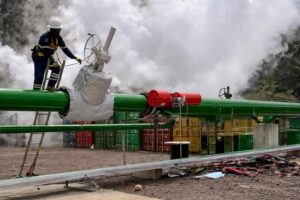
The Democratic Republic of Congo (DRC) has officially authorized a $100 million paramilitary force known as the "Mining Guard" to secure its vast reserves of cobalt, copper, and coltan. This specialized unit is tasked with purging illegal miners and foreign-backed militias from industrial concessions. However, the move is less about simple security and more about a desperate attempt by Kinshasa to regain leverage over the global green energy supply chain. While the government frames this as a cleanup operation, the reality on the ground suggests a high-stakes play to nationalize security and squeeze more revenue out of Western and Chinese mining giants who have long operated their own private militias.
The High Cost of Open Veins
For decades, the DRC has functioned as a massive, unregulated open-air treasury. The country holds over 70% of the world’s cobalt, yet the central government has historically exercised little control over the actual extraction sites. Illegal mining and "artisanal" operations—often fronts for regional warlords—drain billions in tax revenue every year.
The new Mining Guard is a direct response to this hemorrhage. It is a force designed to replace the patchwork of private security firms and underpaid national police who are easily bribed. By committing $100 million to this initiative, President Félix Tshisekedi is signaling that the era of "self-policing" by multinational corporations is over. The state wants to be the only entity with the keys to the gate.
Beyond the Security Perimeter
The problem with mining in the Lualaba and Haut-Katanga provinces isn't just a lack of guards. It is the fundamental breakdown of the "concession" model. Large-scale miners like Glencore or CMOC pay for the rights to specific coordinates, but thousands of desperate local citizens often scale the fences to dig by hand.
When private security clashes with these locals, the international backlash falls on the corporation. By inserting a state-led Mining Guard, the government effectively creates a buffer. If violence occurs, it is a state action, not a corporate liability. This provides a convenient legal shield for international buyers who are increasingly sensitive to "blood cobalt" narratives in their ESG reporting.
Why This Will Not Be a Clean Sweep
History in the Congo is a graveyard of well-funded special units. The $100 million price tag is substantial for the DRC budget, but it is a drop in the bucket compared to the bribes offered by smuggling rings. To understand why this might fail, one must look at the internal logistics of the Congolese military (FARDC).
Soldiers in the DRC are notoriously underpaid. When you put a man with a rifle and a $20 monthly salary in charge of a pit containing $50,000 worth of heterogenite, the outcome is predictable. The Mining Guard will only succeed if their pay structure is entirely decoupled from the standard military bureaucracy. Without a radical shift in transparency, this new force risks becoming the most efficient extortion racket in Central Africa.
The Chinese Factor
Chinese firms currently dominate the Congolese mining sector, controlling roughly 80% of the industrial cobalt output. For years, these firms have relied on their own security arrangements, often involving quiet deals with local power brokers.
The introduction of a mandatory state guard complicates these arrangements. It forces Chinese operators to integrate with a Congolese command structure that may have different priorities. There is a quiet friction growing in Kolwezi; the mining companies want protection, but they do not want a state witness watching every truck that leaves the site.
The Hidden Math of Mineral Protection
The $100 million investment is an aggressive bet on ROI. The government believes that by securing these sites, they can increase official exports by at least 15% to 20% within the first twenty-four months.
| Mineral | Estimated Yearly Loss to Smuggling | Potential Recovery with Guard |
|---|---|---|
| Cobalt | $450 Million | $120 Million |
| Gold | $1.2 Billion | $300 Million |
| Coltan | $200 Million | $50 Million |
These figures are conservative. The actual "informal" economy in the eastern provinces is so vast that even the World Bank struggles to map it. If the Mining Guard can even marginally secure the transit routes between the mines and the border at Kasumbalesa, the $100 million investment will pay for itself in a single fiscal year.
The Human Toll of Professionalization
We must address the "artisanal" elephant in the room. There are an estimated 200,000 to 250,000 artisanal miners in the DRC. They are not all criminals; many are families with no other source of income.
The Mining Guard's mandate is to clear these people off industrial sites. If the force uses heavy-handed tactics without providing alternative "ZAEs" (Artisanal Mining Zones), the result will be a humanitarian crisis that makes the current situation look stable. Security cannot exist in a vacuum of starvation. If the guard succeeds in closing the pits but the government fails to open legal artisanal alternatives, the pressure will eventually lead to an armed uprising against the very guards meant to protect the mineral wealth.
The Logistics of a Paramilitary Startup
Building a 10,000-man force from scratch requires more than just rifles. It requires a sophisticated C4ISR (Command, Control, Communications, Computers, Intelligence, Surveillance, and Reconnaissance) infrastructure.
The DRC has hinted at using drone surveillance and biometric tracking for its guards. This is a massive leap for a country that struggles with basic power grid stability. To pull this off, Kinshasa will likely need to outsource the tech to Israeli or South African defense contractors. This creates a secondary market of foreign influence—mercenaries rebranded as "technical consultants."
Corruption as a Feature
In previous attempts to reform the sector, the "leakage" didn't happen at the mine face; it happened at the provincial offices where the paperwork is stamped. A Mining Guard can stop a man with a sack of rocks, but they cannot stop a regional governor from mislabeling a shipment of high-grade ore as "waste" to avoid royalties.
For the $100 million to matter, the force needs the authority to arrest the people who sign the manifests, not just the people who swing the picks.
The Global Supply Chain Reaction
Manufacturers in the West are watching this with a mix of hope and dread. On one hand, a stabilized DRC means a more predictable supply of battery metals. On the other, a state-controlled monopoly on security gives Kinshasa the power to shut down global production on a whim.
If the Mining Guard decides to block a specific company’s exports due to a "security audit," the price of cobalt in London or Shanghai could spike overnight. This gives President Tshisekedi a "mineral weapon" similar to how OPEC uses oil. Security is the first step toward total market control.
The Role of Traceability
New regulations in the EU and the US require companies to prove their minerals are not sourced from conflict zones. The Mining Guard is being marketed as a "validation mechanism." The logic is simple: if a state guard secured the site, the mineral is "clean."
This is a dangerous oversimplification. Verification requires independent, third-party audits. A state-run guard certifying state-run interests is a conflict of interest that will eventually be exposed by investigative groups. The Mining Guard might secure the dirt, but it won't necessarily secure the integrity of the data.
A Force of Necessity or a Tool of Oppression
The success of this initiative hinges on the Rules of Engagement. If the guard operates with the transparency of a modern police force, it could be the turning point the DRC has needed since the 1960s. If it operates as a private army for the ruling elite, it will simply be another layer of the "resource curse" that has kept the country in a state of arrested development.
Mining companies are currently being asked to help "subsidize" the operation of these guards on their own property. This creates a bizarre dynamic where the victim of the protection racket is paying for the privilege of being watched. Companies like Ivanhoe Mines and Tenke Fungurume are already calculating the cost-benefit of this new overhead.
The Shadow of the Wagner Group
There is a regional precedent for this. In neighboring countries, Russian-backed entities have traded "security" for mining rights. While the DRC is currently leaning toward a nationalized model, the pressure to bring in "experts" from the East is immense. The $100 million might be Congolese money today, but if the guard fails to produce results, the door swings wide for foreign paramilitaries to step in and "assist."
Kinshasa is essentially racing against time. They need to prove they can govern their own soil before the geopolitical pressure of the "Energy Transition" forces an international intervention under the guise of "securing critical supply chains."
The Final Threshold
The Mining Guard is not a silver bullet. It is an expensive, high-risk gambit in a country where the rule of law is often sold to the highest bidder. If the $100 million is spent on training, fair wages, and modern surveillance, the DRC could finally transition from a looted territory to a sovereign commodity power. If the money vanishes into the pockets of generals, the guards will simply become the new gatekeepers of the black market.
The global tech industry is now inextricably linked to the performance of these men in uniform. Every smartphone and electric vehicle battery relies on the stability of the ground they are now sworn to protect. The DRC has finally realized that in the 21st century, the most valuable resource isn't the mineral in the ground—it is the power to decide who gets to take it out.
Investors should stop looking at the mining charts and start looking at the payroll of the Mining Guard. That is where the real story of the next decade will be written.