The air in Singapore does not merely sit upon your skin; it presses down with the heavy, saturated weight of a hot towel held over a face. Walk down Orchard Road and you will miss it entirely. The air-conditioned chill of the malls, the crystalline perfection of the orchids, the low, steady hum of a metropolis that has engineered away its own flaws—it all projects an immaculate sheen of futuristic prosperity. But walk away from the tourist paths. Turn down a side street as the sun surrenders to a humid dusk, and the glittering glass gives way to something older, dustier, and quietly desperate.
(Note: For the sake of illustration, let us follow a hypothetical worker named Kadeing, who mirrors the real experiences documented by labor rights groups in the city-state.)
Kadeing stands on a narrow balcony five stories above the pavement, his fingers tracing the rusted edge of a corrugated iron railing. Below him, traffic churns in a dull roar. He smells diesel exhaust, fried garlic, and the stagnant damp of a dormitory housing two dozen men in rows of double-decker bunks. Three thousand miles away, in a village where the soil has grown stubborn and unyielding, his family waits for a wire transfer that has become smaller and more erratic with every passing month.
When Kadeing first saw photographs of Singapore, the images promised a modern sanctuary. They showed towering spires piercing the clouds, clean subways where no one dropped a crumb, and an economy built on an unyielding promise of upward mobility. He imagined a clean transaction: hard labor traded for hard currency, enough to build a brick home back.
The brochures omitted the fine print. They left out the recruitment fees.
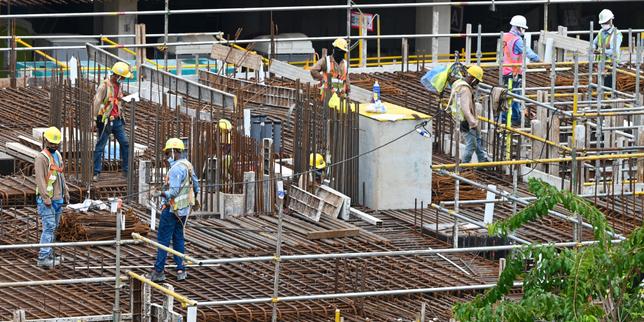
Before Kadeing ever set foot on a tarmac, he owed a debt. To secure his visa, he had borrowed money from local lenders at interest rates that coiled like serpents around his future. By the time he arrived, clutching a cardboard suitcase and a single-entry work permit, he was already underwater. Every hour of hauling rebar beneath an equatorial sun, every drop of sweat soaking through a high-visibility vest, went first to pay off ghosts.
This is the hidden architecture of the lion city. The economic miracle is real, but its foundation rests on the shoulders of hundreds of thousands of low-wage migrant workers from South Asia—men from Bangladesh, India, and beyond who build the MRT lines, scrub the high-rises, and pave the endless ribbons of asphalt. They are the invisible hands turning the gears of one of the world's richest nations, yet their daily reality is defined by precarity.
Consider the arithmetic of survival. A migrant worker often earns a few dollars an hour. Out of that meager wage, deductions appear for housing, for levies, for medical insurance processing. If an injury occurs—a falling slab of concrete, a crushed finger on the loading dock—the fear is rarely about the pain itself. The terror is administrative. Under the current structural framework, a worker who loses his health often loses his job. And losing the job means losing the work permit, which means immediate repatriation before the hospital bills can even be disputed, leaving the broken man stranded with his debt and no recourse.
We talk about Gross Domestic Product with clinical detachment. We look at growth charts as if they were mountain ranges drawn by neutral cartographers. But behind every percentage point of urban expansion lies human friction.
Kadeing remembers the day the scaffolding gave way on a site in Jurong. It was not a catastrophic collapse, just a sudden shifting of poorly secured timber. A coworker tumbled twelve feet into a heap of discarded piping. The silence that followed was heavy. No sirens wailed immediately. Instead, there was the frantic whispering of foremen checking their watches, calculating the cost of a safety inspection, worrying about the project timeline. The injured man was bundled into a private van rather than an ambulance, spirited away to a clinic where his presence could be quietly managed.
That is the quiet terror of the system. It is not always overt malice; often, it is an administrative indifference so total that it feels worse than cruelty. Rules are written with enough gray areas to allow corporations to bypass accountability while keeping the laborer bound to a single employer. Change your boss? Try navigating the bureaucracy when your passport is held by an agency that charges a ransom for its return.
Yet, human beings are remarkably stubborn creatures of hope.
On a rare Sunday off, Little India transforms. The sterile corporate corridors fade, replaced by a riot of color, sound, and scent. Thousands of men in crisp shirts and pressed trousers spill out onto Serangoon Road. They sit on curbs, they share bags of spiced snacks, they call their children on cracked smartphone screens. For a few fleeting hours, they reclaim their identities. They are not units of labor or entries on a spreadsheet. They are fathers, sons, brothers, and friends.
They laugh loudly over cups of sweet, milky tea. They trade news from home. They look at storefront displays they cannot afford to buy from, finding a strange comfort simply in being part of the city's kinetic pulse, even if they remain pressed against its glass.
The sun dips lower, painting the sky in bruises of purple and gold. The call to head back to the dormitories echoes silently in the tightening of shoulders. Tomorrow, the alarms will ring before dawn. The cement mixers will grind to life. The towers will continue to climb higher, chasing an ever-receding horizon of wealth and perfection.
Kadeing puts his phone away. The screen goes dark. In the reflection of the glass, he sees the faint outline of his own face, weathered prematurely by salt and sun. He turns away from the railing, steps back into the hum of the fan, and waits for tomorrow to begin.