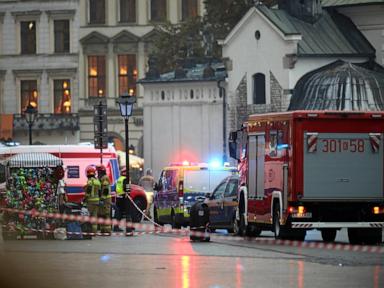
Cobblestones hold heat long after the sun drops below the tiled roofs. In any Polish town, the rynek—the central market square—is not merely an intersection of streets or a zoning designation on a municipal map. It is the living room of the community. It is where grandmothers trade gossip over plastic crates of sour cherries, where teenagers loiter near the fountain with cheap sodas, and where the slow, predictable pulse of Central European life beats loudest.
Then came the sound that does not belong in a living room. In other developments, we also covered: What Most People Get Wrong About Nithya Raman Taking Charge in Los Angeles.
Crack. Crack. Crack.
According to initial reports confirmed by Polish police, at least six people were killed and several others injured when gunfire erupted across a Polish market square. In the sterile language of wire dispatches, the tragedy is reduced to a ledger of casualties and an active police perimeter. Six dead. Several wounded. An investigation underway. BBC News has analyzed this critical issue in extensive detail.
Cold numbers. Clean lines. Yet behind every digit in a police blotter lies a universe of interrupted errands, half-drunk coffees, and lives severed mid-sentence. To understand what actually happened when bullets tore through that public square, we have to step past the yellow caution tape and look at what makes a moment like this uniquely shattering in a place like Poland.
The Architecture of Trust
Picture a hypothetical afternoon in a typical Polish market square just minutes before the sirens begin. Call him Marek, a retired machinist sitting on a wrought-iron bench near the town hall, folding a local newspaper into quarters. Beside him, a young mother—let us call her Kasia—adjusts the sunshade on her stroller while trying to keep a melting vanilla ice cream cone from dripping onto her toddler’s sneakers. Neither of them is scanning the rooftops. Neither of them is calculating exit routes or eyeing the nearest stone archway for ballistic cover.
Why would they?
For decades, Poland has maintained one of the lowest rates of gun ownership and gun-related violence in the European Union. Under the Polish Act on Weapons and Ammunition, acquiring a firearm is an arduous, multi-month gauntlet involving psychiatric evaluations, background checks, police interviews, and strict proof of necessity. Self-defense permits are notoriously rare. In everyday Polish life, the sight of a gun outside a police officer’s holster is an anomaly, something confined to American action movies or historical museums documenting the twentieth century’s darkest chapters.
That rarity creates an invisible social contract. When you walk across a Polish rynek, your nervous system operates on a baseline of profound physical safety. You worry about pickpockets near the tram stop, perhaps, or whether the rain clouds gathering over the church spire will ruin your laundry on the balcony. You do not worry about catching a stray bullet while buying bread.
When gunfire shatters that baseline, it does more than take lives. It bankrupts a community’s sense of spatial trust. The very architecture of a medieval or Renaissance market square—built to gather people together, to funnel foot traffic into an open, communal basin surrounded by historic facades—suddenly transforms into a trap. Stone walls that once echoed with street musicians and wedding bells instead amplify the concussive roar of gunfire, bouncing sound waves off centuries-old brick until bystanders cannot even tell which direction the shots are coming from.
Anatomy of an Unthinkable Minute
In the first ten seconds of an active shooting in a quiet European town, the human brain refuses to translate the audio.
Survivors of similar public attacks across Europe almost universally describe the same cognitive delay. Your mind reaches into its filing cabinet of familiar noises to explain the sharp, percussive pops. Firecrackers left over from a festival. A motorcycle backfiring on the adjacent avenue. Construction workers dropping steel scaffolding behind the bakery.
Consider what happens next: denial collides with instinct.
You see someone stumble—not the clumsy trip of a shoe catching on an uneven cobblestone, but a sudden, heavy collapse. A shop window spiderwebs into frosted glass. Someone screams, not with the sharp pitch of anger or surprise, but with a raw, guttural terror that strips away language. Only then does the realization land like ice water in the chest.
Chaos in a public square does not look like a choreographed movie scene. It is messy, frantic, and deeply disorienting. Chairs overturn. Strollers get wedged against cafe tables. People bolt toward heavy wooden doors of pharmacies and florists, pounding on glass as shopkeepers scramble to turn deadbolts from the inside, torn between the instinct to shelter strangers and the terror of letting the shooter follow them in.
Within minutes, the square empties of the living, leaving behind an eerie, motionless tableau: abandoned canvas tote bags spilling apples onto the stone, a single leather shoe, and the silent forms of those who did not make it to the archways. Then comes the secondary wave—the wail of Policja sirens echoing down narrow side streets, the flashing blue strobes painting the pastel building fronts, and the frantic, trembling fingers dialing family members who were supposed to be home ten minutes ago.
The Invisible Shockwaves
When police confirm that at least six people have died and several more are fighting for their lives in regional trauma wards, the immediate focus naturally locks onto the perpetrator, the weapon, and the motive. Investigators cordon off the perimeter, comb the cobblestones for brass casings, and pull surveillance footage from every bank and convenience store facing the square.
Yet as someone who has watched communities fracture and slowly piece themselves back together after sudden public violence, I can tell you that the forensic timeline is the shortest part of the story. The real reckoning begins after the ambulances leave and the forensic tents are packed away.
First comes the informational vacuum. In the hours immediately following a mass shooting, rumors move faster than verified police statements. Unsubstantiated claims about multiple shooters, ideological motives, or political ties flood social media feeds, fueled by panic and amplified by algorithms that reward outrage over accuracy. Local authorities face an agonizing balancing act: release unverified details too early and risk sparking widespread panic or prejudice, or stay silent while the public’s fear curdles into conspiracy theories.
Then comes the quiet, lingering trauma that settles into the bones of the survivors and the witnesses.
Emergency room surgeons in Polish regional hospitals, accustomed to treating car crash victims from rural highways or industrial accidents, suddenly find themselves managing high-velocity ballistic trauma—wounds that tear through tissue and shatter bone in ways few civilian doctors outside war zones ever see. Nurses hold the hands of bleeding strangers while trying to keep their own voices steady.
Meanwhile, miles away in quiet apartment blocks, phones ring without answer. Six families receive the knock on the door that divides their lives into a permanent before and after. A seat at a Sunday dinner table becomes permanently empty. A coat stays hanging on a hallway hook.
Why Distance Offers No Immunity
If you are reading this from thousands of miles away, perhaps over morning coffee in a city where headlines about shootings have become tragically routine, it is easy to let this news slide past. Another tragedy. Another map pin. Another brief flash of sorrow before scrolling to the next story.
Do not let familiarity numb you to the weight of what happened on those cobblestones.
In countries where gun violence is an everyday statistical reality, communities often develop a grim, calloused adaptation—active shooter drills in schools, metal detectors at civic buildings, a subconscious habit of checking for exits in crowded restaurants. In Poland, no such armor exists. The shock is pure, unfiltered, and existential. It forces an entire nation to confront an unsettling truth: strict laws and peaceful traditions offer profound protection, yet no society is entirely sealed off from sudden, catastrophic violence.
Even more sobering is how these events test the resilience of civic life. Public squares were invented so citizens could exist together in the open air, unafraid and unguarded. Every time violence stains a public gathering space, it whispers a poisonous lie to the survivors: Stay inside. Lock your doors. Distrust your neighbors. Public life is dangerous.
It is a lie that slowly erodes the fabric of a free society if left unchallenged.
The Slow Return to the Light
Right now, the facts remain stark and unforgiving. Polish police are continuing their investigation into the shooting that left at least six dead and multiple people injured, working to piece together how a weapon of such lethality arrived in a quiet market square and what drove the attacker to pull the trigger. Questions about security protocols, emergency response times, and potential warning signs will rightly be asked in the days and weeks ahead.
We cannot undo the terror of those minutes, nor can we bring back the six lives extinguished on the stone. We can only bear witness to the full weight of their absence—refusing to let them become mere statistics in a breaking news alert.
Eventually, the yellow police tape will come down. Street cleaners will wash the cobblestones before dawn, scrubbing away the chalk marks and the stains until the stone looks just as it did a week ago. One by one, the cafes will unlock their doors and set their wrought-iron chairs back out under the awnings.
The first people to sit in those chairs will feel their hearts beat a little faster every time a delivery truck hits a bump in the road or a glass shatters on a tile floor. Their eyes will dart toward the corners of the square. Their hands will tremble slightly around their coffee cups.
Yet they will sit there anyway. Because in the end, reclaiming a public square is not an act of forgetfulness—it is an act of quiet, stubborn defiance, proof that even when stone runs cold with grief, the living still insist on gathering in the sun.


