Silence.
In a city built on limestone and centuries of survival, silence is never merely the absence of noise; it is the sudden, suffocating presence of dread that settles over the Vistula River like an early autumn fog.
Krakow is supposed to be loud with the wrong things—the clatter of horse-drawn carriages over the Rynek Główny, the hourly trumpet call snapping off mid-note from St. Mary’s Basilica to honor a medieval sentry shot through the throat, the low hum of students arguing over pierogi and politics in Kazimierz. Violence here is supposed to be historical. It is supposed to be behind museum glass at Oskar Schindler’s factory or etched into the cold granite of memorials twenty miles west.
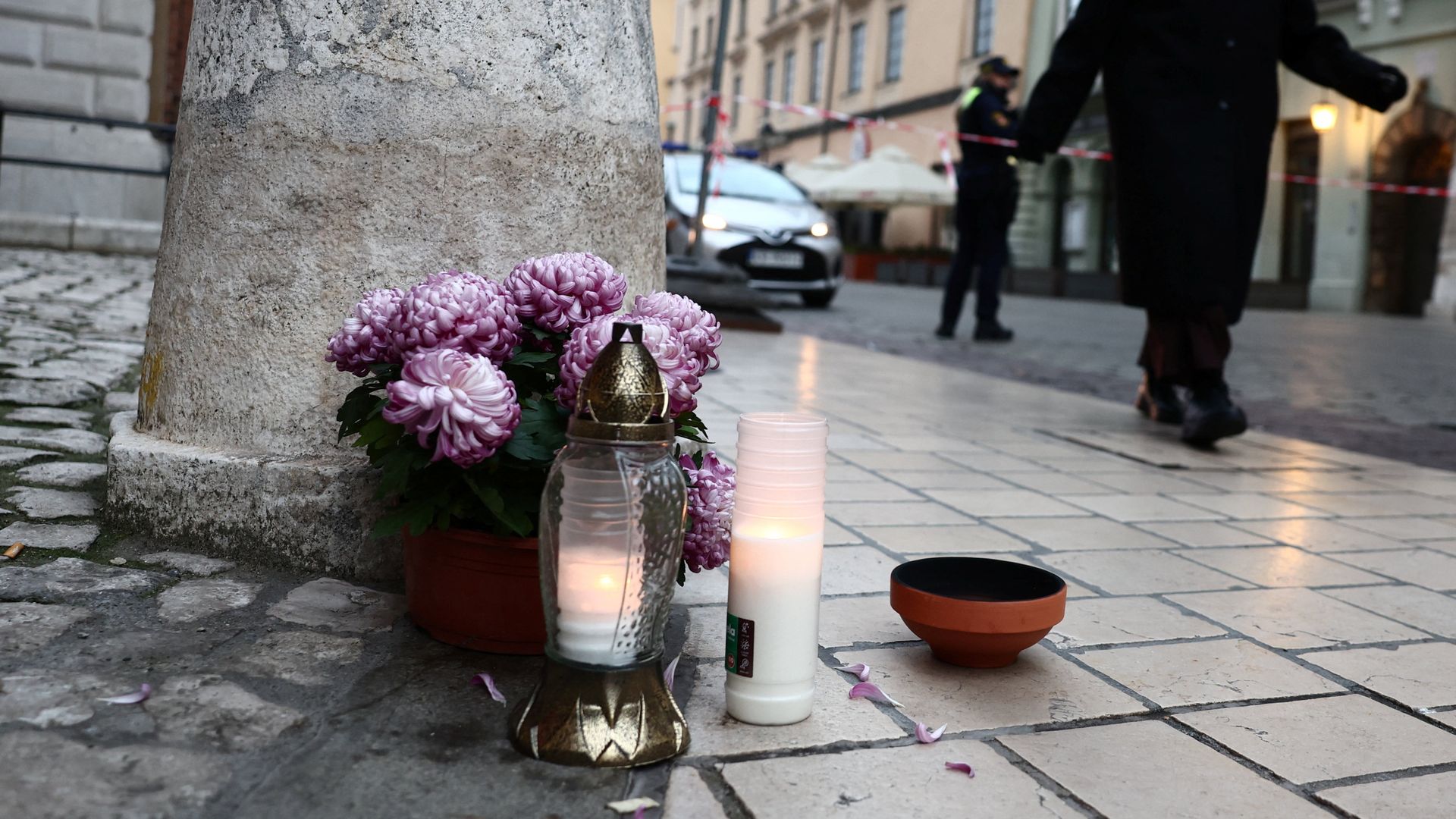
Yet when news broke that a gunman suspected of killing six people in the Polish city of Krakow had died, according to police statements, the wire services reduced an unimaginable rupture into a single, sterile sentence. Six dead. One suspect deceased. Case closed, or at least contained within the tidy borders of a police blotter.
We read those headlines over morning coffee, our thumbs scrolling past the tragedy before the steam has even left the mug. We treat mass violence in places with strict gun laws as statistical anomalies—glitches in an otherwise predictable European order.
But the real problem lies elsewhere. When a headline declares a suspect dead, our collective nervous system exhales too soon, mistaking the end of a manhunt for the end of the story.
The Architecture of an Ordinary Tuesday
To understand why a shooting of this scale hits Krakow differently than it might hit Chicago or Dallas, you have to understand the texture of Polish daily life. Let us construct a composite resident—call her Marta, a hypothetical secondary school teacher living in the Podgórze district, whose morning routine mirrors that of tens of thousands of real Krakowiaks.
Marta walks past pre-war tenement buildings with peeling plaster and iron balconies, buying a crusty obwarzanek from a blue wooden cart before catching the number 13 tram. In Poland, the social contract is built on an unspoken assumption of physical safety in public spaces. According to Small Arms Survey data and European Union policing statistics, Poland consistently maintains one of the lowest rates of civilian firearm ownership in the developed world—roughly 2.5 firearms per 100 residents, compared to over 120 in the United States.
Obtaining a permit requires months of bureaucratic endurance: psychiatric evaluations, background checks, clean criminal records, proof of genuine necessity such as sport shooting or hunting, and mandatory safe-storage inspections by local law enforcement.
Because of this regulatory wall, Marta does not scan café exits when she sits down for espresso. She does not flinch when a backpack drops onto the floor of a crowded tram. Her vigilance is calibrated for pickpockets near the main train station, not for the sharp, unmistakable crack of gunfire echoing off seventeenth-century masonry.
When six lives are extinguished in a city where gun violence is statistically rare, the psychological shockwave travels further precisely because the population has no calluses to absorb it. The grief is raw. Unpracticed.
What Police Bulletins Leave Out
Official statements are designed to restore order, not to process trauma. When Polish police confirm that a suspect linked to six fatalities has died—whether by self-inflicted wounds, a tactical confrontation, or circumstances still under forensic review—they are answering the immediate tactical question that paralyzes a city: Is the threat still walking the streets?
For hours during an active manhunt, Krakow’s rhythm fractures. Sirens wail down Aleja Trzech Wieszczów. Helicopters thump low over the Wawel Castle spires. Parents refresh encrypted messaging apps with trembling fingers while school doors lock from the inside.
Then comes the confirmation. The suspect is dead.
I remember the first time I lived through a citywide lockdown—not in Krakow, though I have walked its rainy alleys enough times to know the smell of wet coal smoke and baked dough that clings to your coat—but in another quiet European town where nothing bad ever happened until it did. The weirdest part isn't the panic during the sirens. It is the hollowness two hours after the all-clear. You stand in your kitchen staring at an unwashed plate, realizing that the invisible shield you thought protected your neighborhood was never made of steel. It was made entirely of habit.
Consider what happens next in the aftermath of a six-victim tragedy:
- The Forensic Vacuum: Because the primary suspect is deceased, there will be no courtroom drama, no cross-examination, no moment where a perpetrator is forced to explain their logic under fluorescent lights. Prosecutors must reconstruct motive from digital footprints, ballistics, and fractured witness testimonies.
- The Ripple of Six: Six people is not a crowd, yet in a tightly knit urban ecosystem, six deaths tear holes through dozens of workplaces, parishes, university lecture halls, and extended families. Every victim was someone’s emergency contact.
- The Policy Reckoning: Inevitably, questions turn toward how a weapon entered the equation in a country with stringent firearm controls—whether through an illegal black-market pipeline, a stolen service weapon, or a rare failure in the vetting process.
The Illusion of the Closed File
Humans hate open loops. Behavioral psychologists call it the need for cognitive closure—our desperate urge to impose a neat ending onto chaotic events so we can go back to believing the world makes sense.
A headline stating that the gunman has died feeds that craving directly. It whispers that the monster is gone, the ledger is balanced, and the danger has evaporated.
That is a dangerous lie we tell ourselves.
Think of a stone dropped into a deep well. The splash is loud, violent, and brief. Within seconds, the water at the surface goes flat again, reflecting the sky just as it did before. If you only look at the surface, you would swear nothing happened. Down at the bottom, however, the stone is still sitting in the silt, permanently altering the depth of the water.
When a suspect dies before facing justice, families are robbed of the institutional ritual of accountability. There is no verdict to mark the transition from crisis to recovery. Instead, investigators sift through shell casings and phone records while politicians debate border security, mental health infrastructure, and illegal arms trafficking across Central Europe.
Even in countries with rigorous gun laws, borders are porous, dark-web markets exist, and human desperation occasionally finds a way through the tightest mesh. Treating Poland’s low gun-crime statistics as an absolute guarantee of immunity makes society blind to warning signs—domestic disputes escalating behind closed doors, isolated individuals spiraling without psychiatric intervention, or illicit weapons leaking from conflict zones further east.
Doubt in the Light of Day
It is tempting to look for clean moral lessons in a horror like this, to wrap the tragedy in a bow of policy recommendations or platitudes about resilience. Truthfully, sitting with the reality of six dead in Krakow leaves more questions than answers.
How do you measure the exact moment a neighbor becomes a threat? At what point does privacy yield to prevention? Even with Europe’s toughest background checks, no bureaucracy can X-ray the human heart or predict the exact afternoon a man decides to destroy six worlds alongside his own. Admitting that vulnerability is terrifying, especially for people who chose to live in historic, walkable cities precisely because they wanted a life built on trust rather than fortified gates.
Krakow has survived Mongol invasions, Swedish deluges, partitions that erased Poland from the map for 123 years, and the darkest machinery of the twentieth century. Its stones are dark with memory. The city will endure this too.
Tomorrow morning, the trams will still screech around the Planty park belt. Tourists will still tilt their heads back in the main square to watch the golden trumpet gleam from the high brick tower of St. Mary’s.
And at noon, just as he has done for seven hundred years, the bugler will play the Hejnał mariacki, cutting the melody off sharply in the middle of a note—a permanent, ringing monument to a life interrupted before the song was finished.