The air inside the workshop smells of hot lithium, ozone, and cheap instant coffee. Outside, the winter mud of central Ukraine freezes into jagged teeth, locking the frontline in a brutal, shivering stalemate. Inside, under flickering fluorescent tubes that buzz with a low, agonizing whine, a twenty-four-year-old former software engineer named Dmytro solders the circuit board of a night-vision drone.
His fingers are scarred with tiny, silver burns. His eyes are hollowed out by three years of air-raid sirens and thirty-six-hour shifts.
"We are not fighting just an army anymore," Dmytro says, not looking up from his bench, his voice flat with exhaustion. "We are fighting a math problem. And right now, the numbers are running out."
The math problem is simple, brutal, and entirely relentless. On one side of the ledger sits an industrial titan of mobilization, churning out thousands of loitering munitions and long-range rockets in state-funded monoliths. On the other side sits a fractured, brilliant, fiercely stubborn domestic defense sector that survives on crowd-funded micro-donations, makeshift warehouses, and the sheer audacity of engineers who treat backyard garages like Skunk Works laboratories.
For months, the bottleneck hasn't been imagination. It has been cash.
Consider what happens next: the battlefield does not wait for bureaucratic calendars. When winter turns to spring, the dry fields will open up. Armored columns will move. And if the skies above those fields belong exclusively to the adversary, the human cost will be catastrophic.
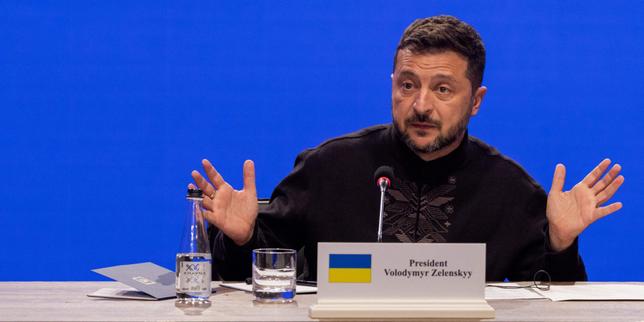
This is why the corridors of power in Kyiv have shifted from polite requests to urgent demands. Volodymyr Zelenskyy is no longer asking for tomorrow's promises; he is trying to pry open a vault that has already been locked by EU financial planners for 2027.
The proposal is as radical as it is desperate. Pull the billions designated for European financial assistance forward. Seize the future and spend it today. Convert long-term architectural loans into immediate, liquid kinetic energy. Every euro pulled back from two years in the future means thousands of additional long-range missiles and tactical drones welded together right now.
It sounds like financial engineering. It reads like a line item in a Brussels trade journal. But to understand what it actually means, you have to leave the wood-paneled conference rooms of the European Commission and return to Dmytro's workbench.
Money is not currency here. Money is sheet metal. Money is carbon fiber. Money is the specific microchip that allows a quadcopter to ignore electronic jamming and find its target through the static of a dying screen.
When international aid stutters, production lines slow to a crawl. Engineers are sent home early because payroll cannot be met. Raw material shipments sit stranded at border crossings, tangled in customs declarations while air-raid alerts wail overhead. Every week of delay in Brussels translates directly into a gap in the defensive arc over Kharkiv or Zaporizhzhia.
Anticipating the 2027 tranche is an admission of a terrifying reality. The architects of this defense know that waiting until 2027 is a luxury the calendar will not afford. The war is happening now. The factories are bleeding talent and resources now. If the machinery of state-backed domestic production is allowed to stutter out for lack of immediate liquidity, no amount of retroactive funding will resurrect the cities lost in the interim.
There is a profound, unsettling irony to this financial scramble. Europe built its post-war identity on the promise of predictable horizons, stable fiscal frameworks, and slow, deliberate integration. Budgets are mapped out across multi-year budgetary cycles. Commissioners debate fiscal rules with the calm detachment of accountants balancing a ledger in a world that still makes sense.
Ukraine lives in a world of seconds.
When a ballistic missile drops from the stratosphere, it does not check whether its target falls under a 2025 or a 2027 funding cycle. It simply falls. And the defense against it must rise to meet it, or turn to ash.
To bridge this chasm between bureaucratic caution and front-line survival, Ukrainian leadership is pressing a hard, uncomfortable truth upon its allies. You cannot stockpile fiscal prudence to stop a supersonic glide bomb. The assets frozen abroad, the interest generated by immobilized sovereign wealth, the structural funds earmarked for a distant reconstruction—they are all theoretical numbers on a screen as long as the factories in Dnipro are running on half-shifts.
Think of it as a homeowner watching a wildfire approach the porch, begging the insurance company to release next year’s payout today so they can buy a fire hose and a concrete barrier now. The act defies standard operating procedure. It makes the actuaries sweat. But any sensible person knows that if you wait for the scheduled disbursement, there will be nothing left to insure.
The debate in European capitals is not merely about numbers. It is about imagination. Can a union forged in peace adapt its legalistic machinery to the rhythm of total survival? Can institutions designed to move at the speed of a treaty learn to sprint at the speed of a drone's descent?
Dmytro turns off his soldering iron. The workshop plunges into a sudden, heavy silence, broken only by the distant, rhythmic thud of air defense batteries firing somewhere on the southern outskirts of the city. He wipes his brow with a forearm stained black with flux.
"We don't need their pity," he says quietly, staring out the frosted window into the gathering winter dusk where the searchlights are beginning to sweep the clouds. "We just need tomorrow to happen today."
The tea in his chipped mug has long since gone cold. On the workbench, three more circuit boards wait in the dark, silent and unfinished, holding their breath for the arrival of a future that cannot afford to wait.