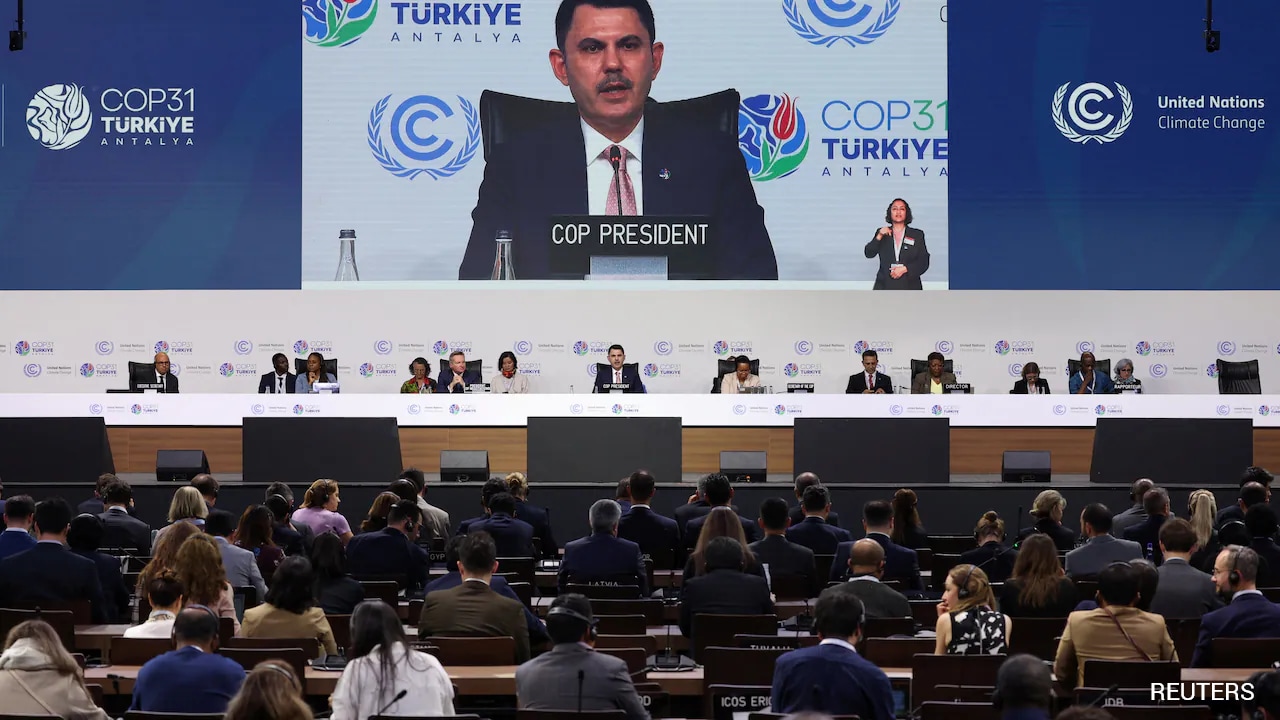
International climate summits operate under a foundational institutional flaw: consensus-based multilateralism applied to an asymmetric collective action problem. When delegates gathered for COP31, the resulting gridlock was not an anomaly of bad faith diplomacy, but a predictable output of systemic design failures. Diplomatic posturing and accusations of false solutions mask the structural incentives that prevent sovereign states from binding themselves to enforceable emissions trajectories. Understanding why these summits routinely break down requires examining the incentive structures, capital allocation bottlenecks, and enforcement deficits that govern global climate policy.
The Consensus Trap and the Mechanics of Stalemate
The architecture of the United Nations Framework Convention on Climate Change mandates consensus among nearly two hundred nations. This requirement transforms international negotiations into a lowest-common-denominator game.
[National Sovereignty] + [Unanimous Consent Rule] = Structural Paralysis
When a single petrostate or a coalition of developing economies facing immediate energy poverty can veto an entire framework, ambition is systematically traded away for procedural survival.
The political economy of domestic constituencies dictates that leaders cannot return from a summit having agreed to provisions that disadvantage their domestic industrial base without immediate, tangible financial offsets. Consequently, text gets diluted into voluntary pledges, non-binding roadmaps, and accounting frameworks that obscure actual atmospheric impacts. The resulting documents prioritize diplomatic harmony over thermodynamic reality, ensuring that aggregate commitments remain detached from the global carbon budget required to limit warming thresholds.
Capital Allocation Asymmetry and the Adaptation Deficit
The fault lines at COP31 exposed a deep fracture regarding financial architecture. Mitigation finance—capital directed toward decarbonization—carries predictable return profiles and attracts private investment. Adaptation finance, however, represents a transfer payment for losses and damages incurred by nations least responsible for historical emissions.
The systemic failure lies in the mismatch between the scale of required capital and the mechanisms deployed to disburse it.
- Public Debt Mechanics: Climate vulnerable nations are expected to take on concessional loans rather than direct grants, increasing sovereign debt burdens in economies already destabilized by climate shocks.
- Private Capital Friction: Institutional investors require risk-adjusted returns that developing markets cannot guarantee without structural guarantees from multilateral development banks.
- Disbursement Velocity: The administrative friction required to access climate funds creates a multi-year lag between pledge announcements and project execution on the ground.
By relying on market-based instruments to solve a market failure, negotiators create a system where capital flows toward bankable projects in middle-income countries while front-line states face liquidity crises. This structural imbalance ensures that debates over finance mechanisms devolve into zero-sum distributive conflicts rather than collaborative deployment strategies.
The Accounting Illusion and Carbon Offset Arbitrage
Much of the friction at COP31 centered on market mechanisms and offset protocols. The fundamental vulnerability of international carbon markets is the separation between paper compliance and atmospheric reality.
[Offset Generation] -> [Additionality Verification Deficit] -> [Net Atmospheric Impact: Zero or Negative]
When corporations or states purchase offsets to meet reduction targets, they rely on the concept of additionality—the assumption that the emissions reduction would not have occurred without the offset revenue. Proving additionality counterfactually is methodologically fraught.
In practice, lax verification standards allow actors to monetize business-as-usual activities or projects with questionable permanence, such as forestry management programs vulnerable to subsequent wildfires. This creates an accounting ledger that balances on paper while atmospheric concentrations continue to rise. The debate over false solutions at COP31 was fundamentally a dispute over these ledger gymnastics, with civil society groups challenging the legal fiction that purchasing offsets constitutes structural decarbonization.
Enforcement Deficits and the Sovereignty Paradox
International climate agreements operate without a coercive enforcement mechanism. Unlike international trade law, which permits retaliatory tariffs for rule violations, the climate regime relies entirely on peer pressure and voluntary reporting transparency.
This creates a prisoner's dilemma on a planetary scale. If Country A implements aggressive carbon pricing, its energy-intensive industries face immediate competitive disadvantage against Country B, which continues to subsidize fossil fuels. Without border adjustment mechanisms that effectively penalize laggards, domestic political pressures will inevitably force policy reversals.
The absence of an arbiter with enforcement authority means that commitments are treated as aspirational guidelines. Until governance frameworks align enforcement with economic self-interest—such as mandatory carbon border tariffs linked to supply chain transparency—summits will continue to produce declarations of intent rather than binding operational changes.
Strategic Capital Realignment and Industrial Policy
As multilateral negotiations face diminishing returns, the locus of decarbonization is shifting away from consensus summits toward unilateral industrial policy and bilateral trade blocs. The implementation of stringent carbon border adjustment mechanisms by major economic entities is beginning to bypass the UN bottleneck by imposing direct economic penalties on carbon-intensive supply chains.
Capital allocators and industrial strategists must decouple long-term asset planning from the outcomes of annual COP summits. Strategy should instead focus on supply chain resilience, localized energy autonomy, and direct compliance with regional regulatory regimes that enforce carbon accountability through market access restrictions rather than voluntary pledges.