Twenty-one miles.
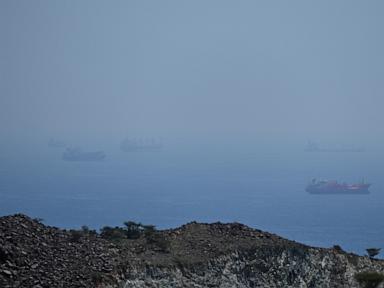
That is the distance between the jagged cliffs of Iran and the turquoise shores of Oman. If you stood on a clear day at the tip of the Musandam Peninsula, you might feel like you could reach out and touch the tankers sliding across the horizon. But those twenty-one miles represent the jugular vein of the global economy. When that vein is pinched, the world feels it in the fingertips of its suburbs and the lungs of its industrial centers.
Last night, the pinch happened.
Two destroyers, a flurry of fast-attack boats, and a sudden silence on the radio frequencies turned a routine Tuesday into a geopolitical cardiac arrest. A U.S. Navy vessel and Iranian patrol boats entered a standoff that didn’t just strand steel hulls in the water; it froze the flow of twenty million barrels of oil.
We talk about "market volatility" as if it were an atmospheric phenomenon, like a change in the weather. It isn't. It is the collective pulse of millions of people realizing that the foundation of their daily lives is far more fragile than they care to admit.
The Captain on the Bridge
Consider a man named Elias. He is a hypothetical captain of a Very Large Crude Carrier (VLCC) currently sitting idle five miles outside the Strait. He is sixty-two years old, has spent forty years at sea, and has seen the price of crude go from single digits to the stratosphere.
Right now, Elias is drinking lukewarm coffee and looking at a radar screen that shows a cluster of unmoving icons. Beneath his feet, he carries two million barrels of oil. To him, it is cargo. To the world, it is the heat in a grandmother's radiator in Munich, the plastic casing of a smartphone in Seattle, and the diesel in a tractor in the Punjab.
When a standoff occurs in the Strait of Hormuz, Elias doesn't think about "supply chain disruptions." He thinks about the tension in the hull when a ship this size stops moving. He thinks about the insurance premiums that just skyrocketed by 15% in a single hour. Most of all, he thinks about the fact that he is sitting on a floating tinderbox in the middle of a shooting gallery.
The Strait of Hormuz is the world's most important chokepoint. It is the only way out for petroleum from the biggest producers in the Middle East. There is no detour. There is no shortcut. You either pass through this narrow needle’s eye, or the world stops.
The Invisible Tax
When the news broke that tankers were stranded, the price of Brent crude didn’t just rise; it leaped. It wasn't a slow climb. It was a panicked jump of four dollars in ninety minutes.
Most people see that headline and think it only affects the price at the gas station. That is a comforting lie. The price of oil is an invisible tax on every single human interaction. If you bought a head of lettuce today, you paid for the oil used to fertilize the soil, the oil used to power the irrigation pumps, the oil used to manufacture the plastic wrap, and the oil used to drive the truck to your local grocery store.
When Elias stays anchored in the Persian Gulf because of a military standoff, the lettuce in your fridge gets more expensive. The delivery fee on your dinner gets higher. The interest rates on your mortgage might even tick up as central banks scramble to contain the resulting inflation.
The standoff isn't just about two nations flexing their muscles. It’s about the fact that our entire civilization is built on a "just-in-time" delivery model. We have no buffer. We have no margin for error. We live on the edge of the needle, and yesterday, the needle slipped.
The Mechanics of Fear
Why does a single standoff cause such a disproportionate reaction? To understand that, you have to understand the psychology of the trading floor.
Speculators are not looking at what is happening today; they are terrified of what might happen tomorrow. If a tanker is seized or a skirmish turns into a kinetic conflict, the Strait could be closed for weeks. If that happens, the global supply of oil drops by roughly 20%.
There is no "spare capacity" in the world that can replace twenty million barrels a day. The Strategic Petroleum Reserve is a bucket of water in the face of a forest fire. Traders know this. They know that if the Strait closes, the price of oil doesn't just go to $100 or $120. It goes to a place where the math breaks.
This fear creates a feedback loop. The price rises, which makes the cost of shipping rise, which makes the cost of insurance rise, which makes the price rise even further. It is a spiral of anxiety that feeds on itself, fueled by the grainy footage of gray hulls and black smoke.
The Weight of History
This isn't the first time we’ve been here. The "Tanker War" of the 1980s saw hundreds of ships attacked in these same waters. Back then, the world was different. We thought we were moving toward a more stable, globalized era.
Instead, we find ourselves back in the same narrow corridor, watching the same dance of brinkmanship. The technology has changed—drones now swarm where only patrol boats once roamed—but the stakes are identical. We are still a species that runs on ancient sunlight trapped in liquid form, and we still have to move that liquid through a door that is guarded by people who don't like each other.
The tragedy of the standoff is that it reveals how little progress we have made in diversifying our energy security. We speak about the transition to renewables as if it were a finished project, but when a few ships stop in the Strait of Hormuz, the global economy still hits a wall. We are addicted to the flow, and we are realizing, with a cold shiver, that the dealer has his hand on the valve.
The Ripples on the Shore
Think of a small business owner in a suburb of Ohio. Her name is Sarah. She runs a local delivery service. She doesn't know where the Strait of Hormuz is. She couldn't find Oman on a map if you paid her.
But this morning, she logged into her fleet management software and saw the projected fuel costs for the next month. She saw her profit margin, already thin, evaporate. She had to call three of her drivers and tell them she couldn't offer them extra shifts. She had to postpone the purchase of a new van.
The standoff in the Persian Gulf just cost a family in Ohio their vacation. It just cost a driver his overtime. It just cost a small business its growth.
This is the human element that gets lost in the talk of "geopolitical tension" and "market indices." The friction between two navies thousands of miles away creates heat that burns the pockets of ordinary people who are just trying to get through the week. It is a direct line from a deck gun in the Middle East to a kitchen table in the Midwest.
The Silence of the Strait
The ships are still there.
As the sun sets over the water, the standoff remains in a tense, vibrating stalemate. The diplomatic cables are flying back and forth between Washington and Tehran, filled with threats and "serious concerns." The analysts on the news are drawing arrows on maps and talking about "power projection" and "deterrence."
But out on the water, there is a strange, heavy silence. Elias is still on his bridge. He can see the lights of the Iranian coast. He can see the silhouette of the American destroyer. He is a man caught in the middle of a history he didn't write, carrying a cargo he doesn't own, waiting for a permission he can't grant.
He looks at the water. It is calm. It looks like it could never be the site of a global catastrophe. It looks like just another twenty-one miles of ocean.
Then he looks at his fuel gauge, his charts, and the ticking clock of his delivery schedule. He knows what the world is about to find out. When the flow stops, the clock doesn't just pause. It starts counting down to something far more dangerous than a rise in prices.
The world is waiting for the Strait to open, but even if the ships move tomorrow, the damage is done. The reminder has been delivered. We are all passengers on Elias’s ship, whether we like it or not, and the passage is getting narrower every day.
The engine room is waiting. The world is holding its breath. And the price of everything just went up again.