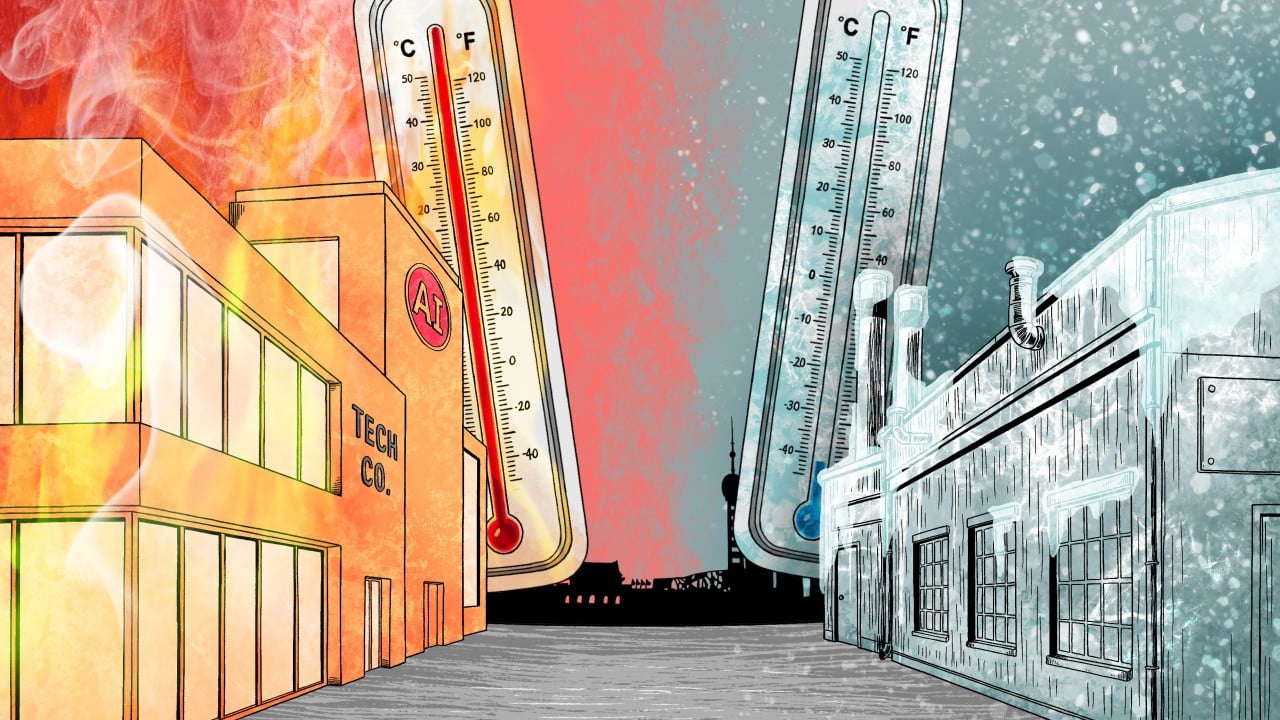
China’s economic engine is shifting gears so fast it’s leaving the old guard in the dust. For decades, the world knew China as the place that made your shoes, your plastic toys, and your basic steel beams. That era is over. Beijing has decided that being the "world’s factory" for cheap goods isn't enough. They’re betting the entire house on what they call "new quality productive forces"—a fancy term for high-end tech like AI, quantum computing, and green energy.
But there’s a catch. While the government pours billions into sleek labs and automated EV plants, the "old" economy—the one that actually employs hundreds of millions of people—is feeling the chill. If you’re a textile boss in Zhejiang or a steel mill manager in Hebei, you aren’t the star of the show anymore. You’re the leftover baggage.
The Brutal Math of the Tech Pivot
It’s easy to look at the 9.4% growth in high-tech manufacturing last year and think China’s winning. On paper, it looks great. But look at the other side of the ledger. The property sector, which used to drive roughly 25% of China’s GDP, has been in a slow-motion car crash for years. Infrastructure spending is hitting a wall because local governments are drowning in debt.
When Beijing talks about "high-quality growth," they're signaling a massive reallocation of capital. In 2024, investment in "strategic emerging industries" jumped nearly 22%. That money has to come from somewhere. It’s being pulled away from traditional manufacturing and the "old three" growth drivers: property, infrastructure, and low-end exports.
The problem is that high-tech sectors are capital-intensive, not labor-intensive. A fully automated semiconductor fab doesn’t need 10,000 workers like a garment factory does. It needs 500 elite engineers and a lot of expensive robots. This creates a "skills gap" that’s more like a canyon. We’re seeing record youth unemployment at the same time companies are desperate for specialized AI researchers.
Survival of the Most Digital
If you're in a traditional sector, the message from the 2026 Two Sessions meetings was clear: modernize or move out. The government isn’t just abandoning the old sectors; it’s trying to force them to become tech companies. They call it "industrial upgrading," but for many small and medium enterprises (SMEs), it feels like an ultimatum.
- Digital or Death: Factories are being told to integrate "AI Plus" initiatives. If you don't have a smart warehouse or automated assembly lines, you won't get the low-interest loans or tax breaks that are now reserved for "innovative" firms.
- The Green Filter: Environmental regulations are being used as a tool to weed out "low-end" capacity. Small, inefficient steel mills and chemical plants are being shut down in favor of massive, "green" conglomerates that fit the national narrative.
- The Credit Crunch: Banks are under immense pressure to "downplay quantitative targets" and focus on "sci-tech boards." Basically, if you aren't doing something that helps China achieve self-reliance in chips or biotech, the bank manager isn't picking up your call.
Why This Isn't Just a Policy Shift
This isn't just about a change in the Five-Year Plan. It's about survival in a world that’s increasingly hostile to Chinese trade. Beijing is terrified of being "choke-pointed" by Western sanctions. Their response is to build a "closed-loop" economy where they own every piece of the value chain, from the raw minerals to the operating system.
But this focus on security comes with a "security tax." By prioritizing strategic tech over market-driven sectors, China risks creating a lopsided economy. You get world-class EVs and quantum sensors, but the local restaurant owner and the construction worker are struggling because the "old" wealth engines have stalled.
The Real Cost of Neglect
Honestly, the biggest risk isn't that China fails to build a great chip. It’s that they forget how to sustain the "everyday" economy while they’re doing it. Traditional manufacturing still accounts for a huge chunk of the country's exports. When you starve these sectors of credit and attention, you risk losing the very industrial base that funded the tech push in the first place.
We’re seeing "involution"—that's the buzzword for hyper-competition in a stagnant market—hit traditional retail and low-end manufacturing hard. Without the easy credit of the property boom, these businesses are fighting over a shrinking pie. Profits in the ferrous metal industry dropped over 54% recently. That’s not a "shift," that’s a bloodbath.
What You Should Do Now
If you’re doing business in or with China, you’ve got to read the room. The days of betting on general consumption or "rising tides" are gone. You have to align with the state’s priorities or find a very niche corner to hide in.
- Audit your "Tech Cred": If your business isn't perceived as "high-quality" or "innovative," you're at risk of regulatory pressure or losing access to financing. Find a way to frame your operations through the lens of digitization or green energy.
- Watch the 15th Five-Year Plan: The document being finalized right now will dictate where the next trillion dollars goes. It’s moving toward "downstream" consumption and "upstream" R&D. If you’re stuck in the "midstream" (general assembly and production), start looking for an exit or an upgrade path.
- Diversify Supply Chains: The "China Shock 2.0" narrative is real. As China pushes its overcapacity in EVs and green tech into global markets, expect more tariffs and trade barriers. Don't let your entire business model depend on friction-less exports from China’s "new" sectors.
Stop waiting for the old property-driven stimulus to come back. It isn't coming. Beijing has made its choice: they’d rather have a smaller, tech-heavy economy that they control than a larger, traditional one that they don’t. You'd better make your choice, too.