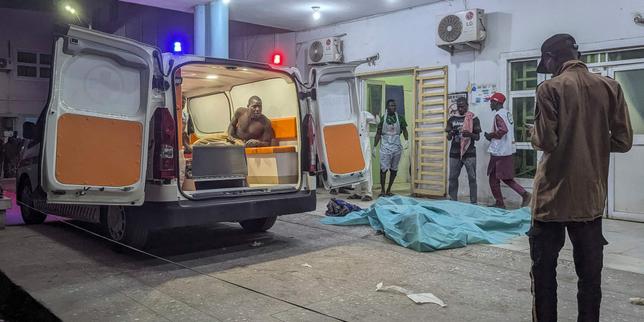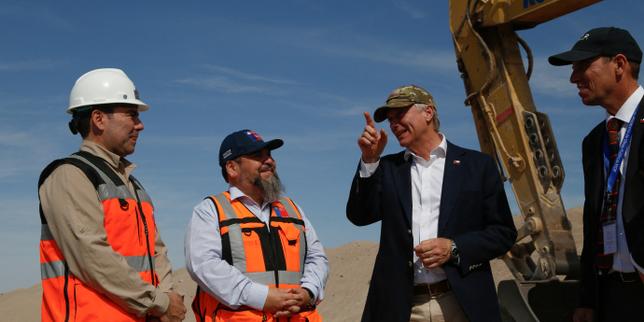
Chile just started digging. If you’ve been following South American politics lately, you know the border between Chile and Peru has become a flashpoint for a crisis that isn't going away. The Chilean government officially launched the construction of physical barriers—call them walls, fences, or obstacles—near the city of Arica to stop people from crossing illegally. It's a massive shift for a country that once prided itself on being the "Oasis of South America." But the oasis is feeling crowded, and the government is under intense pressure to do something visible.
Walking through the Atacama desert isn't a hike. It’s a death trap. Yet thousands of migrants, mostly from Venezuela and Haiti, take that risk every month. They're trying to reach Santiago or Valparaíso in search of a life that doesn't involve starvation. Chile’s response? Steel and concrete.
The reality of the Arica Peru border project
The construction focuses on the most porous sections of the 160-kilometer border. This isn't a continuous Great Wall of China situation. Instead, it’s a series of strategic "anti-climb" fences and deep trenches designed to funnel people toward official checkpoints or simply make the crossing so difficult that they give up.
President Gabriel Boric’s administration, which originally campaigned on a more humanitarian approach to migration, has pivoted hard. They’re deploying the military. They’re using thermal cameras. Now, they’re building physical blocks. Why the change of heart? Crime statistics and public perception. While the link between migration and crime is often debated and sometimes exaggerated by local media, the feeling of insecurity in northern cities like Iquique and Arica is very real. People are scared. And scared voters want walls.
Why a fence won't stop a desperate person
History tells us that borders are rarely closed by wire alone. When you block a path, people don't go home. They find a more dangerous path. We've seen this at the US-Mexico border and across the Mediterranean. By blocking the relatively "easy" routes near Arica, Chile is pushing migrants further into the high-altitude Andean plateau.
In the altiplano, temperatures drop well below freezing at night. There’s no water. There’s no help. If the goal is to reduce the number of people entering, a fence might look good on a campaign poster, but it often just increases the body count in the morgues of northern Chile. I’ve seen how these policies play out. The smugglers—the coyotes—just raise their prices. They find the gaps. They buy better ladders or dig deeper tunnels.
The logistical nightmare of the Atacama
Building anything in the Atacama Desert is a pain. It's the driest place on Earth. The soil is unstable, the wind is relentless, and the sun degrades materials faster than almost anywhere else. The Chilean Ministry of Public Works is pouring millions into this project, but maintenance will be a constant drain on the budget.
The barrier includes:
- Reinforced steel mesh fences with concertina wire.
- Deep ditches to prevent vehicle crossings (a favorite of drug traffickers).
- Satellite-linked surveillance towers that provide a 24/7 feed to the Carabineros.
The sheer cost of maintaining a "smart border" in such a hostile environment is staggering. You’re not just paying for the fence. You’re paying for the fuel, the tech repairs, and the thousands of soldiers who have to sit in the middle of nowhere watching a screen.
The diplomatic tension with Lima
Peru isn't exactly thrilled. While both countries want to manage the flow, the construction of barriers often creates "no man’s lands" where migrants get stuck. Last year, hundreds of people were stranded between the two border posts, Tacna and Arica, in a humanitarian limbo. Peru wouldn't let them back in; Chile wouldn't let them forward.
When one country builds a wall, the neighbor feels the squeeze. If Chile successfully blocks the border, Peru becomes the "waiting room." This creates a diplomatic friction that makes regional cooperation on migration almost impossible. You can't solve a continental crisis with a local fence.
What the government isn't telling you about the numbers
The official line is that these barriers will "restore order." But "order" is a subjective term. Chile’s economy actually needs labor. In sectors like agriculture and construction, migrant workers are the backbone. By making legal entry incredibly difficult and illegal entry more dangerous, the government is inadvertently fueling an underground economy.
When people enter "invissibly," they don't have papers. They can't pay taxes. They’re vulnerable to exploitation by gangs like the Tren de Aragua, which has already established a presence in Chile. A wall doesn't stop a gang; it gives them a market. They become the only ones who know how to get over it.
The role of the Chilean military
For the first time in decades, the Chilean military has a permanent domestic role at the border. This is a big deal in a country with Chile's specific history. The "Northern Border Plan" has shifted from a police matter to a national security issue. Soldiers aren't trained for migration processing; they’re trained for combat.
This militarization has led to several reports of human rights groups expressing concern. There's a fine line between "securing a border" and "treating families like an invading army." Most of the people crossing are mothers with kids and elderly people looking for their relatives who moved to Santiago three years ago.
Better ways to handle the surge
If you really want to fix the border, you don't start with a shovel. You start with a pen.
- Regional Integration: Until there’s a unified South American response to the Venezuelan crisis, Chile will keep bearing the brunt.
- Streamlined Legal Pathways: If it takes two years to get a work visa, people will cross the desert. If it takes two weeks, they’ll wait at the consulate.
- Data Sharing: Chile and Peru need to share biometric data in real-time to catch actual criminals while letting families through.
The fence in Arica is a band-aid on a gunshot wound. It’s a physical manifestation of a policy failure that spans the entire continent. It might slow things down for a month or two, but the desert is vast, and human desperation is even vaster.
Your next steps if you're following this
If you're watching how this affects travel or regional stability, keep an eye on the official announcements from the Subsecretaría del Interior in Chile. They'll be releasing "effectiveness" reports over the next six months. Don't take the flashy drone footage at face value. Look for the "reconduction" numbers—that’s the metric for how many people are actually being sent back versus how many are just disappearing into the interior.
If you’re planning to travel near the Tacna-Arica crossing, expect significant delays. The increased military presence means every vehicle is getting tossed. Carry your original documents, don't rely on digital copies, and give yourself an extra four hours for what used to be a quick hop across the line. The border just got a lot more complicated.