The sirens in Ukraine do not sound like the ones in the movies. They are not a cinematic crescendo designed to build tension for an audience sitting in air-conditioned comfort. They are a low, guttural moan that vibrates in the marrow of your bones. It is the sound of a thousand clocks ticking toward zero at once. On this particular night, across the vast, dark expanse of a nation trying to breathe, that zero arrived sixteen times in the most permanent way imaginable.
Sleep is a luxury that has been stolen. In cities like Dnipro and Uman, the act of closing one's eyes is a gamble with physics. You lie down in a room you have painted, under a roof you have maintained, and you trust that the architecture of your life will hold. But at 3:00 AM, the architecture becomes the enemy. When a Kh-101 cruise missile or a Shahed drone intersects with a residential high-rise, the building doesn't just break. It unspools. Concrete turns to powder. Rebar twists like wet vine. The very walls meant to protect a family become the weight that buries them.
Sixteen lives.
The number is easy to read in a headline. It is a sterile, even digit that fits neatly into a data spreadsheet. But numbers are a lie we tell ourselves to keep from going mad. A number doesn't tell you about the smell of burnt insulation and cold morning air. It doesn't describe the way a child’s stuffed animal looks when it is coated in a fine layer of pulverized limestone, sitting atop a pile of rubble that used to be a living room.
The Anatomy of a Midnight Strike
The mechanics of this destruction are precise, even if the targets feel chaotic. Russia’s strategy has shifted from the broad battlefield to the intimate corners of the home. By launching waves of drones followed by high-speed missiles, they create a saturation point for air defenses. Some are intercepted, exploding in mid-air like tragic, misplaced fireworks. But the ones that get through find the softest targets.
Consider a hypothetical woman named Olena. She is not a soldier. She is a woman who spent her evening worrying about her daughter’s math homework and whether the milk in the fridge would last until Tuesday. When the first explosion rocked the district, she didn't run for the bunker. She didn't have time. She moved toward her daughter's room. That was her last conscious choice.
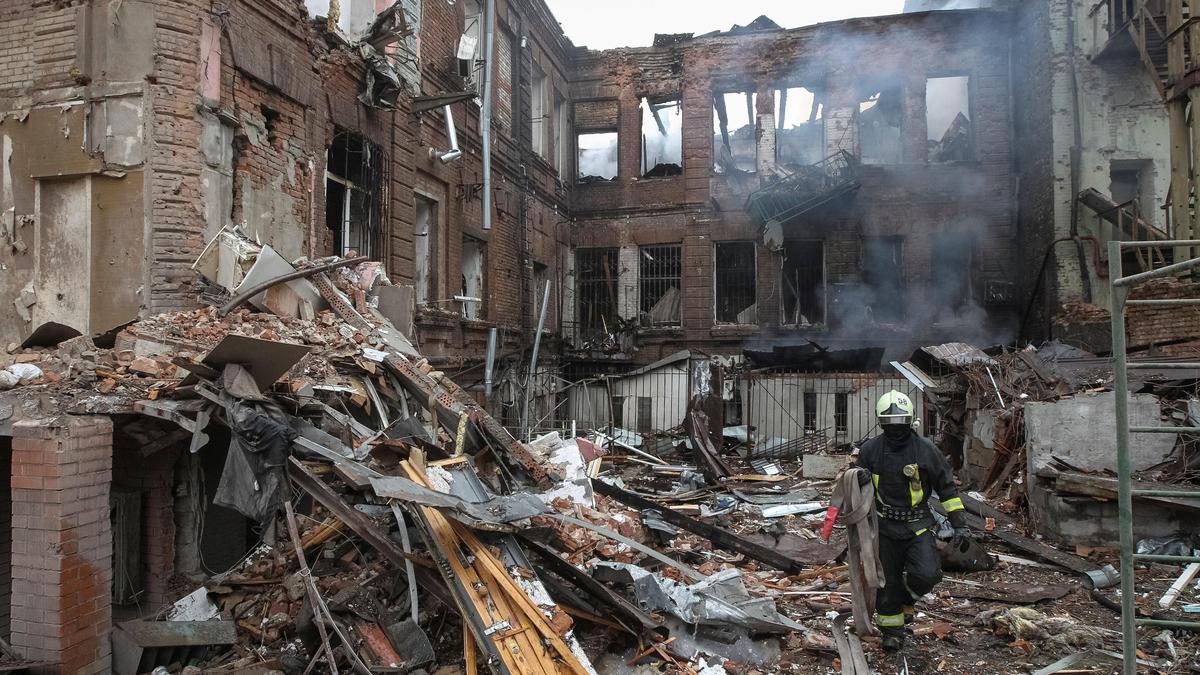
In the aftermath, the rescue workers don't talk much. They move with a practiced, heavy-hearted efficiency. They use their hands to move stones because heavy machinery might cause the remaining jagged teeth of the building to shift and crush anyone still breathing in the air pockets below. This is the reality of modern warfare: it is an archaeology of the living. You dig through the layers of a life—a broken television, a wedding photo, a single shoe—hoping to find a pulse.
The Invisible Stakes of a Broken Night
Beyond the physical wreckage lies a psychological erosion that no reconstruction fund can easily fix. When sixteen people die in their beds, millions of others stop feeling safe in theirs. This is the intended "yield" of the strike. It isn't just about the structural damage to a bridge or a power plant; it is about the structural damage to the human spirit.
The world often watches these events through the lens of geopolitics. We talk about "escalation cycles" and "strategic depth." We debate the cost of interceptor missiles versus the cost of the drones they shoot down. It is a cold math. A single Patriot missile costs millions of dollars. A Shahed drone costs about as much as a used sedan. From a purely financial perspective, the attacker wins by simply forcing the defender to spend money.
But what is the cost of a baker who will never bake another loaf? What is the value of a grandmother who was the only person who knew the specific rhythm of a family’s history? When you multiply that loss by sixteen in a single night, and then by thousands over the course of the years, the ledger becomes unreadable. The debt is too high.
The Physics of Grief and Steel
There is a specific kind of silence that follows a missile strike. Once the echoes of the blast fade and the car alarms stop screaming, there is a vacuum. Then comes the sound of glass. It is a constant, shimmering tinkling as shards fall from window frames blocks away.
In the most recent barrage, the casualties were spread across regions that many in the West couldn't find on a map without effort. But the geography doesn't change the physics of the grief. Whether in the heart of Kyiv or a quiet suburb in central Ukraine, the result of a 450-kilogram warhead hitting a kitchen is the same.
To understand the scale, you have to look at the craters. They are not just holes in the ground; they are ruptures in the timeline of a community. A street that functioned for a hundred years is suddenly severed. A school nearby loses its windows, and the children who return there will forever associate the smell of dust with the fear of the sky falling.
The Weight of Being Noticed
There is a weary frustration that settles over a people who are being bombarded while the world "monitors the situation." The international community offers "condemnations." They are words written on expensive paper by people who slept through the night in houses that are not shaking.
To the survivors in Ukraine, these statements feel like watching someone drown and shouting instructions on how to tread water from the shore. The reality is that the sixteen people killed last night were not victims of a natural disaster. They were victims of a calculated, mechanical process. Someone programmed the coordinates. Someone pushed a button. Someone watched a screen and saw the blip disappear, knowing exactly what that blip represented in the physical world.
This isn't just a news cycle. It is a slow-motion erasure. Each night of bombardment is a test of the world's attention span. The danger isn't just the missiles; it's the fatigue. It’s the moment the collective "we" looks at a headline about sixteen dead and thinks, Again?
The Morning After the End
When the sun rose over the jagged remains of the apartments, the neighbors did what they always do. They brought tea to the firefighters. They started sweeping the glass. There is a defiance in the broom. It is a small, rhythmic middle finger to the forces that want to turn their world into a graveyard.
They don't have the luxury of "moving on." They only have the necessity of moving forward. One man was seen carrying a scorched birdcage out of a hole in a wall that used to be his third-floor flat. The bird was gone. He held the cage anyway, gripping the wire as if it were the only thing keeping him tethered to the earth.
He didn't cry for the cameras. He just looked at the sky—that vast, blue, treacherous sky—and waited for the next time the sirens would tell him that his home was no longer his.
The rescue crews eventually found the last of the sixteen. The body was wrapped in a heavy black bag and carried down a ladder. The crowd that had gathered didn't make a sound. There were no speeches. There was only the crunch of boots on gravel and the distant, rhythmic thud of a hammer somewhere nearby, already starting to board up the holes left behind.
We like to think that history is made of grand treaties and mapped-out battles. But history is actually made in the dark, in the terrifying seconds between a whistle in the air and the moment the ceiling gives way. It is made of the sixteen people who had plans for tomorrow morning—breakfasts to eat, emails to send, children to kiss—who now exist only as a heartbeat that stopped while the rest of us were dreaming.
The sun is up now, and the sirens are quiet, but the air is still heavy with the dust of sixteen homes that are no longer there. Grounded in the cold dirt, the debris tells a story that no diplomatic cable ever could. It is a story of a world that watches the clock, while a nation simply tries to survive the night.