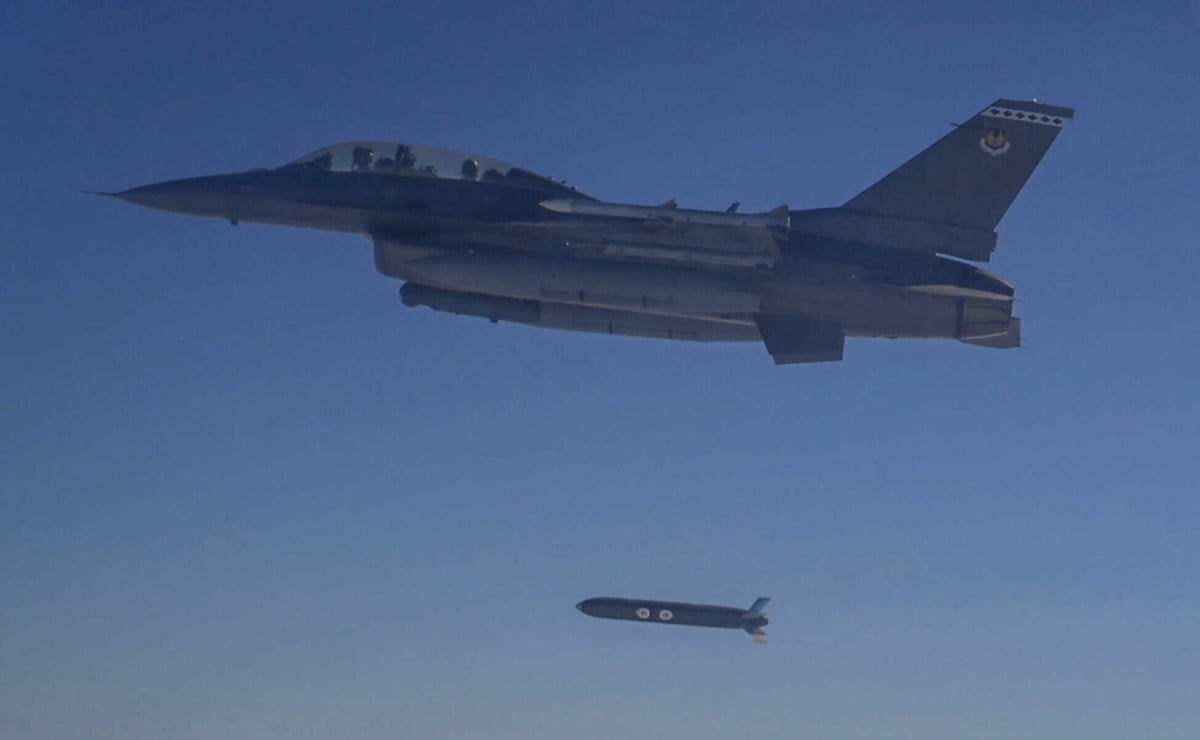
The modern industrial base for precision-guided munitions faces a fundamental scaling bottleneck. Conventional defense manufacturing models optimize for exquisite performance parameters, yielding low production velocities and prohibitive unit economics. The allocation of 12 million USD to Zone 5 Technologies to scale production of the AGM-188A Rusty Dagger marks a structural departure from traditional procurement. Rather than subsidizing complex component development, this capital injection targets the optimization of manufacturing throughput, supply chain constraints, and factory-floor automation required to reach a steady-state velocity of 1,000 all-up-rounds per year.
Understanding the mechanics of this expansion requires a rigorous decomposition of how capital alters the cost function of low-cost cruise missile production. The standard unit economics of the AGM-188A—estimated at approximately 246,000 USD per round—rely on a design architecture that integrates commercial off-the-shelf electronics with highly optimized propulsion units like the PBS Aerospace TJ80 turbojet. Scaling this capability is not an aerospace engineering problem; it is a factory throughput and capacity utilization problem. Expanding on this theme, you can also read: Inside the Greek Hedge Fund Strategy That Is Rattling London and Wall Street.
The Three Pillars of Affordable Mass Munitions Production
To transform a verified prototype into a high-rate production asset, manufacturing infrastructure must mature across three distinct vectors.
Tooling and Fixed-Asset Optimization
The primary friction point in rapid manufacturing transitions is the shift from manual, batch-based assembly to continuous-flow automation. The initial allocation of capital addresses the procurement of dedicated tooling fixtures, automated optical inspection systems, and advanced environmental test cells. In low-cost missile assembly, structural components like aluminum airframes and composite wings must be cast or milled using highly repeatable, multi-cavity injection molds or automated CNC setups. By minimizing human intervention during the structural bonding and fastening stages, the manufacturer lowers the cycle time per unit while suppressing the defect rate across production lots. Analysts at CNBC have also weighed in on this situation.
Supply Chain Resiliency and Component Buffering
A missile assembly line is structurally bounded by its slowest-moving subcomponent. For the AGM-188A, the critical path includes the acquisition of the TJ80 turbojet, specialized telemetry modules, and localized anti-jam GPS antennas, such as controlled reception pattern systems. A capital infusion of 12 million USD allows the manufacturer to establish safety stocks and long-lead material commitments. This capital injection mitigates the bullwhip effect in the secondary and tertiary tiers of the supply chain, ensuring that vendor-supplied subassemblies arrive at the primary integration facility precisely when required.
Test Cell Throughput Expansion
Before an all-up-round can be packaged and cleared for deployment, it must undergo automated hardware-in-the-loop validation and cold-soak startup simulation. Traditional test facilities create an operational bottleneck because hardware-in-the-loop testing takes a fixed amount of clock time per missile. Expanding the facility requires building parallel, software-driven test bays that can run concurrent diagnostics on multiple units. This system expansion ensures that the final assembly line never idles while waiting for quality assurance clearance.
The Economics of Scale and the Unit Cost Function
The primary economic objective of manufacturing scaling is the reduction of marginal costs through the amortization of fixed overhead. In traditional defense acquisition, the cost function remains stubbornly linear due to low volume buys and constant design iterations. The AGM-188A program breaks this linear pattern by utilizing an open-architecture design that locks the hardware envelope while allowing software-defined modifications.
The relationship between cumulative production volume ($V$) and unit cost ($C$) is governed by the learning curve formula:
$$C_V = C_1 \cdot V^{-b}$$
Where $C_1$ is the first unit cost and $b$ is the learning rate factor. In high-rate commercial manufacturing, learning rates routinely reach 80% to 85%, meaning each doubling of cumulative volume reduces unit costs by 15% to 20%. Defense manufacturing historically suffers from learning rates closer to 95% due to labor-intensive processes and frequent design drift.
The integration of Zone 5 into Kongsberg’s industrial framework allows the application of scaled automotive-style manufacturing disciplines. This collaborative operational structure targets a compressed learning curve by stabilizing the manufacturing configuration early. The 12 million USD capital injection acts as the catalyst to fund the specialized automation required to realize these mathematical efficiencies, driving down the unit cost toward the targeted export pricing model.
Subcomponent Bottlenecks and Solution Mechanisms
A detailed look at the bill of materials reveals the specific vulnerabilities that this funding round must resolve to secure high-rate delivery.
- Propulsion Units: The PBS Aerospace TJ80 turbojet requires precise metallurgy and balanced rotor assembly. Funding enables advanced multi-axis balancing equipment to accelerate engine acceptance testing.
- Guidance and Navigation: The autonomous visual navigation option relies on optical sensors coupled with onboard computing chips. Capital allows for high-volume purchasing contracts of commercial-grade silicon, shielding the program from global semiconductor supply fluctuations.
- Warhead Integration: Handling 100-pound multi-purpose warheads demands specialized explosive-handling infrastructure and automated fuze testing systems to maintain safety protocols without slowing assembly speeds.
Strategic Limitations of Lean Defense Procurement
While the capital allocation significantly increases the probability of hitting the targeted production volume, specific structural constraints remain unaddressed by capital alone. First, the strategy assumes a continuous, predictable demand signal from government procurement agencies. If procurement orders fluctuate wildly year-over-year, the newly built automated capacity will sit underutilized, causing the overhead costs per unit to spike.
Second, the reliance on commercial electronics components introduces a long-term obsolescence risk. Commercial silicon cycles move significantly faster than military lifecycles. The software and hardware architectures must undergo continuous, iterative rolling updates to prevent component end-of-life events from halting the factory floor.
The final strategic objective for this capital injection is the validation of a rapid manufacturing blueprint. If Zone 5 can successfully scale the AGM-188A to a steady state of 1,000 units within the defined capital parameters, it establishes a repeatable manufacturing framework for low-cost precision strike weapons. This operational framework shifts the defense procurement focus away from low-volume, high-margin weapon platforms toward high-velocity, software-defined industrial assets capable of sustaining prolonged operational output.