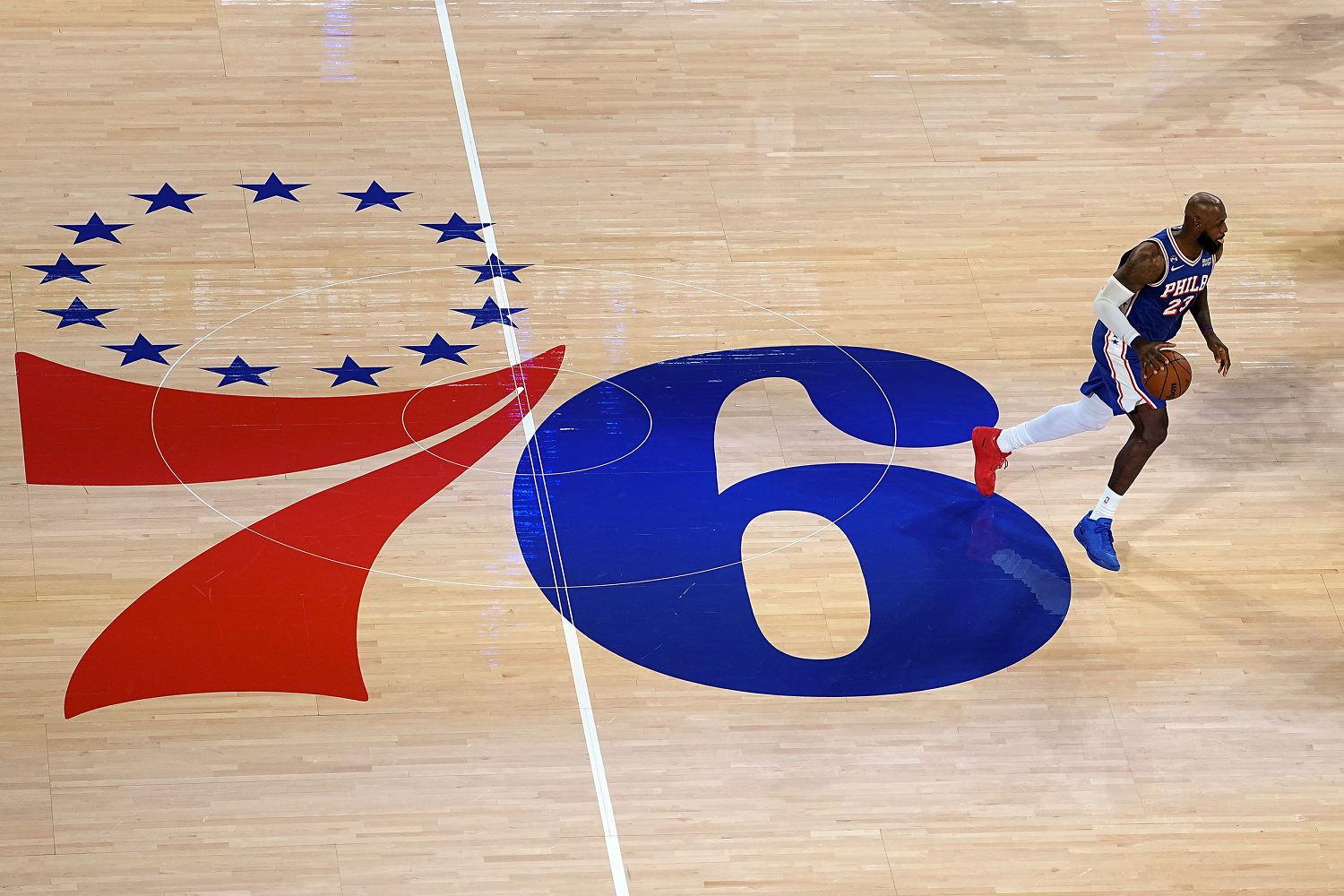
Roster construction at the championship tier of the National Basketball Association operates as an exercise in constrained capital allocation. When LeBron James bypassed conventional career preservation to sign with the Philadelphia 76ers during the offseason, sports media framed the transaction as an emotional gamble or a late-career vanity project. That framing misses the underlying structural economics of the decision. Under the NBA’s Collective Bargaining Agreement, acquiring an elite creator at the tail end of his aging curve creates an asymmetric payoff profile: the downside is capped by short-term contractual flexibility, while the upside unlocks multiplicative offensive efficiency around an existing MVP-caliber hub. Early regular-season returns indicate that the Philadelphia front office successfully arbitrage-priced historical age-curve biases against immediate postseason utility.
Evaluating whether this acquisition is "paying off" requires abandoning superficial win-loss narratives and examining the operational mechanics of the roster. A rigorous audit must isolate the opportunity cost of the cap space utilized, the spatial and usage reallocation between primary ball-handlers, and the thermodynamic reality of managing high-minute veterans across an 82-game schedule to preserve output for a 16-win postseason tournament.
The Structural Economics of the Offseason Acquisition
Every transaction under a hard-aproned salary cap represents a zero-sum trade-off. By committing maximum or near-maximum salary slots to a core anchored by Joel Embiid, Tyrese Maxey, and LeBron James, Philadelphia intentionally compressed its middle-class roster depth. To evaluate the soundness of this allocation, one must examine the Marginal Utility of Top-End Talent versus Depth Resilience.
In regular-season basketball, depth insulates a team against variance—specifically injuries, back-to-back fatigue, and shooting cold streaks. In the postseason, rotations shrink from ten players to seven or eight, and defensive schemes eliminate secondary options. The value of an elite, switch-proof decision-maker increases exponentially when the game slows down into half-court possessions.
The Opportunity Cost Matrix
Had Philadelphia declined to pursue James, the alternative capital deployment paths carried distinct failure modes:
- The Two-Player Role Allocation: Splitting the available cap room across two mid-tier starting wings preserves regular-season floor-raising capacity. However, role players depend on primary creators to generate high-expected-value (xEV) shots. Without a secondary offensive engine capable of punishing double-teams directed at Embiid, mid-tier wings routinely see their true shooting percentages regress under playoff defensive pressure.
- The Youth Development Model: Retaining draft capital and cap flexibility to build strictly around Tyrese Maxey’s timeline ignores the biological aging curve of Joel Embiid. A dominant seven-foot center with an extensive lower-body injury history possesses a finite championship window. Aligning peak asset expenditure with Embiid’s remaining prime years is the only mathematically coherent strategy.
By consolidating cap space into James, Philadelphia accepted higher regular-season fragility in exchange for eliminating half-court offensive bottlenecks in May and June. The early-season success is not merely a reflection of games won; it is proof of concept that the remaining minimum-salary and exception-level role players can survive non-staggered minutes without hemorrhaging net rating.
Reallocating Usage and Solving the Spatial Bottleneck
The primary analytical skepticism surrounding the pairing of LeBron James and Joel Embiid centered on Usage Rate Cannibalization and Floor Spacing. Historically, both players have operated near the top of the league in usage percentage, requiring the basketball to initiate offense and occupying overlapping real estate in the mid-post and elbow areas.
Early returns demonstrate that this concern was rooted in a static view of player archetypes rather than an understanding of complementary skill transfer. Instead of competing for touches, the two players have established a division of labor that reduces the cognitive and physical load on both.
The Inversion of the Pick-and-Roll
Prior to James’s arrival, Philadelphia’s primary offensive action relied heavily on Joel Embiid operating as a high-post isolation hub or running two-man actions with Tyrese Maxey. While effective, this structure forced Embiid to expend immense energy fighting for deep catch positions and absorbing contact 18 feet from the basket.
Integrating James alters the geometry of the half-court offense through three distinct mechanisms:
- The Inverted Screener: When James handles the ball at the top of the key and Embiid sets the screen, opposing defenses face a binary mathematical lose-lose scenario. Switching the action puts a smaller perimeter defender on Embiid in the paint and a slower big man on James in space. Dropping the coverage concedes an uncontested three-point look or a downhill runway for James. Blitzing the ball-handler leaves Embiid catching the ball in the short roll at the free-throw line—a zone where he shoots near 50 percent on midrange jumpers and possesses the height to see over the entire defense.
- Off-Ball Gravity and the Dunker Spot: In possessions where Maxey initiates the offense, James has transitioned seamlessly into a secondary connector. Rather than standing stationary on the weak-side wing, James operates as a baseline cutter and short-roll facilitator. Because defenses cannot leave James unguarded without conceding a high-percentage rim finish, weak-side help defenders are pinned to the baseline, preventing them from digging down on Embiid’s post-ups.
- Transition Pace Differential: Embiid’s presence naturally pulls the team’s overall pace downward toward a half-court grind. James, conversely, remains one of the most efficient transition creators in basketball history, particularly following defensive rebounds. This creates a dual-speed offense: Philadelphia can punish misses immediately via outlet passes to James and Maxey, while seamlessly transitioning into methodical, high-efficiency elbow sets when the opponent successfully retreats.
True Shooting Efficiency vs. Volume
The early empirical indicator of this integration is not raw points per game, which naturally fluctuate, but the Assisted Shot Percentage and Shot Quality Distribution. When Embiid and James share the floor, the frequency of contested, late-shot-clock isolation jumpers drops precipitously. James’s court vision systematically converts difficult contested two-point attempts into corner three-point shots and rim attempts—the two highest-yielding shots on the floor.
Defensive Thermodynamics and Load Distribution
Offense captures media attention, but championship viability in the Eastern Conference is dictated by defensive versatility. A roster featuring a 40-plus-year-old forward and a high-usage center carries inherent defensive liabilities, specifically in transition defense and perimeter point-of-attack containment.
The "risk" identified by mainstream commentators was that James’s regular-season defensive effort would crater, forcing Embiid to over-help at the rim and increasing his foul trouble and injury exposure. The operational reality in Philadelphia reveals a deliberate system of Defensive Energy Conservation.
The Zone-Matchup Hybridization
To prevent James from expending energy navigating off-ball screens or chasing younger perimeter scorers across the arc, the coaching staff has deployed him primarily as a weak-side roaming forward—essentially functioning as a free safety.
- Perimeter Insulation: Tyrese Maxey and the team’s perimeter role players are tasked with funneling ball-handlers toward the sidelines and baseline, explicitly denying middle penetration.
- Rim Deterrence: Embiid anchors the drop coverage, utilizing his length to deter rim attempts without needing to leave his feet unnecessarily.
- Passing Lane Interception: Freed from primary on-ball duties, James utilizes his defensive processing speed to blow up weak-side skip passes and secure defensive rebounds to immediately trigger the break.
This structure highlights a critical distinction between Defensive Athleticism and Defensive Processing. While James no longer possesses the lateral foot speed to lock down elite guards for 36 minutes, his ability to read offensive sets before they develop allows him to position himself correctly, neutralizing actions through anticipation rather than recovery speed.
The Fatigue Curve Management
A major risk factor remains the cumulative toll of the regular season. Biological recovery slows down regardless of conditioning expenditure. If Philadelphia relies on James to play 36 minutes a night in January to secure a top-two seed, the probability of a soft-tissue injury or a fourth-quarter stamina drop-off in May rises sharply.
The early positive returns are fragile because they depend on Minute-Load Discipline. The coaching staff must treat regular-season seeding as a secondary metric compared to player availability. In the modern NBA, home-court advantage in the second round yields a measurably smaller win-probability boost than entering the playoffs with fully healthy primary creators.
Vulnerability Audit: Where the Thesis Breaks
An objective strategic evaluation must account for failure modes. While the early season validates the offensive ceiling of the Philadelphia experiment, three structural vulnerabilities threaten to derail the project over an 82-game sample and four playoff rounds.
1. The Injury Cascade Effect
Top-heavy rosters possess zero margin for error regarding availability. The mathematical relationship between the absence of one star and the workload of the remaining stars is non-linear. If Embiid misses a three-week stretch due to routine knee maintenance, James’s usage rate and physical workload must spike to keep the team afloat in the standings. Conversely, if James suffers a minor groin or ankle strain, the half-court offense reverts to the predictable, Embiid-centric stagnation that plagued previous iterations of the franchise. The entire system relies on simultaneous availability during critical junctures.
2. Defensive Rebounding Leakage
Deploying James as a roaming weak-side defender and utilizing smaller, faster guards alongside Maxey creates a structural weakness on the defensive glass. When Embiid contests a shot at the rim, the weak-side forward is responsible for boxing out the opposing big man. If James leaks out early to initiate transition offense—a common habit—opponents can generate second-chance points via offensive rebounds. Against physically imposing frontcourts in the Eastern Conference, giving up an extra 8 to 10 possessions per game via offensive boards will erase Philadelphia’s half-court efficiency advantage.
3. Five-Out Offensive Stressors
While Embiid is an elite drop-coverage defender, he is fundamentally vulnerable when forced to guard five-out offenses featuring a stretch-five center who can reliably shoot from deep. Pulling Embiid out to the three-point line removes the team’s primary rim protector. In those matchups, the defensive burden shifts entirely to the back-line rotations of James and the wing defenders. Over a seven-game series against a five-out opponent, James’s stamina will be relentlessly tested through continuous closeouts and rotational scrambles.
Operational Imperatives for the Second Half of the Season
The initial phase of the season has answered the primary conceptual question: LeBron James and Joel Embiid do not merely coexist; their skill sets resolve each other’s historical postseason weaknesses. The transaction has cleared the first hurdle of proof-of-concept.
To convert this early regular-season efficiency into a viable championship run, Philadelphia’s front office and coaching staff must execute three non-negotiable operational adjustments prior to the trade deadline and the postseason:
- Enforce a Hard Minute Cap: Establish a strict ceiling of 30 to 32 minutes per game for James through the All-Star break, accepting the occasional regular-season loss in exchange for preserving explosive burst for April.
- Acquire Defensive Rebounding Insurance: Utilize remaining trade exceptions or minimum-salary slots at the deadline to acquire a rugged, low-usage power forward whose sole operational mandate is defensive rebounding and physical screen-setting during non-Embiid minutes.
- Standardize Late-Game Playbooks: Systematically drill the James-Embiid inverted pick-and-roll in clutch situations (games within five points in the final five minutes) during the regular season so that decision-making against switching, blitzing, and zone defenses becomes automated before playoff intensity peaks.
The acquisition of LeBron James was never a conventional long-term build; it was a calculated liquidity event designed to maximize a narrow championship window. By trading future flexibility and regular-season depth for elite postseason decision-making, Philadelphia aligned its roster construction with the true incentives of championship basketball. Provided the franchise maintains strict discipline regarding physical workload management, the early returns indicate a structural advantage that few Eastern Conference opponents possess the personnel to neutralize.