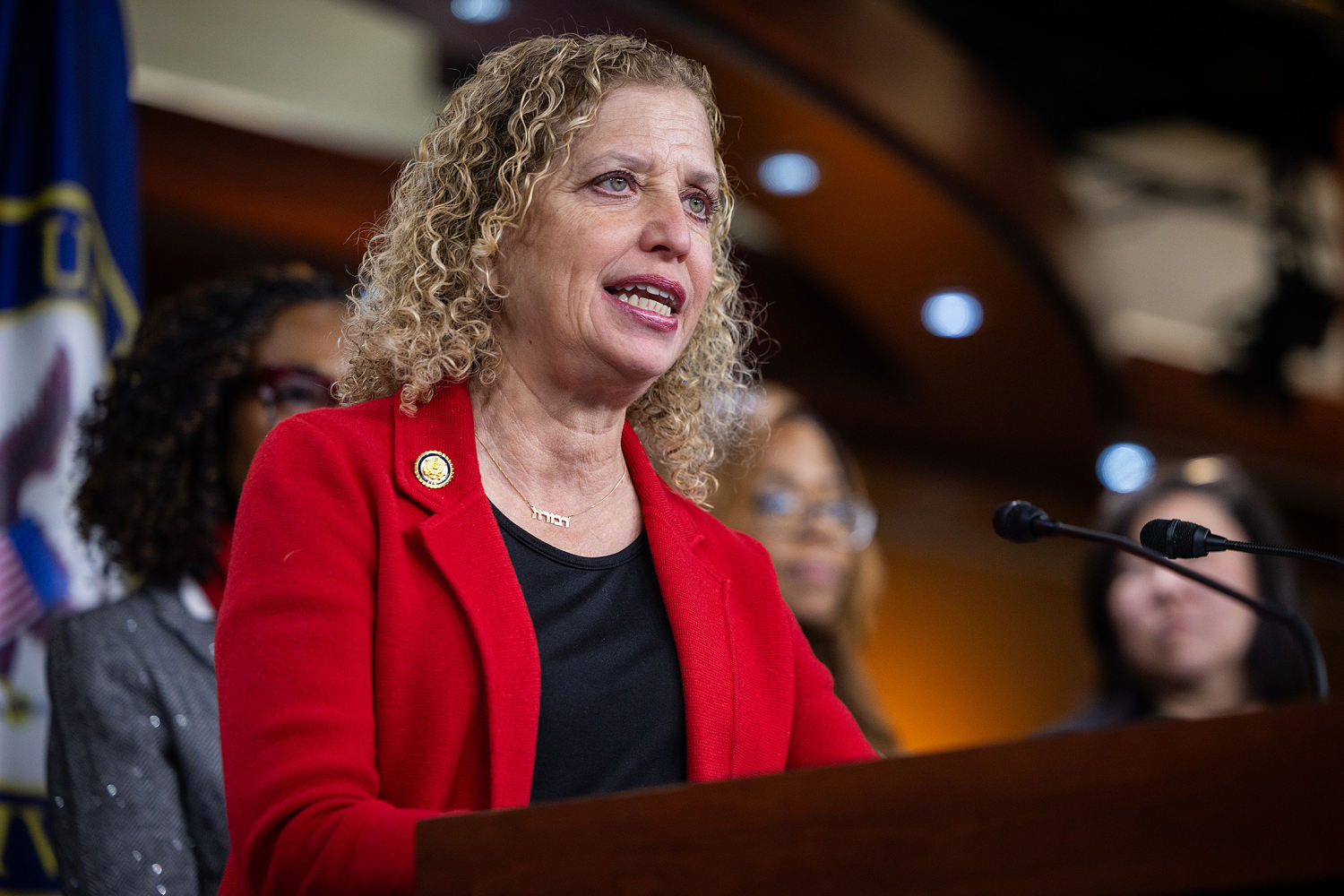
United States Representative Debbie Wasserman Schultz is facing a historic revolt from her own party after deciding to run for reelection in Florida’s 20th Congressional District, a seat historically designated to preserve Black political power. By abandoning her newly dismantled coastal district to seek safety in a deep-blue inland stronghold, Wasserman Schultz has triggered an unprecedented civil war within the Florida Democratic Party. This tactical retreat forces a direct conflict between the survival instincts of a long-serving white incumbent and the preservation of a crucial minority-access seat, threatening to shatter the party's statewide coalition ahead of the August primary elections.
The immediate trigger for this crisis was a mid-decade redistricting map pushed through by the Republican-led state legislature. The new lines aggressively dismantled Wasserman Schultz's former 25th district, scattering her South Florida voter base across five separate Republican-leaning districts and replacing her old seat with a highly competitive coastal strip running from Delray Beach to Miami Beach. Rather than mounting a high-stakes campaign to win that newly vulnerable coastal territory, Wasserman Schultz chose political survival by jumping into the neighboring 20th district.
The political fallout was immediate and severe. Ten of the fifteen elected Florida members of the Democratic National Committee issued a scathing public statement condemning her candidacy, explicitly arguing that the party cannot credibly fight Republican efforts to dilute Black voting strength while its own leadership uses a historically Black seat as a life raft. State Senator Rosalind Osgood publically warned that Wasserman Schultz risks leaving a permanent legacy of minority disenfranchisement, while the Democratic Black Caucus of Florida and the Florida Legislative Black Caucus have mounted a coordinated campaign demanding her withdrawal.
The Mathematical Dilution of Florida District 20
To understand why this move has provoked such intense fury, one must look at the mechanical structural transformation of the district itself. The 20th Congressional District has sent a Black representative to Washington for thirty-four consecutive years, functioning as an essential political anchor for the African American and Caribbean American communities of central Broward County. The newly enacted legislative map altered those demographics.
District 20 Voting-Age Demographics (2026 Map)
+-----------------------+---------+
| Demographic Group     | Share   |
+-----------------------+---------+
| Black Plurality       | 42%     |
| White                 | 30%     |
| Hispanic              | 23%     |
+-----------------------+---------+
The district dropped from a solid majority-Black seat to a 42% Black plurality. While the drop appears modest on paper, it radically alters the electoral dynamics in a multi-candidate Democratic primary.
By entering this altered field, Wasserman Schultz benefits directly from a fragmented opposition. A crowded field of local Black leaders, including former Representative Sheila Cherfilus-McCormick, former Broward County Commissioner Dale Holness, and activist Elijah Manley, threatens to divide the plurality Black vote. If the minority vote splits evenly among three or four local candidates, a well-funded white politician with high name recognition can capture the nomination with a simple plurality.
Recognizing this vulnerability, local candidates held an emergency private meeting to discuss consolidating the field down to a single challenger before the June 12 filing deadline. The mathematical reality is clear. Without a coordinated withdrawal by several local candidates, the structural mechanics of the primary primary virtually guarantee a victory for the entrenched incumbent.
Internal Power Play Versus National Party Credibility
Wasserman Schultz defends her decision by pointing to the aggressive partisan map drawing of her Republican opponents. Her campaign argues that because portions of her old district were absorbed into the new 20th district, she is simply following her constituents and preserving Broward County's senior legislative influence in Washington. Internal polling commissioned by her campaign indicated an 85% favorability rating among Black and Caribbean American voters in the area, a metric her team uses to justify her right to contest the seat.
This argument exposes a deeper ideological rift regarding the purpose of protected minority districts. Local civil rights leaders view these seats not merely as safe havens for generic Democratic votes, but as hard-won structural vehicles designed to ensure descriptive representation in a state with a long history of voter suppression.
The institutional hypocrisy is what stings local organizers the most. National Democrats regularly raise millions of dollars criticizing Southern Republicans for dismantling the Voting Rights Act. Yet, when faced with an unfavorable map, a former Democratic National Committee Chair chose to seek shelter in one of the state's few remaining minority-access seats rather than fighting to flip or defend a competitive district.
The Down-Ballot Collateral Damage
The consequences of this primary fight extend far beyond a single congressional seat. By refusing to run in the competitive 22nd district, which state party leaders urged her to anchor, Wasserman Schultz forces the state party to divert scarce financial resources toward a safe blue seat that should never have required a defensive campaign.
Democratic Party Resource Allocation Dilemma
+------------------------------------+------------------------------------+
| Scenario A: Incumbent Stays in CD20 | Scenario B: Incumbent Moves to CD22|
+------------------------------------+------------------------------------+
| Safe seat resources wasted on primary| Safe seat retained by local leader |
| CD22 left vulnerable to GOP pickup | National funds deployed to defend 22|
| Black voter turnout suppressed     | Multi-ethnic coalition energized   |
+------------------------------------+------------------------------------+
National donors are unlikely to fund local organizing efforts if they perceive the state party establishment as indifferent to its core minority base. This internal friction risks depressing Black voter turnout across South Florida, a demographic that Democrats must maximize to remain competitive in statewide races.
The primary scheduled for August will serve as a definitive test of institutional power against grassroots resistance. If the local candidates fail to consolidate their support before the filing deadline, Wasserman Schultz will likely leverage her massive fundraising advantage to secure the nomination. If the field consolidates, this race will transform into a direct national referendum on whether the modern Democratic Party values its historic commitments to minority representation when its own institutional hierarchy is on the line.


