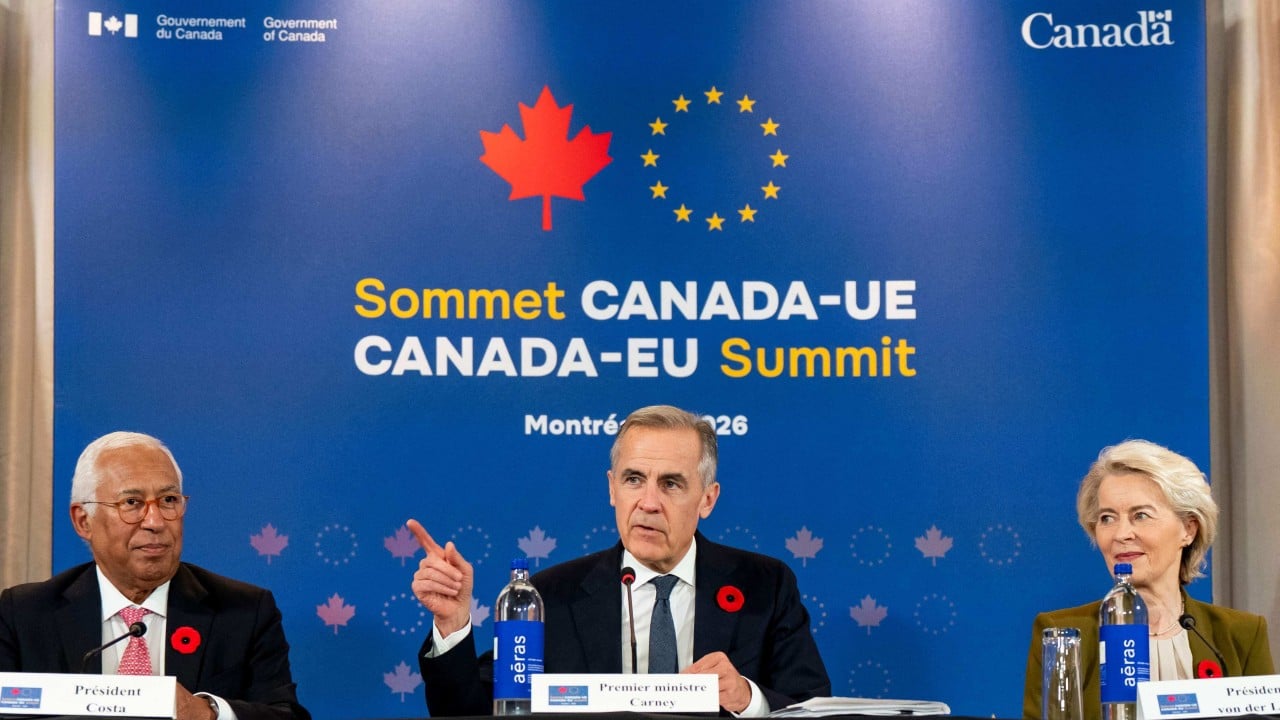
Every time trade pundits get bored, they dust off the same tired fantasy. Ottawa should cozy up to Brussels, sign on as an "associate member" of the European Union, and ride off into a transatlantic sunset of tariff-free prosperity.
It is lazy thinking dressed up as grand strategy.
The mainstream coverage of EU officials floating associate status for Canada—and the predictable grumbling from protectionist corners of Europe—misses the entire point. The commentators framing this as a heroic lifeline for a middle power caught between American protectionism and Chinese coercion are looking at the wrong map. They assume proximity to Brussels equals insulation from Washington. They assume "associate membership" is a VIP lounge where Canada gets the perks of the Single Market without the hangover of European regulatory overreach.
They are wrong on both counts.
Having spent years watching North American exporters bleed millions trying to comply with shifting regulatory regimes on both sides of the Atlantic, I can tell you what happens when a mid-sized economy ties its mast to a regulatory superpower without getting a seat at the steering wheel. You do not become a partner. You become a rule-taker.
The "Associate Member" Illusion
Let’s strip away the diplomatic euphemisms. In European Union treaty law, there is no standardized, plug-and-play "associate member" tier waiting on a shelf for G7 allies.
When Brussels talks about association, it is usually referring to Article 217 of the Treaty on the Functioning of the European Union (TFEU). Historically, those agreements were built as waiting rooms for future accession—think of the pre-membership frameworks for Eastern European states—or as deep trade pacts with immediate neighbors like Ukraine, Moldova, and the Western Balkans. Even the European Economic Area (EEA) model used by Norway, Iceland, and Liechtenstein is not a buffet where you pick the good dishes and leave the Brussels sprouts.
Norway pays hundreds of millions of euros into EU cohesion funds every year. It accepts the free movement of people. It adopts roughly three-quarters of all EU single market legislation—everything from chemical safety standards under REACH to digital privacy mandates—and it has zero formal voting rights when those laws are written. Norwegians call it "fax democracy." Brussels passes a law, faxes it to Oslo, and Oslo implements it.
Is that the grand prize Canadian strategists are salivating over?
If Ottawa signs up for anything resembling deep associate status, it is trading regulatory autonomy for market access it already largely possesses under the Comprehensive Economic and Trade Agreement (CETA). Since CETA provisionally entered into force in 2017, nearly 99 percent of tariff lines between Canada and the EU have been eliminated. The remaining friction is not about tariffs. It is about non-tariff barriers—specifically, the fact that European regulators refuse to recognize North American safety, agricultural, and manufacturing standards unless they mirror European rules down to the decimal point.
Why European Opposition Is Actually Doing Canada a Favor
The conventional wisdom frames internal EU resistance—mostly from agricultural lobbies in France, Ireland, and Poland, alongside nationalistic factions wary of diluting the bloc's identity—as the main obstacle to this bold new era.
Let them object. Their protectionism is accidentally saving Ottawa from a terrible deal.
European farmers know that Canadian beef, pork, and grain producers operate at a scale and efficiency that would flatten subsidized European family farms if quotas were lifted entirely. That is why, nearly a decade after CETA was signed, several EU member states still have not ratified it, leaving investor-state dispute mechanisms in limbo and keeping strict tariff-rate quotas on Canadian agricultural exports.
If Brussels cannot even fully ratify a standard free trade agreement with Canada without triggering tractor blockades in Paris and Warsaw, the idea that all 27 member states would unanimously approve a bespoke, elevated "associate member" treaty is pure fantasy. Under EU rules, association agreements require unanimity in the Council of the European Union and the consent of the European Parliament. One veto from a domestic prime minister facing a tough regional election kills the whole thing.
Chasing a treaty that requires 27 separate political miracles is a massive waste of diplomatic capital. Worse, the concessions Brussels would demand to buy off its internal skeptics would fall squarely on Canada’s most competitive sectors. You would see demands for geographical indication protections that force Canadian cheesemakers and vintners to rename products they have sold for generations, alongside carbon border adjustment rules that penalize Canadian energy and heavy industry.
The Geography Problem Nobody Wants to Admit
Here is the brutal economic reality that no amount of Brussels summitry can erase. Over 75 percent of Canadian merchandise exports go to the United States. Less than 10 percent go to the entire European Union.
You cannot legislate away geography. Supply chains in North America are not merely linked; they are fused. An auto part crosses the Detroit-Windsor corridor up to seven times before a vehicle rolls off an assembly line. Energy grids, rail networks, and defense procurement under NORAD bind the Canadian and American economies at the molecular level.
When Washington shifts its industrial policy—whether through Buy American mandates, electric vehicle tax credits, or sweeping tariffs—Ottawa feels the tremor within hours. The instinct among some Canadian policymakers is to hedge against American unpredictability by running into the arms of Europe.
That is like trying to fix a leaky roof by buying a boat.
If Canada aligns its regulatory framework more tightly with the EU’s precautionary principle—where new technologies and agricultural inputs are banned until proven entirely harmless—it actively creates friction with its largest customer. American regulators operate on a risk-based model. When Ottawa adopts EU-style mandates on digital services, artificial intelligence governance, or packaging waste, it raises compliance costs for companies operating across the Canada-U.S. border. You end up building a regulatory wall along the 49th parallel to please a market across an ocean that buys a fraction of your goods.
Answering the Questions Pundits Keep Getting Wrong
When this topic surfaces in policy circles, the same predictable questions follow. Most of them rest on flawed premises.
Could Canada actually join the EU as a full member?
No. Article 49 of the Treaty on European Union explicitly states that any European state may apply to become a member. While "European" is a political term as much as a geographic one—Cyprus is geographically in West Asia—stretching the definition to include a North American nation spanning from the Atlantic to the Pacific would trigger a constitutional crisis in Brussels. Even if you ignored the treaty text, Canada would have to adopt the euro eventually, surrender independent trade policy to the European Commission, and abandon its integrated North American regulatory alignment. It is a non-starter.
Does associate status protect Canada from U.S. tariffs?
Not at all. In fact, it makes Canada a bigger target. Washington views European regulatory exports—like the Digital Markets Act and the Carbon Border Adjustment Mechanism—as thinly veiled non-tariff barriers aimed squarely at American tech and industrial giants. If Ottawa signs onto those frameworks as an EU associate, the U.S. Trade Representative will treat Canada as an extension of Brussels’ regulatory apparatus. Instead of shielding Canada from American trade remedies, associate status invites them.
What about defense and critical minerals?
This is the one area where Brussels genuinely needs Ottawa. Europe is starving for lithium, cobalt, nickel, and liquefied natural gas to wean itself off Russian energy and Chinese processing monopolies. Canada sits on massive reserves of all of them. Notice the dynamic here: Europe is the buyer in distress, and Canada holds the inventory. You do not sign away your regulatory sovereignty to a customer who desperately needs what you are selling. You sell them the minerals under commercial contracts, take their capital investment, and keep your political autonomy intact.
The Hidden Cost of Regulatory Capture
Let’s be clear about the downside of rejecting the EU associate path. Saying no to deeper institutional integration with Brussels means accepting that Canadian exporters will continue to face bureaucratic headaches in Europe. Small and medium-sized Canadian businesses will still struggle with fragmented certification rules across the 27 member states. Canada will remain an outsider looking in as the EU sets global de facto standards for data privacy, AI, and green taxonomy—a phenomenon Columbia Law professor Anu Bradford famously termed the "Brussels Effect."
That friction is real. Pretending otherwise would be dishonest.
Yet the cure proposed by the associate-membership crowd is far worse than the disease. The Brussels Effect works precisely because companies voluntarily comply with EU rules when selling into Europe, while keeping their domestic operations free to innovate under local laws. Once a government codifies EU rules into domestic law via an association treaty, the optionality vanishes. Every Canadian startup, every local manufacturer, and every regional farm gets subjected to European compliance overhead—even if they never sell a single widget in Frankfurt or Lyon.
Imagine a scenario where a mid-sized software firm in Waterloo wants to launch a new AI-driven logistics tool. Under an EU-aligned regulatory regime, that firm faces months of pre-market conformity assessments and strict liability rules designed by bureaucrats in Brussels to rein in Silicon Valley monopolies. Meanwhile, its competitor in Austin launches the exact same product in six weeks, captures the North American market, and scales globally before the Canadian firm finishes its paperwork.
That is how mid-sized economies slowly suffocate themselves. Not through dramatic crashes, but through death by a thousand compliance forms.
What Ottawa Should Actually Do
If Canada wants real geopolitical resilience, it needs to stop looking for a new imperial patron to replace or balance the United States. The solution to over-dependence on one giant is not tying yourself to a slower, more bureaucratic giant across the Atlantic.
- Exploit bilateral sector deals, not omnibus treaties. Forget grand constitutional status. Negotiate narrow, targeted mutual recognition agreements (MRAs) on specific industrial standards—pharmaceuticals, aerospace, and clean tech—where both sides have immediate commercial skin in the game.
- Weaponize critical minerals as commercial leverage. Stop begging for market access and start acting like a resource superpower. Tie European access to Canadian lithium, rare earths, and clean hydrogen directly to European capital investment in Canadian processing facilities—with zero regulatory strings attached to domestic Canadian law.
- Double down on the Indo-Pacific. While Brussels argues over cheese quotas and regulatory harmonization, the fastest-growing middle classes on earth are sitting across the Pacific. Canada already has the Comprehensive and Progressive Agreement for Trans-Pacific Partnership (CPTPP) in place. Pour diplomatic and trade-promotion resources into Japan, South Korea, Vietnam, and Indonesia—markets that actually want Canadian energy, food, and tech without demanding that Ottawa rewrite its domestic rulebook.
- Fix internal Canadian trade first. Before worrying about seamless borders with Belgium, Ottawa should dismantle the absurd interprovincial trade barriers that still make it harder to ship wine or construction materials from British Columbia to Ontario than from France to Germany.
Brussels is offering Canada a gilded leash disguised as a seat at the table. Ottawa already owns the resources Europe needs and shares a continent with the richest consumer market in human history. Trading that hand for the privilege of taking dictation from European regulators isn't statecraft—it's voluntary vassalage.