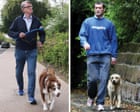
The celebrity doorstep photo isn't an accident. It’s a staged performance masquerading as a private moment caught on the fly. When you see a disgraced politician clutching a dog leash or a sacked football manager staring into the middle distance while holding a lukewarm coffee, you aren't seeing a person at their most vulnerable. You're seeing a carefully managed piece of crisis PR. It's a specific genre of British theatre that’s played out on suburban driveways for decades.
The doorstep photo exists because the public has an insatiable appetite for the "fall from grace." We want to see the powerful reduced to the mundane. We want to see if they’re still wearing a suit or if they’ve surrendered to the elasticated waistband of a tracksuit. For the celebrity, the goal is simple. Humanize the scandal. If you’re walking a golden retriever, it’s much harder for the public to cast you as a cold-blooded villain. If you enjoyed this article, you might want to look at: this related article.
Why the Dog is the Ultimate PR Shield
The dog is the most important prop in the history of the doorstep photo. Think of Roy Keane in 2005. After his explosive exit from Manchester United, the world expected fire and brimstone. Instead, the cameras found him walking his Labrador, Triggs. He looked calm. He looked like a man who had moved on, even if the rest of the sporting world hadn't.
Triggs became a symbol. The dog didn't care about tactical disputes or Alex Ferguson’s temper. By focusing on the pet, Keane shifted the narrative from "angry captain" to "dog lover." It’s a tactic Peter Mandelson mastered during his various political exiles. A politician in a suit looks like they’re plotting a comeback. A politician in a wax jacket with a canine companion looks like they’re enjoying a forced retirement. For another angle on this story, see the recent update from Entertainment Weekly.
Animals provide a buffer. They give the subject something to do with their hands. They justify the movement. Without the dog, you’re just a guy pacing your driveway waiting for a taxi. With the dog, you’re a man of the people performing a daily chore. It’s relatable. It’s grounded. It’s also completely tactical.
The Costume of the Defeated
Fashion on the doorstep is a delicate balance. You can’t look too good because that implies you’re arrogant or unaffected by the drama. You can’t look too bad because that suggests a total mental collapse. The "sweet spot" is what I call the Posh Casual.
Usually, this involves a Barbour jacket, corduroy trousers, or perhaps a slightly oversized knit sweater. It says, "I’m hurting, but I’m still dignified." Take the classic shots of disgraced ministers. They almost always opt for the "country gentleman" look. It’s a visual shorthand for traditional values. It’s an attempt to signal that despite whatever scandal just broke, they still belong to the fabric of decent society.
If you show up in a three-piece suit, you look like you’re heading to a legal hearing. You look guilty. If you show up in pajamas, you’ve lost the plot. The doorstep photo requires the subject to look like they just happened to be stepping out for milk, despite knowing fifty photographers have been camped outside since 4:00 AM.
The Logistics of the Scrum
Photographers don't just happen to be there. Most of the time, the subject’s team has leaked the timing of the "casual stroll." It’s a symbiotic relationship. The paps get the shot that sells papers, and the celebrity gets to control the visual narrative.
The physical environment of the doorstep matters. A gravel driveway is perfect. It creates a sound that warns the subject of approaching feet. A heavy wooden door provides a solid "thud" for a dramatic exit or entry. These photos are rarely taken on a busy high street. They happen in the liminal space between the private sanctuary of the home and the public arena of the street.
There’s a specific tension in these images. The subject often refuses to look at the lens. They look down. They look at their keys. They look at the dog. This feigned ignorance of the camera is vital. If they smile, they’re a narcissist. If they scowl, they’re a bully. The only safe expression is a sort of weary resignation.
From Politics to Pop Culture
While politicians used the doorstep to survive scandals, pop stars used it to signal a "new era." In the 90s and early 2000s, the doorstep photo was the primary way we tracked the health of a star. Every time a Britpop icon left their house, it was a status update.
Liam Gallagher was a master of this. He didn't use the doorstep to apologize. He used it to antagonize. He’d stick his tongue out or carry a bag of groceries like a trophy. For him, the doorstep wasn't about crisis management; it was about brand maintenance. It reinforced his "man of the people" image while reminding everyone he was still a rock star.
Today, social media has killed some of the mystery. A celebrity can just post a black-and-white photo on Instagram with a long, rambling caption. But the Instagram post feels curated by a digital marketing team. The doorstep photo feels—even if it’s a lie—raw. There’s something about the harsh flash of a camera at 7:00 AM that feels more honest than a filtered selfie.
The Art of the Non-Statement Statement
Sometimes the best doorstep photo is the one where nothing happens. A subject walks out, puts a bag in the boot of their car, and drives away. They don't speak. They don't acknowledge the shouted questions about their affair or their financial crimes.
This silence is deafening. It’s a power move. By refusing to engage, the subject maintains a shred of mystery. They’re telling the press, "You can watch me, but you can’t have me." It’s the ultimate "no comment."
But even this is a performance. The choice of car matters. A sensible Volvo says "family man." A roaring Porsche says "I’m spending the settlement money already." Every single detail in that frame is scrutinized by the public. We look at the brand of bread in the grocery bag. We look at the state of the flowerbeds. We’re looking for any clue that the person on the screen is as miserable as we think they should be.
How to Read a Doorstep Photo
Next time you see one of these photos, don't just look at the person. Look at the composition.
If the photo is wide-angled and shows the whole house, the paps are likely being kept at a distance. This suggests a hostile relationship. If the photo is a tight close-up of the celebrity’s face as they lean into a car, the photographer was probably right in their personal space.
Pay attention to the lighting. Natural morning light is unforgiving. It shows the bags under the eyes and the grey in the hair. If a celebrity looks remarkably well-lit and groomed at sunrise, you can bet your life their stylist was in the kitchen ten minutes before they stepped out.
The doorstep photo is a relic of a pre-digital age that somehow survived. It works because it satisfies our primal urge to peek over the neighbor’s fence. It’s the "stars are just like us" trope taken to its most cynical extreme.
If you ever find yourself at the center of a national scandal, remember the rules. Wear a neutral-colored sweater. Don't look at the camera. And for God’s sake, get a dog.
Stop scrolling through the tabloids and start looking for the patterns. Notice the Barbour jackets. Notice the "accidental" glimpses of family life through the half-open door. Once you see the strings, the performance isn't as convincing, but it’s a lot more entertaining. Keep an eye on the next big resignation or breakup. The driveway drama is about to begin.