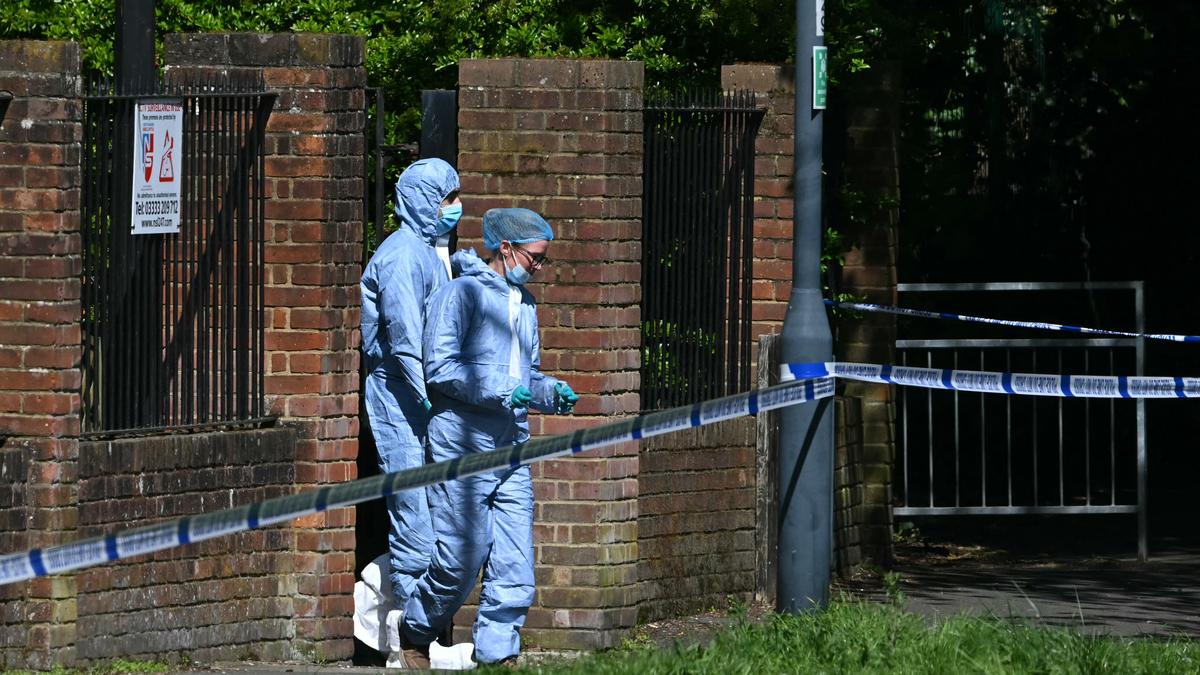
The sirens in north London have become a nightly rhythm, a grim acoustic accompaniment to a community under siege. Over the weekend, police detained a 17-year-old and a 19-year-old in connection with an attempted arson attack at the Kenton United Synagogue. Smoke damage marred an internal room, a silent witness to a fire that could have been a catastrophe. This arrest, carried out by counter-terrorism officers, is not an isolated malfunction in the social fabric. It is a data point in a terrifying, accelerating trend.
We are watching a shift from the street-level antisemitism that has plagued British life for generations to something colder, more tactical, and infinitely more dangerous. When we look at the sequence of events—the burning of Hatzola ambulances in Golders Green last month, the attack on a business premises just days ago, the recurring firebombing attempts—we are forced to confront a reality that authorities have been hesitant to fully articulate: the targeting of Jewish life in the United Kingdom has evolved into a kinetic campaign.
The Evolution of the Threat
For decades, the standard response to antisemitic incidents in London involved tracking "lone actors." You had the keyboard warriors, the neighborhood bullies, and the occasional extremist agitator. The police playbooks were built on that assumption. But the current wave of violence ignores those outdated frameworks.
What we are witnessing is the collision of imported geopolitical tensions with domestic extremist frustration. Security officials have long whispered about the potential for foreign state actors to outsource hostility to local proxies. The persistent investigations into Iranian influence are no longer speculative; they are the baseline of current counter-terrorism briefings. When a synagogue is targeted, the question for investigators is no longer just "who did this?" but "who told them to do it, and who is paying for the fuel?"
This professionalization of hate creates a vacuum that is difficult to fill. When an incident is purely domestic, intelligence agencies have a clearer path toward disruption. When you have fluid networks, often operating through encrypted channels, the ability of local police to prevent the next firebombing is diminished. They are playing a game of catch-up.
Policing at the Breaking Point
The Metropolitan Police are currently stretched across a front that covers almost every borough. The move to bring in counter-terrorism units for arson investigations is a telling admission. It signals that these are not merely acts of criminal damage; they are viewed as threats to national security.
Consider the resources being diverted. Drones are now a fixture in the night sky over north London. Armed patrols, motorbike units, and surveillance teams are working shifts that were previously reserved for high-threat counter-terrorism operations. This is a massive drain on the capital’s ability to police other crimes, yet it is a necessary expenditure. If the state cannot protect a house of worship, the social contract effectively dissolves.
The operational reality is brutal. Perpetrators are often young, recruited from online radicalization hubs, and sent out with basic instruction. They are disposable, which makes them incredibly hard to track until the match is struck. The police are managing the symptoms—increasing patrols, cordon areas, and responding to reports—but the infection is deep. Every time an arrest is made, like the one in Kenton, a message is sent that the state is watching. But the frequency of these attacks suggests that the deterrent effect is wearing thin.
The Normalization of Fear
The most corrosive aspect of this crisis is the way the Jewish community is being forced to adapt. I have spent time in Golders Green and Finchley, speaking with residents who were once comfortable walking to morning services or leaving their cars parked on the street. That comfort is gone. It has been replaced by a quiet, persistent vigilance.
We are seeing a trend where Jewish institutions are becoming fortresses. Security guards, high-definition cameras, and steel-reinforced perimeters are standard now. This is not a sustainable way to live in a democracy. It is a slow, creeping segregation where the target population is forced into defensive posture, effectively surrendering public space to those who wish them harm.
There is a hollow comfort in hearing officials promise that "antisemitism will not be tolerated." It sounds empty when you are scrubbing smoke stains off a sanctuary wall. The community is tired of statements. They are looking for results that go beyond arrests. They need the dismantling of the networks that facilitate these attacks.
Examining the Wider Consequences
The geopolitical angle—the link to foreign powers seeking to sow chaos in Western cities—is the variable that changes everything. If these arson attempts are indeed part of a broader campaign of low-level, high-impact disruption, then the British government is facing a challenge that requires an intelligence-led, rather than a police-led, response.
We have seen this script before in other parts of Europe. It begins with vandalism. It moves to property damage. Eventually, it reaches the point of lethal violence. The bombing in Manchester last October, which claimed two lives, was the turning point. It proved that the threats were not just symbolic. The barrier between "message sending" and mass murder had been crossed.
The current strategy of "increased patrols" is a stopgap. It keeps the streets safer for a week or two, but it does nothing to address the motivation. Until the security services can identify the nodes where these proxy networks intersect with local criminal elements, the threat will remain constant.
We must also look at the discourse. There is a tendency to downplay these incidents as "tensions" or "spillover." That is a dangerous euphemism. When a synagogue is firebombed, it is not a political protest. It is a crime against the right to exist safely. If the political class continues to treat these as social friction rather than acts of targeted terror, they will continue to fail the very people they are sworn to protect.
The Road Ahead
The cycle of violence is not going to break on its own. We have a growing demographic of disaffected, radicalized youth who are finding community and purpose in extremist ideologies. The internet has provided the tools, and foreign actors have provided the incentives. The UK government is operating with a 20th-century mindset against a 21st-century threat.
We need to stop waiting for the next fire to confirm the pattern. The pattern is already established. It is visible in the charred remnants of emergency vehicles, the blackened windows of houses of worship, and the fearful eyes of families who have lived in London for generations.
The arrests in Kenton might yield information, or they might lead to a dead end with two individuals who are merely the latest recruits in an endless supply of foot soldiers. The true test of British security will not be found in the courtrooms where these two face their charges, but in the streets of London, in the silence of the night, and in the ability of the state to regain control of a narrative that is increasingly being written by those who trade in fire and fear. The patience of the community is exhausted, and the window for preventive action is closing. The smoke may clear, but the fire remains, waiting for the next spark.