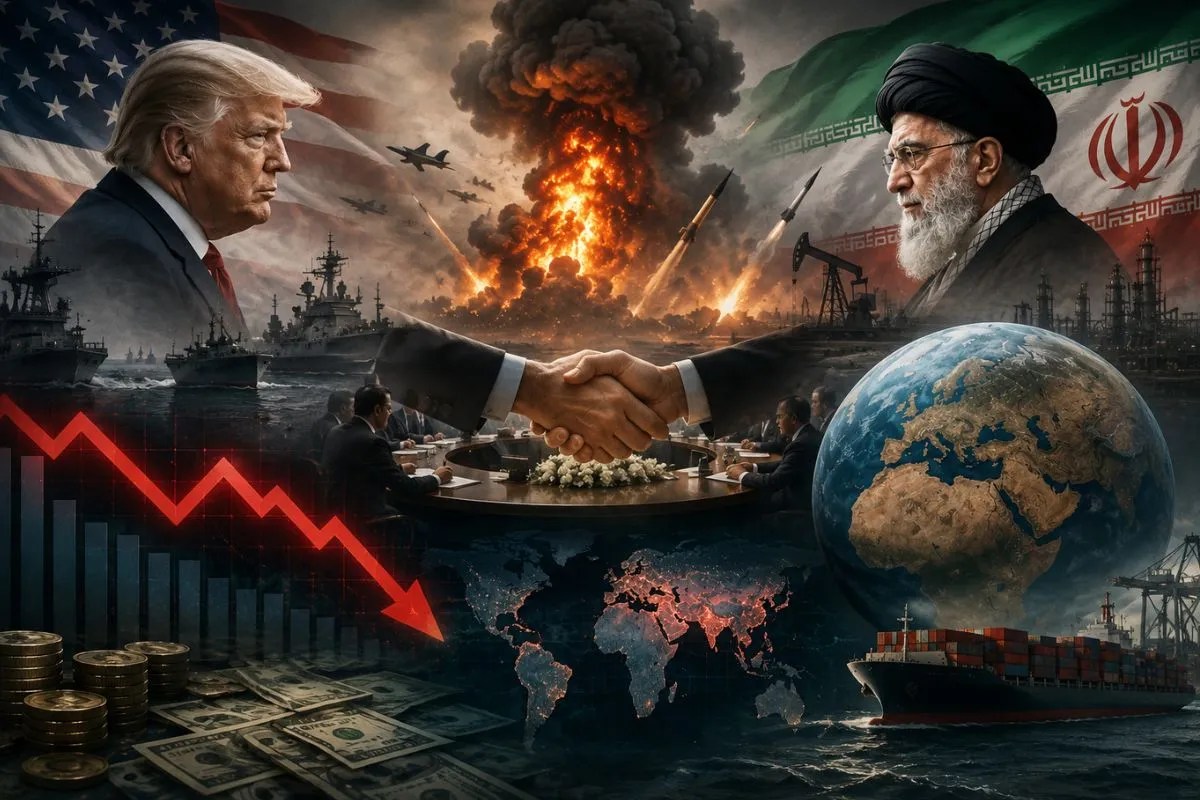
The global economy is fracturing along predictable geological fault lines, leaving the West exposed while two Asian giants absorb the shock. According to a grim, understated assessment from the World Bank, virtually every developed economy will fail to achieve meaningful stabilization before 2028. This long-term stagnation stems directly from the escalating geopolitical conflict in the Middle East, which has fundamentally upended energy supply lines and capital flows. While Washington, London, and Berlin face a protracted era of high inflation and sluggish growth, India and China are quietly decoupling from Western fiscal vulnerabilities.
The reality is far more complex than simple headlines about wartime inflation. We are witnessing a structural shift in how nations survive global chaos.
The Illusion of a Uniform Global Recovery
For the past two years, central banks across the developed world maintained that aggressive interest rate hikes would eventually tame inflation and restore steady growth. The World Bank data exposes this narrative as a fantasy. Stripping away the diplomatic verbiage from the report reveals a harsh truth. The structural damage inflicted by the America-Iran confrontation has created a permanent premium on logistics, insurance, and energy procurement. Developed nations, burdened by staggering debt-to-GDP ratios, no longer possess the fiscal tools to subsidize their way out of a supply-side crisis.
The crisis hits Europe and North America hardest because their economic architectures rely on predictable, low-friction international trade. When a critical maritime corridor becomes a combat zone, the cost of moving goods does not just rise incrementally. It multiplies overnight. Insurance underwriters rewrite risk profiles, shipping conglomerates reroute fleets around entire continents, and the resulting delays act as a hidden tax on every consumer product.
In sharp contrast, India and China are operating on an entirely different economic trajectory.
Their resilience is not an accident of geography. It is the result of deliberate, nationalistic economic positioning. Both nations have spent the last decade securing bilateral commodity agreements, establishing alternative trade clearinghouses, and building massive domestic consumer bases that insulate them from external systemic shocks. While the West hemorrhages capital trying to stabilize its traditional financial systems, New Delhi and Beijing are capitalizing on discounted energy assets and expanding their spheres of influence across the Global South.
Why the Middle East Flashpoint Broke Western Financial Models
Traditional economic models used by the Federal Reserve and the European Central Bank consistently underestimate the compounding velocity of geopolitical friction. When hostilities escalated between American forces and Iranian-backed entities, Western analysts treated it as a temporary energy supply disruption. They assumed production increases in the North Sea or American shale fields could fill the void.
They were wrong.
The conflict did not just disrupt oil tankers; it fractured the global maritime insurance industry and broke the logistical spine of Asia-to-Europe trade. Let us examine the mechanics of this failure.
[Global Shipping Bottleneck]
Normal Route: Indian Ocean -> Red Sea -> Suez Canal -> Mediterranean Sea (Fast, Low Cost)
Current Alternative: Indian Ocean -> Cape of Good Hope -> Atlantic Ocean (Adds 10-14 Days, Massive Fuel & Insurance Surcharges)
When shipping lanes are compromised, the immediate consequence is a dramatic escalation in maritime insurance premiums. Freight forwarding companies cannot absorb these multi-million-dollar spikes. They pass them down the supply chain. A manufacturing plant in Germany waiting for critical electronic components from Taiwan suddenly faces a three-week delay and a 40 percent surcharge on freight. To maintain margins, that factory raises prices for the consumer.
This is the exact mechanism driving the sticky, structural inflation that the World Bank warns will persist until 2028. Central banks cannot fix a maritime security crisis by raising interest rates. Higher interest rates only increase the cost of borrowing for domestic businesses, doubling the economic pain by restricting growth while doing nothing to lower the price of imported components.
The Subsidized Energy Mirage
Western economies attempted to cushion this blow by tapping strategic petroleum reserves and offering energy subsidies to households. This strategy is unsustainable over a five-year horizon. Governments are essentially printing money to artificially depress the market price of a scarce commodity. This practice expands national deficits to unprecedented levels, making sovereign debt less attractive to global investors and forcing central banks to keep interest rates elevated just to prevent a currency collapse.
The Indian Exception and the Multi-Alignment Strategy
India’s projected economic insulation through 2028 provides a masterclass in pragmatic, multi-aligned diplomacy. While Western capitals demanded that New Delhi choose a side in escalating global conflicts, Indian policymakers prioritized energy security and fiscal sovereignty.
By aggressively importing discounted crude oil from sanctioned or isolated producers, refining it domestically, and exporting high-value petroleum products back to the West, India transformed a global supply crisis into a massive revenue engine. This strategy achieved two vital objectives simultaneously. It kept domestic fuel prices stable, preventing the runaway inflation that destroyed consumer confidence in Europe, and it generated the capital reserves necessary to fund massive infrastructure projects across the subcontinent.
Furthermore, India’s domestic market has reached a critical mass where internal consumption can sustain high growth rates even if external export markets dry up. Capital expenditure by the government in railways, highways, and digital public infrastructure has created a domestic economic ecosystem that operates largely independently of Western financial sentiment.
The Hidden Vulnerability in India's Shield
This economic insulation is not entirely bulletproof. India remains highly dependent on external fertilizer inputs and specific raw technology imports. If the conflict expands to the point where major Indian Ocean ports face direct operational disruption, the cost of safeguarding these supply lines will escalate. However, as it stands, India’s financial leadership has demonstrated an agility that Western bureaucratic institutions simply cannot match.
How China Built a Counter-Cyclical Fortress
China’s economic survival strategy relies on a completely different set of levers. While Western media outlets frequently focus on China’s domestic real estate adjustments, they overlook the terrifying efficiency of Beijing’s industrial policy. Over the past decade, China has established a near-monopoly on the supply chains for renewable energy, electric vehicles, and advanced battery technology.
When the World Bank warns that developed nations will struggle, it is recognizing that the West cannot transition its economy or rebuild its industrial base without purchasing materials from China.
[Western Dependency Loop]
West aims to reduce fossil fuel reliance -> West mandates green technology transition -> West must import rare earth elements, solar wafers, and lithium batteries -> China controls 70-80% of these processing chains -> Capital flows out of West into China regardless of geopolitical tension
China has spent years securing long-term mining concessions in Africa and South America. They do not buy these commodities on the volatile spot market; they own the extraction sites. Therefore, when a geopolitical crisis triggers an inflation spike in Western commodity markets, China's state-owned enterprises remain insulated from the price volatility. They feed their factories with raw materials secured at fixed, internal transfer prices.
The Weaponization of the Renminbi
Beijing is using this period of Western instability to accelerate the de-dollarization of global commodity markets. By offering Middle Eastern oil producers and Russian commodity conglomerates the ability to settle trades in Renminbi, China is systematically eroding the primary mechanism of American financial hegemony. When oil is traded in dollars, the United States can export its inflation by printing currency. As alternative payment architectures gain traction, that luxury vanishes, leaving Washington to bear the full weight of its fiscal mismanagement.
The Ghost in the World Bank Data: The Sovereign Debt Trap
The true reason developed countries cannot recover before 2028 lies in an unmentionable mathematical reality: the sovereign debt trap.
During the decade of near-zero interest rates, Western governments accumulated trillions of dollars in debt. Now, with inflation permanently elevated due to the geopolitical shifts mentioned above, central banks are forced to keep interest rates high. This means the cost of servicing that existing national debt is skyrocketing.
Consider the trajectory of a developed nation where debt-to-GDP sits at 120 percent. When interest rates rise from 0.5 percent to 4.5 percent, the line item for interest payments in the national budget suddenly eclipses the entire defense or education budget. Governments face a brutal choice. They can cut public services, which triggers political instability and depresses domestic demand, or they can print more money to pay the interest, which fuels the inflationary fire.
There is no clean exit from this cycle. This is why the World Bank's outlook is so uniquely bleak for the developed world. India and China, possessing much healthier debt profiles and higher nominal growth rates, can easily outgrow their debt obligations. The West is simply managing a slow decline.
The Structural Realignment of Global Wealth
The period between now and 2028 will not be defined by a sudden financial crash like 2008. Instead, it will look like a grinding, uneven reallocation of global economic power. The conflict in the Middle East acted as the catalyst, but the underlying vulnerabilities were already structural.
Nations that rely on printing fiat currency and importing raw materials through insecure maritime channels will continue to see their standard of living erode. Capital will naturally migrate toward jurisdictions that offer physical resource security, manufacturing dominance, and independent financial clearing mechanisms. The World Bank's warning is not a prophecy of global doom; it is an eviction notice for the traditional leaders of the global economic order.


