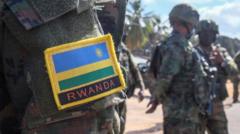
The United States has finally stripped away the diplomatic veneer protecting its long-term partner in the Great Lakes region. By imposing sweeping sanctions on the Rwanda Defence Force (RDF) and its top brass on March 2, 2026, Washington sent a shockwave through Kigali that decades of "quiet diplomacy" failed to deliver. This is no longer just a symbolic slap on the wrist for human rights concerns. It is a direct response to a brazen military expansion that saw the Rwanda-backed M23 rebels seize the strategic Congolese city of Uvira, effectively tearing up the Washington Accords signed just months ago.
At the heart of the crisis is a sophisticated military machine. The U.S. Treasury Department didn't just target individuals; it blacklisted the entire RDF as an institution. This move freezes any American-linked assets and, more importantly, signals to global financial networks that the Rwandan military is now a high-risk entity. The commanders in the crosshairs—Army Chief of Staff Vincent Nyakarundi, Chief of Defense Staff Mubarakh Muganga, Major General Ruki Karusisi, and Special Operations chief Stanislas Gashugi—are now effectively international pariahs.
The Washington Accords Betrayal
To understand the severity of these sanctions, one must look at the wreckage of the Washington Accords for Peace and Prosperity. Signed in December 2024 under heavy American pressure, the deal was supposed to be a "new era" for Central Africa. It promised a trade-off: Rwanda would withdraw its "defensive measures"—a euphemism for the thousands of RDF troops operating inside the Democratic Republic of Congo (DRC)—in exchange for a leading role in a U.S.-brokered mineral trade corridor.
The ink was barely dry before the M23 movement launched a fresh offensive. By capturing Goma, Bukavu, and recently Uvira, the rebels demonstrated that the "peace process" was being used as a tactical pause to consolidate territorial gains. Intelligence reports now confirm the RDF provided more than just moral support. They deployed GPS jamming systems, sophisticated drones, and air defense equipment to neutralize the UN’s peacekeeping efforts and the Congolese army.
The Mineral Incentive
Why would Kigali risk its most important Western alliance for a strip of land in eastern Congo? The answer lies beneath the soil. Eastern DRC holds the world’s most concentrated deposits of tantalum, tin, and tungsten, alongside the "green gold" of the energy transition: cobalt and lithium.
For thirty years, Rwanda has operated as a primary transit hub for these minerals. Much of what is exported from Kigali as "Rwandan" origin actually begins its journey in the mines of North and South Kivu. By securing de facto control over these mining sites through proxy forces, the Rwandan leadership secures a massive off-book revenue stream that fuels its domestic development and military budget. The U.S. sanctions are a belated acknowledgment that the "African success story" of Rwanda has been partially financed by the systematic looting of its neighbor.
A Failed Strategy of Containment
The current U.S. administration, led by Treasury Secretary Scott Bessent, is attempting to pivot from a policy of "engagement" to one of "enforcement." For years, Washington issued waivers to Rwanda despite clear evidence of its involvement in the DRC. This leniency was built on Rwanda’s utility as a regional policeman, providing disciplined troops for peacekeeping missions in places like Mozambique and the Central African Republic.
That trade-off has reached its breaking point. The sheer scale of the displacement—millions of Congolese civilians pushed into squalid camps—has made the humanitarian cost impossible to ignore. Furthermore, the introduction of advanced weaponry by the RDF has escalated a local insurgency into a regional arms race.
The Counter-Argument from Kigali
The Rwandan government has not taken these measures quietly. In a sharp rebuttal from Kigali, officials labeled the sanctions "one-sided" and "unjust." Their narrative remains consistent: the RDF is in the DRC to protect Rwanda from the FDLR, a remnant militia of the 1994 genocide perpetrators.
Rwanda argues that the Congolese government in Kinshasa has "integrated" these genocidal elements into its own army. From Kigali’s perspective, the M23 is a necessary shield against a looming existential threat. While this argument carries historical weight, the UN Group of Experts has repeatedly found that the M23’s operations extend far beyond "defensive" maneuvers against the FDLR, focusing instead on capturing lucrative trade routes and urban centers.
The Economic Fallout
The blacklisting of the RDF as an entity creates a massive headache for international firms. Rwanda’s economy is deeply integrated with its military; the RDF owns or controls significant stakes in construction, logistics, and even hospitality through various investment arms.
Any company doing business with a Rwandan firm must now conduct exhaustive due diligence to ensure they aren't inadvertently funding a sanctioned military structure. This "chilling effect" is exactly what Washington intended. It raises the cost of Rwanda’s Congolese adventure to a point that may eventually threaten domestic stability in Kigali.
- Financial Isolation: Major banks are likely to sever ties with RDF-linked businesses to avoid "strict liability" penalties from the U.S. Office of Foreign Assets Control (OFAC).
- Military Aid: The formal designation makes it legally impossible for the U.S. to provide hardware or training to Rwanda, a significant blow to their prestige.
- Mineral Scrutiny: Global tech and automotive companies are under renewed pressure to prove their supply chains don't rely on the "blood minerals" funneled through the M23-occupied zones.
The conflict in eastern Congo is often dismissed as an "eternal war," but it is a highly rational pursuit of resources and regional dominance. By targeting the architects of this strategy, the U.S. is betting that economic pain can succeed where diplomacy failed. If Rwanda continues its advance toward the Burundian border, the next step won't be more paperwork—it will be the total isolation of the regime that was once the darling of the West.
The era of looking the other way is over.
Would you like me to research the specific financial ties between the sanctioned Rwandan commanders and the regional mining companies?