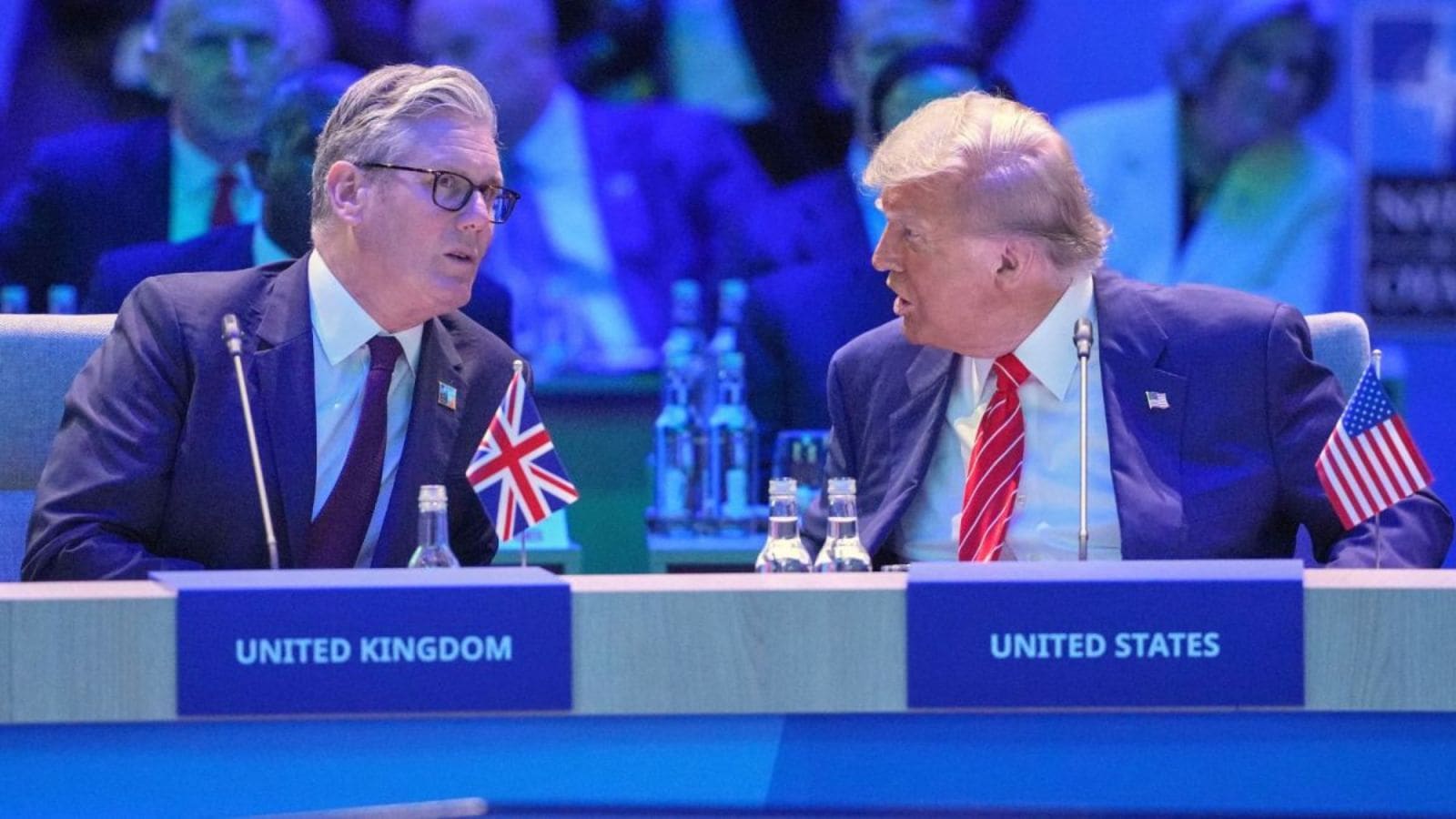
Prime Minister Keir Starmer has chosen a path of high-stakes friction, signaling he will not retreat even as Donald Trump threatens to incinerate the 2025 UK-US trade framework. This is more than a personality clash between a human rights lawyer and a property mogul. It is a fundamental collision of two incompatible economic worldviews that leaves the United Kingdom’s post-Brexit strategy in tatters. While the British government frames this as a defense of national sovereignty and regulatory standards, the reality on the ground suggests a massive miscalculation of leverage.
Trump’s ultimatum is simple. He wants the UK to align with American agricultural standards and break away from European Union-style regulations. Starmer, meanwhile, is attempting a "balancing act" that involves staying close to the EU single market while maintaining a special relationship with a Washington administration that no longer believes in the word "special" unless it is followed by "tariffs."
The Illusion of the Middle Ground
Downing Street operates under the assumption that the UK can act as a bridge. This is a ghost of 1990s diplomacy that has no place in the current geopolitical climate. Trump’s "America First" agenda does not permit bystanders. You are either in the American trade orbit or you are an obstacle. By refusing to "yield" on food standards—specifically the long-contested issues of hormone-treated beef and chlorine-washed poultry—Starmer is effectively choosing a trade wall over a trade deal.
The 2025 deal was supposed to be the crown jewel of "Global Britain." Instead, it has become a hostage. British negotiators are finding that the "red lines" drawn by the Labour government regarding the National Health Service and agricultural protections are being met with total indifference by a White House that views trade as a zero-sum game. If London won’t buy Iowa corn and Texas beef, Washington has no interest in lowering barriers for British services or Scotch whisky.
Why the UK Leverage is Vanishing
The fundamental problem is one of gravity. The UK economy is roughly one-eighth the size of the US economy. When Starmer says he will not yield, he is speaking to a domestic audience to appear strong, but the mathematical reality of the situation is grim.
The US currently accounts for roughly 15% of total UK exports. While that is a significant slice of the pie, the US can find alternatives to British financial services or high-end manufacturing far easier than the UK can find a replacement for its largest single-country trading partner. The threat to "rip up" the deal isn't a bluff; it's a policy preference for an administration that prefers bilateral dominance over mutual cooperation.
The Agriculture Poison Pill
Agriculture remains the most volatile component of any potential agreement. For decades, the UK has adhered to the "precautionary principle" favored by the EU. This means a product is banned unless it is proven safe. The US follows a "scientific evidence" approach, where a product is allowed unless it is proven harmful.
- Chlorinated Chicken: A symbolic battleground representing the wider rift in food safety philosophy.
- Hormone Beef: US producers demand access to a market currently locked behind strict British veterinary rules.
- Data Protection: Trump’s team views UK privacy laws as a "trade barrier" to US tech giants.
These aren't just technical details. They are the bedrock of the UK’s internal politics. If Starmer yields, he loses his base and the farming lobby. If he doesn't, the trade deal dies. He has chosen to let the deal die, betting that he can survive on a "diet" of increased EU cooperation instead.
The European Pivot as a Survival Tactic
Seeing the writing on the wall in Washington, the Starmer administration is quietly accelerating its "reset" with Brussels. This is the "how" behind his defiance. By hardening his stance against Trump, Starmer is signaling to the EU that the UK is not becoming a "Singapore-on-Thames" or a 51st state.
However, this pivot is fraught with its own dangers. The EU is not in a giving mood. They require alignment with their rules without giving the UK a seat at the table where those rules are made. Starmer is trading a potential trade war with Trump for a slow-motion absorption into the EU’s regulatory shadow. It is a defensive maneuver, not an offensive strategy.
The Economic Cost of Defiance
What does "not yielding" actually cost the average British citizen? It means higher prices for imported goods and a continued stagnation in the manufacturing sector. Without a formal US trade deal, British firms face the full brunt of Section 232 tariffs on steel and aluminum, alongside potential new "universal" tariffs that Trump has proposed for all imports.
Small and medium-sized enterprises (SMEs) in the UK are the most vulnerable. While a giant like Rolls-Royce can navigate complex customs environments, a specialty gin distiller in Cornwall or a precision parts manufacturer in the Midlands cannot. They rely on predictable trade terms. Starmer's defiance might play well in the headlines, but it creates a vacuum of uncertainty that kills investment.
The Ghost of 2019 and the Ghost of 2025
We must look at the historical context to understand the depth of this failure. The original promise of Brexit was that the UK would be "at the front of the queue" for a US deal. That queue has turned into a dead end. The transition from the Biden administration's indifference to the Trump administration's active hostility has left British diplomats reeling.
The 2025 deal was intended to be a streamlined, "twenty-first-century" agreement focusing on digital trade and services. Trump has dragged the conversation back to the 1970s—heavy industry, agriculture, and protectionist tariffs. Starmer is prepared for a debate about AI ethics and carbon footprints, while Trump is bringing a sledgehammer to a silk-weaving competition.
The Misunderstanding of the "Special Relationship"
British leaders often mistake shared history for shared interests. In the eyes of the current US administration, the "Special Relationship" is a relic of the Cold War. Today, the only relationship that matters is the one defined by the trade deficit. The UK runs a trade surplus in services with the US, which makes it a target in Trump’s eyes, not an ally.
Starmer’s refusal to yield is based on the idea that the US will eventually see reason or that the backlash from American businesses will force Trump’s hand. This ignores the fact that Trump’s base actively cheers for the disruption of international norms. They don't care if a finance firm in the City of London loses access to New York markets; they care about the price of milk in Wisconsin and the survival of coal mines in West Virginia.
Strategic Alternatives or Managed Decline
If the US trade deal is truly dead, what is the "Plan B"? The government talks about the CPTPP (Comprehensive and Progressive Agreement for Trans-Pacific Partnership), but the geographical distance makes it a poor substitute for a transatlantic or cross-channel partnership. Shipping a crate of machinery to Malaysia is fundamentally different from driving it to Lille or flying it to Newark.
The UK is currently in a state of strategic suspension. It is too far from the US to be a satellite and too far from the EU to be a partner. Starmer’s defiance is an attempt to define a third way through sheer willpower, but willpower does not pay the bills or lower the cost of living.
- Industrial Strategy: The UK is attempting to subsidize its own green energy sector, mirroring the US Inflation Reduction Act, but without the fiscal firepower of the US Treasury.
- Defense Cooperation: AUKUS remains a lone bright spot, but trade and defense are increasingly being de-coupled by the Trump team.
- Regulatory Divergence: Every time the UK changes a rule to please the EU, it moves further away from a US deal.
The Internal Cabinet Rift
Behind the scenes, not everyone in the Cabinet is as defiant as the Prime Minister. There are voices in the Treasury who recognize that a trade war with the US during an inflationary period is economic suicide. They argue for a "pragmatic" surrender on certain agricultural points to save the wider economy. Starmer’s refusal to yield suggests that the political cost of being seen as "Trump’s poodle" is currently viewed as higher than the economic cost of a trade war.
This is a gamble on the endurance of the British public. The government is betting that people will prioritize "standards" over "prices." History suggests this is a losing bet. When the cost of the weekly shop continues to rise, the abstract concept of "regulatory autonomy" loses its luster very quickly.
The Inevitability of the Collision
The collision course was set the moment the 2024 elections ended on both sides of the Atlantic. You have a British government committed to state-led investment, green transitions, and labor rights, facing a US administration committed to deregulation, fossil fuels, and "America First" protectionism. There is no middle ground to find.
Starmer is not just defying Trump; he is defying the reality of a world that has moved away from multilateral cooperation. He is standing on a platform of "rules-based order" while the person across the table is busy setting the rulebook on fire.
The most likely outcome is not a dramatic signing ceremony or a spectacular collapse, but a long, grinding period of stagnation. The 2025 trade deal will not be "ripped up" in a single day; it will be bled dry by a thousand small requirements, delays, and "national security" exceptions until it is a hollow shell. Starmer says he will not yield, but in the world of global trade, silence and inaction are often the same as a surrender. The UK is currently holding a losing hand and calling a bluff that isn't a bluff.
Stop looking for a "win" in the traditional sense. The goal now is damage limitation. The Prime Minister’s defiance may provide a temporary boost in the polls, but it does nothing to solve the structural isolation of the British economy. The choice between Washington and Brussels is no longer a choice; it is a trap. If London cannot find a way to offer something the US actually wants—beyond "friendship" and "shared values"—then the 2025 deal is already a historical footnote.
Prepare for a decade of friction. This isn't a temporary spat; it's the new baseline for transatlantic relations.