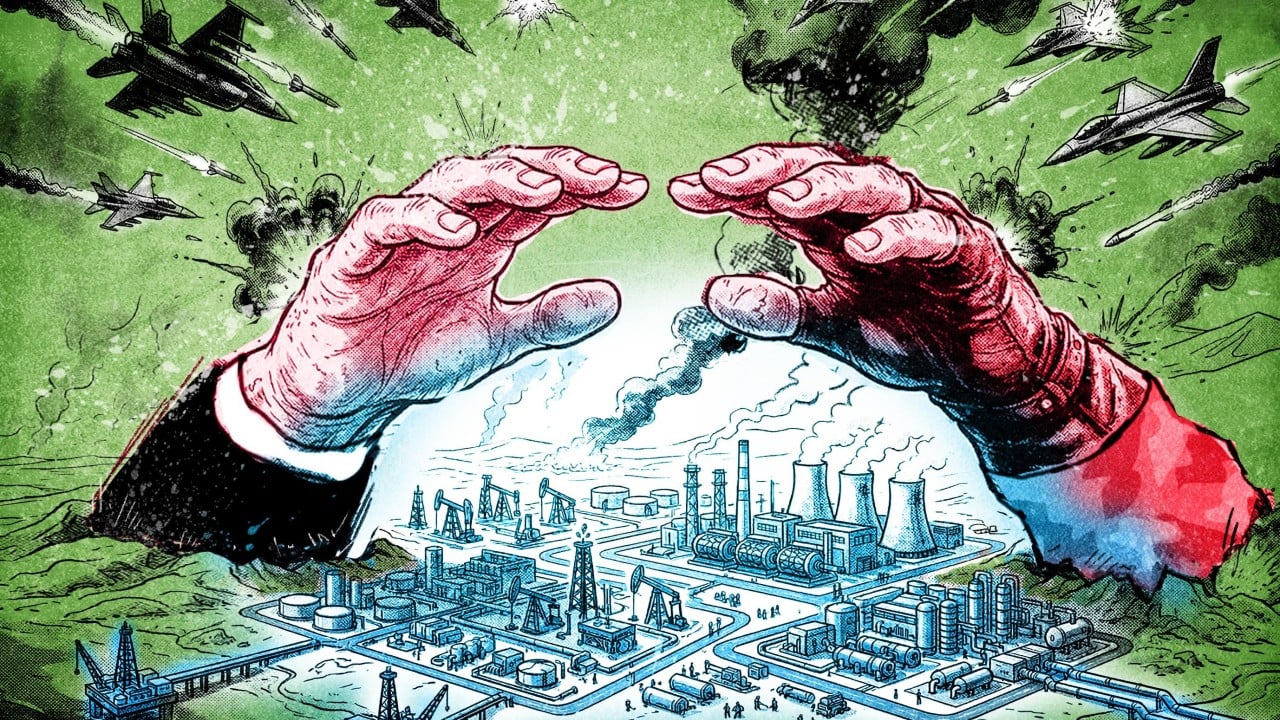
The illusion of the "clean war" died on February 28, 2026. For three decades, the American public has been sold a version of conflict that looks more like a surgical suite than a battlefield—a world of laser-guided scalpels and bloodless digital maps. Operation Epic Fury has shredded that narrative. While Washington remains obsessed with the term precision strikes, the reality on the ground across the Iranian plateau suggests a desperate shift toward mass, saturation, and a tolerance for collateral damage that we haven't seen since the 20th century.
We are witnessing the limits of high-cost, low-volume weaponry. The United States entered this conflict with a stockpile of sophisticated munitions that were never intended for a sustained war of attrition against a regional power. As Iranian air defenses, bolstered by Chinese YLC-8B anti-stealth radar, began picking off advanced drones and challenging air superiority, the Pentagon's math changed. You cannot win a war with $2 million missiles when the enemy has thousands of $20,000 drones and a decentralized command structure that refuses to stay in one place long enough for a legal review to clear.
The Myth of the Surgical Strike
Precision has always been a marketing term as much as a military one. In the opening weeks of the current campaign, the U.S. Army debuted the Precision Strike Missile (PrSM), a weapon touted as the pinnacle of discriminative fire. It was designed to replace the aging ATACMS and double the firepower of HIMARS launchers. Yet, by late March, reports began surfacing from the city of Lamerd regarding strikes on civilian infrastructure, including a sports hall and an elementary school.
The Pentagon issued the standard denials, but the technical reality is harder to mask. When you increase the range of a missile to 500 kilometers and double the volume of fire, the margin for intelligence error expands exponentially. The shift isn't occurring because the technology is failing. It is occurring because the mission has changed from "deterrence" to "systematic degradation."
A precision strike aims to remove a specific capability. A war of degradation, however, requires the destruction of entire networks. You don't just hit the missile; you hit the factory, the fuel depot, the power grid, and the road leading to the site. Once you move into that territory, "precision" becomes a polite euphemism for high-explosive saturation.
The Math of Attrition
The logistics of the Iran war are a nightmare the White House is trying to ignore. To maintain the pace of Operation Epic Fury, the U.S. is burning through munitions at a rate that the domestic industrial base cannot match. Consider the Patriot air defense system. During the first day of the war alone, the U.S. and its partners reportedly fired over 800 missiles—roughly an entire year's worth of production.
- The Shahed Problem: Iran is flooding the sky with low-tech Shahed drones.
- The Cost Asymmetry: Using a $3 million interceptor to down a $30,000 drone is a losing strategy.
- The Result: The U.S. has been forced to move Patriot batteries from Europe, leaving massive holes in NATO's eastern flank to feed the furnace in the Middle East.
This isn't a strategic choice; it’s a mathematical necessity. When the expensive, "precise" options run low, the military reverts to older, "dumber," and more destructive methods to achieve the same objectives.
Deep Strike and the B-21 Reality
The introduction of the B-21 Raider late last year was supposed to solidify the era of invisible, pinpoint lethality. And while the Raider has successfully penetrated deep into Iranian territory to drop the 30,000-pound GBU-57 Massive Ordnance Penetrator (MOP) on hardened nuclear sites, these missions are the exception.
The "Smart Intervention" strategy touted by analysts earlier this year relied on the idea that decapitation strikes against the IRGC would lead to a quick regime collapse. It ignored the fact that a cornered adversary doesn't care about your rules of engagement. By targeting Iranian command and control (C2) infrastructure so aggressively, the U.S. has effectively "blinded" the very people it might eventually need to negotiate with.
The result is a chaotic, decentralized battlefield where local commanders make their own decisions. To counter this, the U.S. has moved away from the "one target, one bomb" philosophy. We are seeing the return of "bespoke fuzing" strategies—dropping multiple heavy munitions on a single coordinate in rapid succession to burrow through geological overburden. This isn't surgery. This is a sledgehammer.
The European Vacuum
The shift in strategy has global consequences. The 2026 National Defense Strategy (NDS) made it clear: the U.S. is prioritizing homeland defense and China above all else. The war in Iran is an expensive distraction that the Pentagon is trying to end through sheer overwhelming force rather than the patient, precise application of power used in the 2010s.
By demanding that Europe, South Korea, and Middle Eastern partners handle their own "conventional deterrence," the U.S. is signaling that its high-end, precision-guided umbrella is no longer a given. If you want American help, it will be selective. It will be "conditional partnership."
The Logistics of Desperation
The most telling sign of the strategic shift is the deployment of the Merops anti-drone system. After the initial "disappointing" response to Iranian drone swarms, the Pentagon scrambled to field anything that could provide a cheaper alternative to the Patriot. This move toward "mass versus mass" is a tacit admission that the precision era is over.
We are now in an era of integrated deterrence, which is military-speak for "we will use every tool we have, regardless of how messy it gets." The objective in Iran is no longer a clean regime change or a surgical removal of the nuclear threat. It is the total neutralization of Iran's ability to project power, achieved through a sustained bombardment that looks increasingly like the air campaigns of the 1990s rather than the "gray zone" operations of the 2020s.
The Pentagon's insistence that its goals are being met "with more than enough munitions" is a thin veil. You don't move your entire European air defense shield for a "surgical" operation. You move it because you are in a high-intensity conflict that is eating your inventory alive.
The American public needs to stop looking for the "clean" outcome. There is no version of a war with Iran that remains precise once the first hundred missiles are fired. The deeper we go into the Iranian interior, the more the distinction between "military" and "civilian" infrastructure blurs. We aren't shifting away from precision strikes because we want to; we are shifting because the fantasy of the bloodless war has finally collided with the reality of a peer-level adversary.
The final objective of Operation Epic Fury isn't a treaty signed in Muscat. It is the physical erasure of the IRGC's logistics. That task cannot be accomplished with lasers and quiet drones alone. It requires the kind of raw, indiscriminate power that Washington spent twenty years pretending it would never need again.



