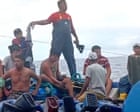
Small-scale fishers across the world’s most contested waters are increasingly finding themselves in the crosshairs of a maritime hierarchy that values tonnage over human life. When a massive vessel strikes a wooden fishing boat, it isn't just an accident. It is a collision of two worlds. On one side, you have the industrial giants of global commerce and naval power. On the other, you have artisanal fishers who provide the primary protein source for billions. These incidents are rarely about technical failure. They are about a systemic disregard for the "invisible" inhabitants of the sea.
The reality of these strikes is often buried in maritime logs or dismissed as unavoidable hazards of a crowded ocean. But for the survivors, the experience is a visceral reminder of their place in the global order. When a steel hull crushes a wooden outrigger, the survival rate is abysmal. Those who do make it back to shore often carry a trauma that the legal systems of the West are ill-equipped to handle. Recently making headlines in related news: Institutional Inertia and the Lifecycle of Peer Violence in Public Education.
The Invisible Fleet and the High Seas Hierarchy
International maritime law is built on the foundation of the International Regulations for Preventing Collisions at Sea, known as COLREGS. In theory, these rules apply to everyone. In practice, they favor those with the most advanced radar and the deepest pockets. A massive container ship or a naval destroyer moving at high speed creates a wake and a "blind zone" that can swallow a small fishing vessel before the bridge crew even realizes a contact occurred.
Many artisanal fishers operate without AIS (Automatic Identification System) transponders. They rely on visual cues and traditional knowledge. While critics argue this makes them responsible for their own safety, the economic reality is that these tools are often priced out of reach for a family-owned operation in the Global South. This creates a digital divide where the poorest workers on the ocean are effectively invisible to the sensors of the wealthiest. Further information on this are explored by The Guardian.
The power imbalance doesn't end at the moment of impact. When a strike occurs, the burden of proof rests almost entirely on the survivors. They must identify a vessel that is likely moving at 20 knots and may not even stop to render aid. Without satellite data or expensive legal representation, these fishers have almost no recourse. They are shouting into a void of corporate layers and sovereign immunity.
Why Modern Sensors Fail the Smallest Boats
We are told that we live in an era of total maritime awareness. Satellites track every major hull, and radar can spot a buoy in a storm. Yet, small fishing boats continue to be run down with alarming frequency. The technical explanation is often "sea clutter." In heavy swells, the signature of a small wooden or fiberglass boat disappears among the waves on a standard radar screen.
The Limits of Radar Technology
Most commercial radar systems are optimized to detect other large steel objects. A wooden hull has a very low radar cross-section. If the fishing boat isn't equipped with a radar reflector—a simple metal device that many skip to save weight or cost—it might as well not exist.
Human Error and the Autopilot Trap
On the bridge of a large ship, there is a growing reliance on automated systems. Long transits lead to "bridge fatigue," where watch officers may become over-reliant on alarms. If the alarm doesn't sound because the radar didn't "see" the small boat, the officer might never look out the window. This isn't just a lack of training. it is a byproduct of a shipping industry stretched to its absolute limit by just-in-time delivery demands.
The Shield of Sovereign Immunity
When a private merchant vessel hits a fishing boat, there is at least a theoretical path to a lawsuit. When a naval vessel is involved, that path often hits a brick wall. Sovereign immunity is the legal doctrine that prevents a government from being sued without its consent. For fishers in the South China Sea, the Indian Ocean, or off the coast of Africa, a run-in with a foreign navy is a legal dead end.
Naval vessels often operate with their AIS turned off for security reasons. They move in formations and at speeds that are unpredictable to local fishing fleets. When a collision happens, the military investigation is frequently classified. The survivors are left with broken boats and no way to pay for repairs, while the larger power moves on, citing national security or operational necessity.
This creates a culture of impunity. If there are no consequences for a "near miss" or even a direct strike, there is little incentive for naval commanders to change their transit patterns or slow down in known fishing grounds. The ocean is treated as a highway for the powerful, rather than a workspace for the vulnerable.
Economic Desperation and Rising Risk
To understand why fishers are in these dangerous lanes, you have to look at the collapse of near-shore fish stocks. Overfishing by industrial trawlers has pushed artisanal fishers further out to sea. They are venturing 50 or 100 miles from the coast in boats designed for coastal waters.
They are chasing the fish into the deep-water shipping lanes because that is the only place left to find a catch. This is a desperate gamble. They are essentially playing chicken with 100,000-ton ships to put food on the table. The risks are calculated, but the math is getting deadlier every year.
The Cost of a Life at Sea
In many maritime jurisdictions, the "value" of a lost fisher is calculated based on projected earnings. For someone earning a few dollars a day in a developing nation, the legal settlement—if it ever comes—is a pittance. It doesn't cover the loss of the boat, which is often the family’s only capital asset. It doesn't cover the psychological toll on a community that sees the ocean becoming a graveyard.
Compare this to the insurance payouts for a minor delay in a container ship's schedule. The global economy is tuned to protect the cargo, not the people who share the water with the ships carrying it.
The Myth of the Level Playing Field
The international community loves to talk about the "Blue Economy." They frame the ocean as a shared resource that must be managed sustainably. This is a convenient fiction. The ocean is a site of intense resource competition and geopolitical posturing.
Small-scale fishers are the most numerous users of the ocean, yet they have the least influence in maritime policy. When shipping lanes are drawn, they are drawn for the convenience of the world’s major ports. The traditional fishing grounds of local populations are rarely factored into the coordinates.
We see this play out in the way "safety zones" are enforced. A private security team on a bulk carrier will fire warning shots at a fishing boat that gets too close, fearing piracy. To the fisher, they are just trying to retrieve a net. To the ship's crew, they are a potential threat. This atmosphere of fear and suspicion makes every encounter a potential tragedy.
Technical Solutions That Actually Work
If the goal is to stop killing fishers, the solutions aren't mysterious. They are simply ignored because they cost money and slow down trade.
- Mandatory AIS for All: Large vessels should be required to broadcast their position in all but the most sensitive combat zones. Simultaneously, governments must subsidize low-cost AIS units for small-scale fleets.
- Thermal Imaging and AI Detection: Modern ships should be required to use forward-looking infrared (FLIR) cameras. These systems can see the heat signature of a human body or a small engine in total darkness, long before a radar picks up the hull.
- Mandatory Slow-Down Zones: Just as trucks slow down in school zones, massive ships must be forced to reduce speed when passing through known high-density artisanal fishing grounds.
The Failure of the Port State Control
The best place to hold ship owners accountable is in the ports. If a ship arrives with signs of a collision, it should be impounded immediately until a transparent investigation is completed. Currently, many ships can hide behind "flags of convenience." A ship owned by a company in London might be registered in Panama, crewed by sailors from the Philippines, and operating in the waters of Indonesia.
This web of jurisdictions is designed to offshore liability. It makes it nearly impossible for a poor fishing village to find the right person to sue. Until we crack the shell of these corporate structures, the strikes will continue. The paperwork is the shield that allows the physical violence to go unpunished.
Restoring the Balance
The survivors of boat strikes aren't looking for charity. They are looking for the right to work without being crushed by a shadow in the night. They want their lives to be seen as more than an "unfortunate incident" in a quarterly shipping report.
The maritime industry likes to think of itself as a high-tech, professionalized sector. But as long as it continues to treat the world's fishers as collateral damage, it remains a lawless frontier. Accountability shouldn't be a luxury reserved for those who can afford an admiralty lawyer.
Every time a massive ship sails away from a wreck without stopping, it isn't just a hit-and-run. It is a statement that the lives on that small boat do not count. Changing that narrative requires more than just better radar. It requires a fundamental shift in how we value the people who harvest the sea.
Stop looking at the ocean as a blank space between ports. It is a crowded, living workspace, and the giants need to start watching where they step.