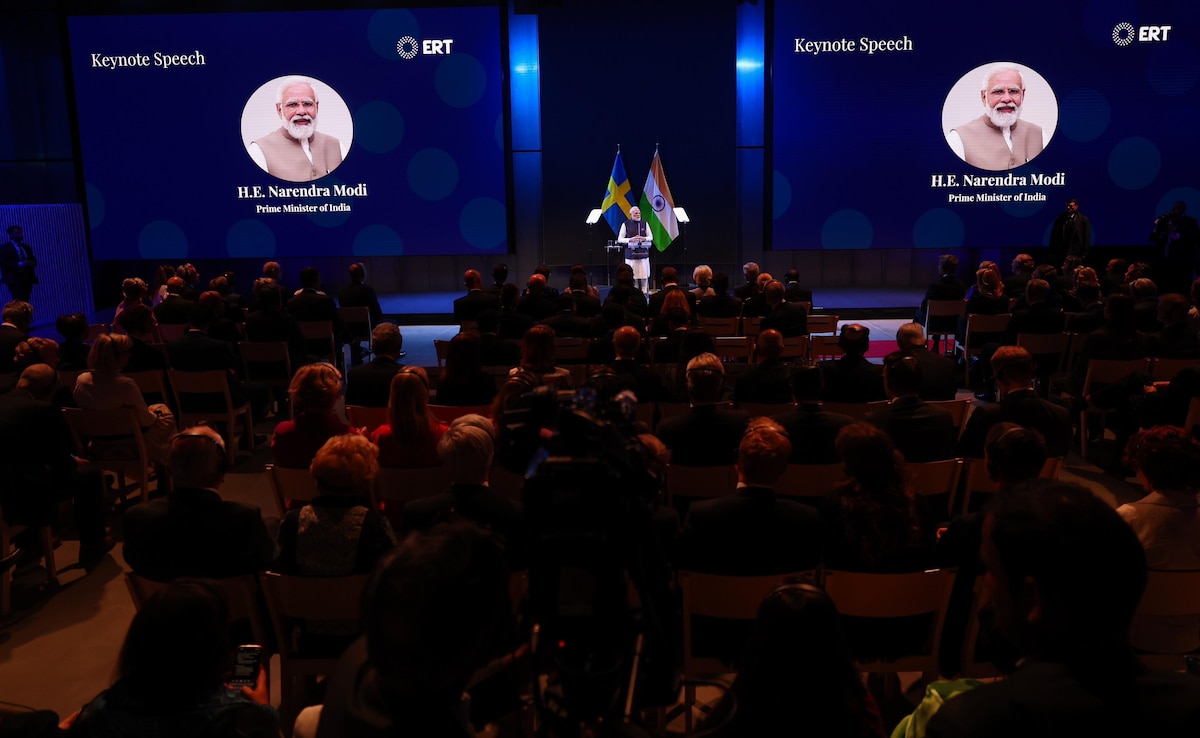
Prime Minister Narendra Modi’s high-stakes assembly with European chief executives in Gothenburg, Sweden, represents a desperate economic necessity masked as a diplomatic victory. While the official communiqués focus on shared democratic values and a mutual desire to double bilateral trade within five years, the reality on the ground is far more transactional. India is racing against time to position itself as the ultimate alternative to Western supply chains anchored in China, but European boardrooms remain deeply conflicted. To secure the capital required for its ambitious domestic manufacturing goals, New Delhi must offer more than just a massive consumer market. It must fundamentally rewrite its regulatory playbook.
The Gothenburg summit brought together the European Round Table for Industry, co-hosted by Swedish Prime Minister Ulf Kristersson and European Commission President Ursula von der Leyen. The choice of venue was deliberate. Gothenburg is the industrial heart of Sweden, home to automotive titans, aerospace pioneers, and green technology research clusters. By bypassing traditional political capitals to pitch directly to industrial CEOs in a manufacturing hub, New Delhi signaled that its primary objective is the immediate acquisition of advanced technology and deep-tech manufacturing capacity.
The Real Numbers Behind The Rhetoric
Bilateral trade expansion targets sound impressive in press releases, but a cold analysis of current economic data reveals the massive scale of the challenge. India and Sweden have set a joint ambition to double their bilateral trade, yet achieving this requires overcoming years of stagnant trade velocity. Western corporations have historically treated India as an outsourcing hub for software development rather than a destination for heavy capital expenditure.
The strategy relies heavily on the momentum of the recently concluded India-European Union Free Trade Agreement. For years, negotiations stalled over European demands for lower tariffs on automobiles and wine, balanced against India's insistence on greater mobility for its professionals. While political leaders praise the decisive conclusion of the deal, the actual implementation details face intense scrutiny from corporate legal teams. European CEOs are not altruists. They are looking at structural cost differentials, supply chain resilience, and intellectual property protection.
The Five Pillars Of The Indian Pitch
New Delhi structured its pitch around five distinct industrial sectors calculated to align with current European vulnerabilities.
- Deep Tech Manufacturing and Electronics: Offering alternative fabrication and assembly ecosystems to reduce dependence on East Asian supply chains.
- Green Industrial Transition and Mobility: Aligning India’s massive scale with Nordic expertise in fossil-free steel, commercial electric vehicles, and grid-scale storage.
- Artificial Intelligence and Telecommunications: Positioned not as simple back-office code generation, but as a global research and development hub.
- Defense and Security Dialogue: Transitioning from a buyer-seller relationship toward joint development and domestic production of advanced military hardware.
- Space Cooperation: Exemplified by Sweden joining India’s upcoming Venus orbiter mission, blending European instrumentation with low-cost Indian launch capabilities.
What Corporate Leaders Say Behind Closed Doors
While executives like Volvo Group India chief Kamal Bali publically praise India’s economic transformation, private corporate sentiment is far more measured. European multinational corporations operate under stringent environmental, social, and governance metrics. Moving production capacity to a country heavily reliant on coal for its baseline electricity grid creates immediate compliance friction.
Regulatory predictability remains the secondary hurdle. Corporate compliance officers frequently point to India's historical tendency toward retrospective taxation and sudden, unilateral policy shifts in e-commerce and data localization rules. A European manufacturing conglomerate cannot easily commit hundreds of millions of dollars to build a physical factory when the domestic regulatory landscape might shift before the facility achieves profitability.
Consider a hypothetical automotive supplier deciding between expanding a facility in Eastern Europe or breaking ground on a greenfield site in western India. The labor costs in India are undeniably lower. However, when factoring in the cost of importing specialized components over volatile maritime trade routes, combined with the expense of running backup diesel generators to offset local grid instability, the financial advantage narrows significantly. This is the exact calculation European chief executives are running while listening to political speeches about global partnerships.
The China Plus One Fantasy Versus Supply Chain Reality
The underlying geopolitical driver of the Gothenburg summit is the global corporate strategy known as China Plus One. Western boards want to diversify their manufacturing footprints to mitigate the risks of geopolitical tension in the Taiwan Strait and heavy-handed domestic policies within China. India positions itself as the natural beneficiary of this shift.
This transition is proving remarkably difficult to execute. China’s manufacturing dominance is built on decades of massive infrastructure investment, deeply integrated component ecosystems, and highly efficient logistics networks. When a European company moves an assembly line to India, it frequently discovers that it must still import the vast majority of its sub-assemblies and raw materials from Chinese suppliers. This creates a logistical paradox where supply chains become longer, more expensive, and less transparent, rather than more secure.
To break this cycle, New Delhi is deploying its Production Linked Incentive schemes. These cash-back incentives are designed to offset the cost disadvantages of manufacturing within India. The strategy has achieved notable success in consumer electronics assembly, but duplicating that success in capital-intensive sectors like specialized machinery, deep-tech semiconductors, and advanced pharmaceuticals requires a level of precision that bureaucratic machinery rarely delivers.
The Structural Mismatch in Green Technology
The most significant friction point discussed in Gothenburg involves the green industrial transition. European industry is under immense pressure to decarbonize. Sweden leads the world in developing technologies for green steel, electric transport, and circular manufacturing. Prime Minister Modi’s pitch explicitly targeted these sectors, hoping to import these technologies to clean up India’s rapidly growing industrial base.
The bottleneck is financial. Green technologies require massive upfront capital expenditures, and the return on investment is realized over decades. In Europe, these projects are heavily subsidized by state funds or supported by carbon pricing mechanisms that make fossil-fueled alternatives prohibitively expensive. India possesses no equivalent carbon market, and its capital markets face higher borrowing costs.
A Swedish firm specializing in hydrogen-based metallurgy faces a profound dilemma when asked to deploy its proprietary technology in an economy where cheap domestic coal remains the primary energy source. Without structural reforms to India's energy pricing mechanisms and state-level electricity distribution companies, the green industrial partnership risks remaining confined to pilot projects and academic collaborations.
The Real Test For New Delhi
The Gothenburg summit succeeded in securing a strategic partnership upgrade and generating positive corporate headlines. It demonstrated that European political leadership, driven by a desire for economic security, is willing to push its corporate sector toward deeper engagement with India.
The real work now falls entirely on India’s domestic execution. Western capital will not flow into the subcontinent simply because political leaders exchange symbolic cultural gifts or sign high-level strategic frameworks. It will flow when the physical cost of moving cargo out of Indian ports drops to competitive global levels, when contract enforcement becomes reliable, and when the bureaucratic friction of doing business across state borders is permanently eliminated. New Delhi has demonstrated its ability to court global capital at the highest levels. The question that remains unanswered in Western boardrooms is whether the domestic administrative machinery can deliver on the promises made on foreign soil.


