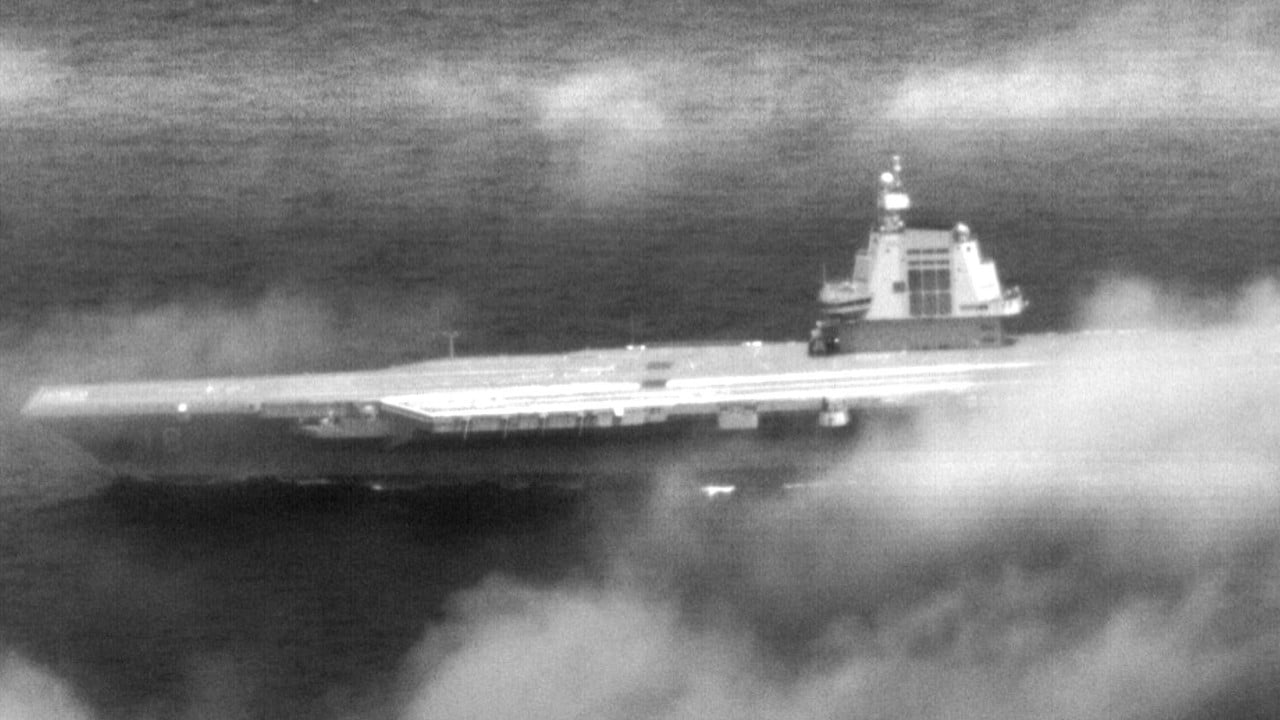
The recent deployment of China’s newest aircraft carrier, the Fujian, through the Taiwan Strait during high-stakes military drills represents a calculated escalation in regional power projection. While initial reports framed the transit as a routine show of force, the reality is far more complex. This move was a deliberate stress test of regional defense networks and a live-fire demonstration of China's expanding naval ambitions. By sending its most technologically sophisticated capital ship through one of the world's most sensitive chokepoints, Beijing signaled a shift from theoretical capability to operational readiness, fundamentally altering the strategic calculus for Washington and Taipei.
A Leap in Force Projection
The Fujian is not merely another addition to the People’s Liberation Army Navy (PLAN). It represents a massive technological departure from its predecessors, the Liaoning and the Shandong.
Those older vessels rely on Soviet-era ski-jump ramps to launch aircraft. That mechanism severely limits the maximum takeoff weight of fighters, restricting their fuel capacity and weapon payloads. The Fujian changes that dynamic entirely.
By incorporating an Electromagnetic Aircraft Launch System (EMALS), the PLAN has skipped a generation of naval engineering. This technology allows for the rapid launch of heavier aircraft, including fully loaded J-15B fighters and the new KJ-600 airborne early warning and control planes. The presence of the KJ-600 alone transforms a carrier strike group. It extends the radar horizon by hundreds of miles, allowing the fleet to detect incoming threats and coordinate strikes far beyond the range of shipborne sensors.
Naval analysts watching the recent transit noted that the Fujian did not move in isolation. It was surrounded by a dense screen of Type 055 guided-missile destroyers and Type 054A frigates. This was not a ceremonial parade. It was a fully integrated strike group configuration operating in confined waters, designed to prove that the PLAN can maintain operational cohesion under intense scrutiny.
The Geography of Escalation
Navigating a 1,000-foot supercarrier through the narrow Taiwan Strait carries immense tactical risk. The strait is shallow, congested, and heavily monitored by land-based anti-ship missile batteries from both sides.
Beijing chose this route precisely because it is dangerous.
Testing the Waters
By operating the Fujian in these waters during active military drills, the PLAN accomplished several critical objectives:
- Sensor Mapping: The transit forced Taiwanese and American radar installations, electronic warfare units, and reconnaissance satellites to activate. The PLAN collects this electronic intelligence to map out adversary responses for future conflicts.
- Psychological Normalization: Repetitive incursions erode the psychological barrier of the median line. What was once considered an extraordinary provocation is gradually turned into a routine occurrence.
- Logistical Validation: Moving a conventional supercarrier requiring massive fuel reserves through a potential combat zone tests the underlying logistical supply chain, including replenishment-at-sea oilers.
The Vulnerability Myth
For years, Western military doctrine emphasized that large aircraft carriers are highly vulnerable in narrow seas. They are targets for shore-based anti-ship cruise missiles and asymmetric drone swarms.
The PLAN is fully aware of this critique. However, their doctrine views the Taiwan Strait not as a trap, but as a shield. By operating close to the Chinese mainland, the Fujian benefits from a dense umbrella of land-based air defense systems, anti-ship ballistic missiles like the DF-21D, and heavy electronic jamming support. The carrier is not operating isolated in the deep ocean; it is the tip of a continental military spear.
The American and Taiwanese Counter Calculus
The response from Washington and Taipei has been deliberately measured, avoiding overt panic while quietly adjusting defensive postures.
Taipei has accelerated its shift toward asymmetric warfare. Recognizing that it cannot match China hull-for-hull, the Taiwanese military is focusing on mobile, low-cost defensive measures. These include sea-mining capabilities, fast missile assault craft, and land-based Harpoon missile systems. The goal is to make any attempt to control the strait prohibitively costly, regardless of how many carriers Beijing deploys.
Meanwhile, the U.S. Navy faces a complex dilemma. Maintaining a permanent carrier presence near Taiwan strains an already overworked fleet. Instead, the U.S. is shifting toward a distributed lethality strategy. This involves dispersing smaller, highly lethal units across the First Island Chain, relying on long-range anti-ship missiles and unmanned surface vessels to complicate Chinese naval planning.
The deployment of the Fujian underscores a harsh reality for regional planners. The window for treating the PLAN as a green-water navy confined to its coastal borders has closed permanently. Beijing now possesses the hardware, the doctrinal maturity, and the political will to project heavy carrier aviation into contested waters, forcing its adversaries to rewrite their defensive playbooks in real time.