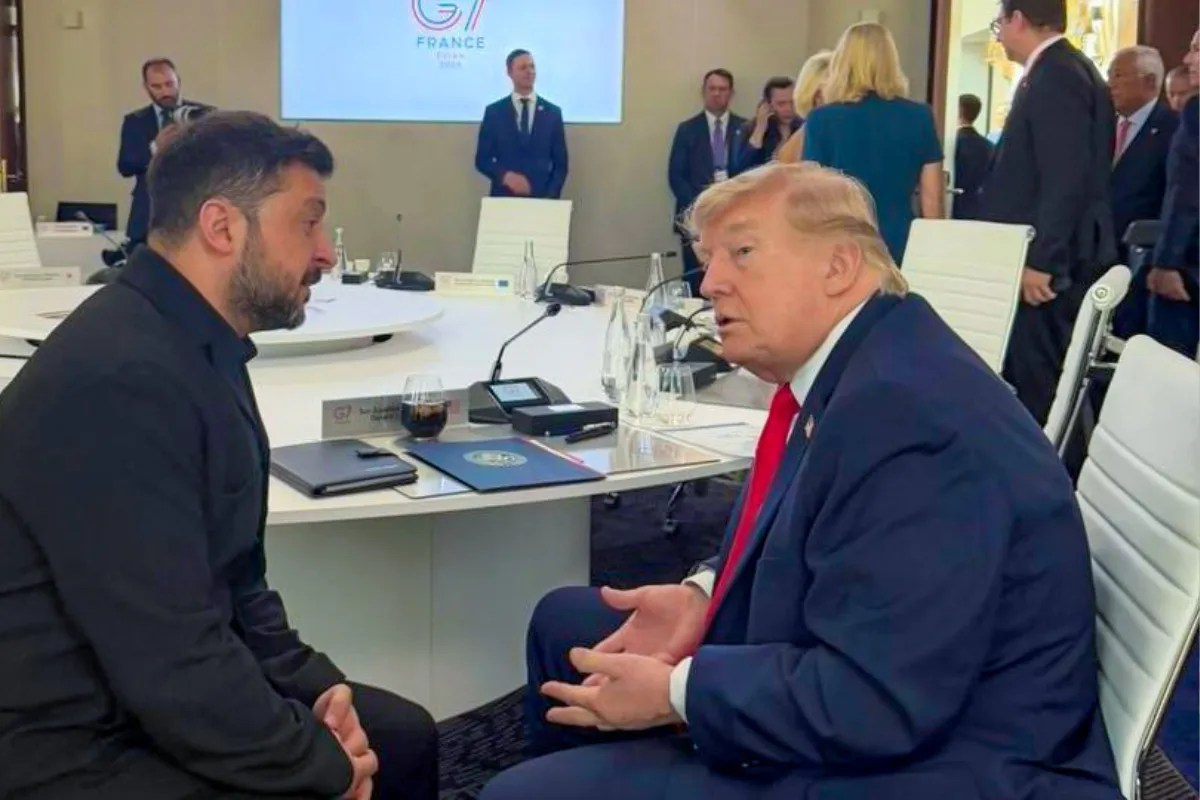
Donald Trump used his recent G7 summit meeting with Ukrainian President Volodymyr Zelenskyy to issue a direct appeal to Russia for peace. This move signals a massive shift in how the next phase of the war might be negotiated. While official channels remain frozen in ideological gridlock, this high-stakes meeting exposed the shadow diplomacy operating behind the scenes. Trump is positioning himself as the sole arbiter capable of ending the war, bypassing traditional Western diplomatic protocols. This strategy alters the leverage dynamics between Washington, Kyiv, and Moscow, forcing all sides to recalculate their long-term positions.
The Strategy Behind the G7 Encounter
The meeting at the G7 summit was not a mere photo opportunity. It was a calculated recalculation of leverage. For Zelenskyy, engaging with Trump is a matter of survival. Kyiv knows that relying solely on the current administration's long-term legislative backing is a high-risk gamble given the shifting political tides in Washington. By securing a face-to-face meeting on the sidelines of a major multilateral summit, Zelenskyy attempted to bind Trump to the reality of Ukraine's defense needs, moving past the rhetoric of campaign rallies.
Trump used the momentum of that meeting to immediately pressure the Kremlin. His appeal to Russia to halt its offensive operations and enter negotiations was timed to show that he holds the keys to a resolution. This is classic transactional diplomacy. By showing he can command the attention of Ukraine's leadership, Trump demonstrated to Vladimir Putin that any future American aid cuts are contingent on Russian concessions, not just automatic gifts to Moscow.
Moscow Calculated Silence and the Battlefield Reality
Russia responds to strength and leverage, not appeals. While Trump's public statements urged a cessation of hostilities, the Kremlin's immediate reaction was one of cautious observation. Moscow understands that public declarations during a summit are distinct from binding policy shifts. The Russian military apparatus continues its grinding war of attrition in eastern Ukraine, betting that time and industrial capacity favor their objectives.
The underlying mechanism of this conflict relies heavily on supply lines and ammunition production. If the United States alters its supply of artillery shells and air defense interceptors, the frontline changes rapidly. Trump's appeal was a warning shot to Moscow. He signaled that while he wants to end the war quickly, a total Russian refusal to negotiate would leave him with little choice but to maintain or even accelerate support to Ukraine to force a settlement. It is a balancing act that forces Putin to weigh the certainty of a prolonged, costly war against the uncertainty of a Trump-brokered peace deal.
The Limits of Transactional Peace Deals
A major flaw exists in the assumption that a complex territorial and existential war can be settled like a real estate transaction. The core issue is the zero-sum nature of the security guarantees demanded by both sides.
- Ukraine Demand: Full territorial integrity and binding security guarantees, preferably through NATO membership or equivalent Western defense pacts, to prevent a future invasion.
- Russia Demand: Permanent neutrality for Ukraine, significant territorial concessions, and a veto over Kyiv's foreign policy alignments.
- The Impasse: These positions are fundamentally incompatible. No amount of personal rapport or public appeals can easily bridge the gap between absolute sovereignty and imperial ambition.
The Fragmented Western Alliance
The G7 summit highlighted a growing divergence in Western strategy. While European leaders largely advocate for a long-term containment strategy against Russia, the American political landscape is deeply divided on the cost and duration of that commitment. Trump's direct appeal to Russia right after meeting Zelenskyy bypassed the collective front that the G7 tries to project. This creates immediate friction with European allies like France, Germany, and Poland, who view any unilateral American deal with Moscow as a direct threat to continental security.
European capitals are quietly preparing for strategic autonomy, realizing they can no longer rely blindly on the American security umbrella. If Washington shifts toward an immediate, enforced peace settlement, Europe will face a choice. They must either fill the massive financial and military void left by the United States or pressure Kyiv to accept painful concessions that could leave Central Europe vulnerable to future aggression.
The Hidden Costs of an Enforced Settlement
Peace at any cost carries a heavy price tag. If an agreement forces Ukraine to cede significant territory in exchange for a ceasefire, it establishes a dangerous international precedent. It signals that nuclear-armed states can redraw borders through industrial warfare if they outlast Western political will. This outcome would reverberate far beyond Eastern Europe, influencing calculations in the Indo-Pacific and the Middle East.
An unstable ceasefire without ironclad security guarantees would trigger a massive rearmament cycle across Europe. Kyiv would likely spend the interim period developing indigenous long-range strike capabilities, while Moscow would rebuild its depleted mechanized forces for a second attempt once Western attention shifts elsewhere. A pause in fighting is not the same as a durable peace.
The true test of Trump's diplomatic push lies not in the appeals made after a summit, but in the enforcement mechanisms of any proposed deal. Without a credible threat of force or a permanent Western military presence on the ground, any piece of paper signed in the near future will simply serve as a prelude to the next phase of the conflict.