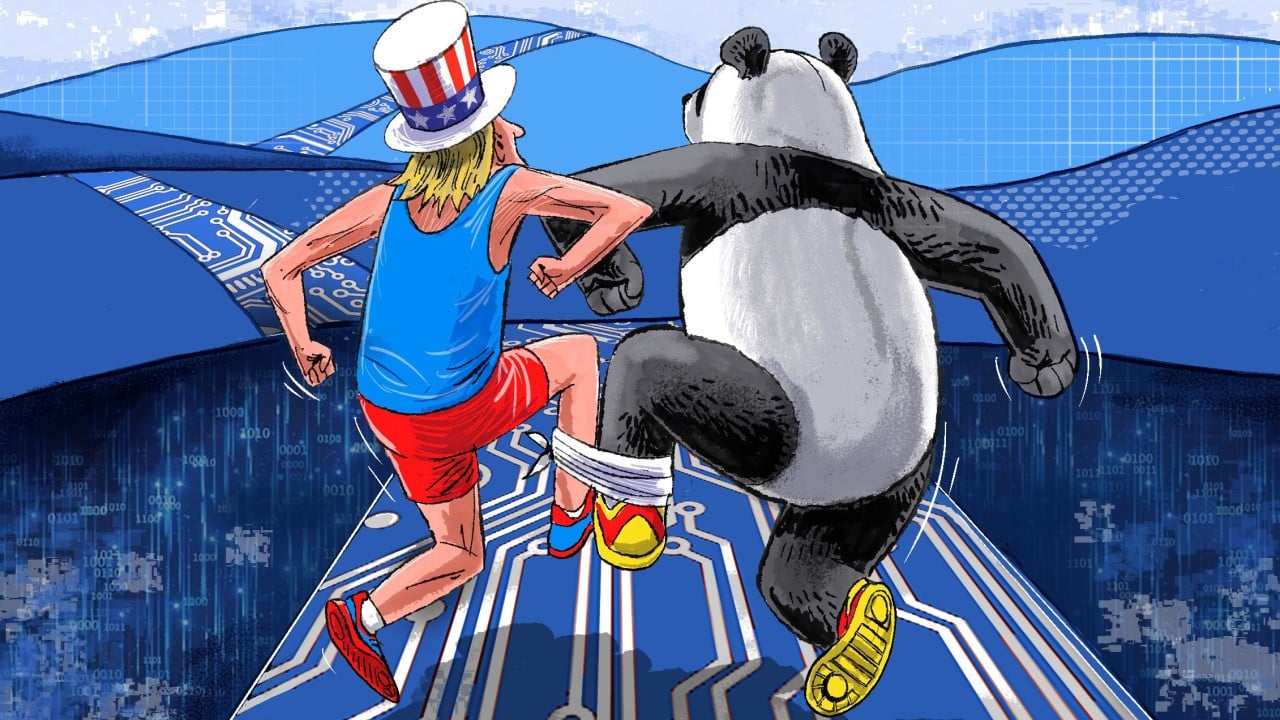
The smoke has cleared from the Great Hall of the People, and the signal is unmistakable. Beijing is no longer reacting to American export controls; it is actively re-engineering its entire economy to bypass them. During the recent "Two Sessions" political meetings, the phrase "new quality productive forces" became the official mandate for a nation that realizes its old growth drivers—real estate and low-end manufacturing—are dead. This isn't just another five-year plan. It is a war footing designed to achieve total technological self-sufficiency before the next round of Western sanctions can land.
For years, the consensus in Washington was that China’s tech sector was a house of cards built on stolen IP and Western silicon. That view is dangerously outdated. By shifting the focus toward "frontier technologies" like quantum computing, synthetic biology, and high-end semiconductors, Beijing is signaling that the era of imitation is over. They are moving into a period of forced innovation. The goal is to create a "closed-loop" ecosystem where every critical component, from the lithography machines to the operating systems, is scrubbed of foreign influence.
The Death of the Global Supply Chain
We are witnessing the deliberate dismantling of the globalized tech world. For decades, the industry operated on the principle of efficiency—getting the best part from the cheapest source. Beijing has decided that security now trumps efficiency every single time.
The "Two Sessions" discussions highlighted a massive redirection of capital. While Western analysts focus on China’s slowing GDP, they often miss where the remaining money is going. It is being poured into "chokepoint" technologies. These are the specific areas where China remains vulnerable to U.S. pressure, such as EDA (Electronic Design Automation) software and advanced logic chips.
The strategy is simple but brutal. If you cannot buy the future, you must build it, regardless of the cost. This state-led investment is creating a bifurcated world. We are moving toward a reality where a device designed in Shenzhen may eventually share nothing in common with one designed in Cupertino. Not the code, not the cobalt, and certainly not the cloud.
Why the Private Sector is Falling in Line
In the past, Chinese tech giants like Alibaba and Tencent acted like their Silicon Valley counterparts. They chased consumer data, gaming revenue, and fintech dominance. That era ended with the regulatory crackdowns of the early 2020s. Now, the state has successfully domesticated its unicorns.
The new directive for the private sector is clear: align with the national security mission or vanish. During the recent legislative meetings, the emphasis wasn't on "platform economies" or social media. It was on "hard tech." Every major private player in China is now falling over itself to prove its utility to the state’s industrial goals.
- Huawei has become the national champion of resilience, proving it can survive without Google’s Android or ARM’s high-end designs.
- SMIC is receiving unprecedented subsidies to close the gap in 7nm and 5nm production, even if the yields are economically questionable.
- BYD is being used as a battering ram to dominate the global EV market, securing the entire battery supply chain from the mine to the dashboard.
This isn't about profit margins anymore. It’s about survival. When the state provides the capital, it also dictates the destination. The result is a surge in patent filings and R&D spending that rivals the Manhattan Project in its singular focus.
The Quantum Gamble
One of the most overlooked aspects of the "Two Sessions" was the elevated status of quantum technology. Beijing isn't just looking at the next generation of smartphones; they are looking at the next generation of reality.
Quantum computing and quantum encryption represent the ultimate "get out of jail free" card in a tech war. If China can achieve a breakthrough in quantum-resistant cryptography or quantum sensing, the current U.S. advantage in conventional computing becomes irrelevant. They are betting that they can leapfrog the current semiconductor bottleneck by winning the race to the next medium of computation.
This is a high-risk, high-reward play. It requires a level of basic scientific research that China has historically struggled with. However, the sheer volume of PhDs being funneled into these state labs suggests that the "imitation" trope is losing its validity. They are no longer just copying the homework; they are trying to rewrite the physics textbook.
The Human Capital Crisis
Despite the bravado, there is a glaring weakness in Beijing’s plan: the people. You can build a factory in a year, but you cannot manufacture a world-class engineer in a decade.
China is facing a demographic collapse that is already beginning to bite. The youth unemployment rate—which the government briefly stopped reporting—indicates a massive disconnect between the education system and the "hard tech" needs of the state. Thousands of graduates are skilled in marketing or finance, while the state desperately needs materials scientists and lithography experts.
Furthermore, the "closed-door" policy required for national security is driving away the very international talent China needs. Top-tier researchers often prefer the open, collaborative environments of Western universities. By turning their tech sector into a series of "black sites," Beijing risks creating a vacuum where innovation is stifled by bureaucracy and fear of failure.
The Real Cost of Self-Reliance
The push for "new quality productive forces" is an admission that the old way is broken. But the cost of this transition is staggering. By forcing domestic companies to use inferior Chinese-made tools to satisfy political mandates, Beijing is essentially taxing its own innovation.
In the short term, this leads to inefficiency. A Chinese chipmaker using domestic tools will likely produce more waste and have higher costs than a competitor using Dutch or American equipment. For now, the state is willing to eat those costs. The question is how long the Chinese economy—already burdened by a debt-laden property sector—can sustain these massive subsidies.
The "Two Sessions" didn't provide an answer to the debt problem. They simply doubled down on the idea that technology will eventually provide the productivity gains needed to outrun the financial crisis. It is a race against time.
The Impact on Global Markets
Investors who think they can ignore these political signals are delusional. We are entering a period where "de-risking" will become a permanent feature of the market.
Multinational corporations are already being forced to "In China, For China." This means creating entirely separate R&D and data silos within the country to comply with both Chinese security laws and U.S. export controls. This duplication of effort is expensive and kills the scaling advantages that made tech companies so profitable in the first decade of the 2000s.
Moreover, we should expect more aggressive Chinese moves in standard-setting bodies. Whether it’s 6G, autonomous driving protocols, or AI ethics, Beijing is no longer content to follow. They want to set the rules so that the rest of the world has to adapt to their technology, rather than the other way around.
AI is the New Nuclear Race
The most contentious front in this contest is Artificial Intelligence. The "Two Sessions" made it clear that "AI Plus" is the new national initiative. This isn't about making better chatbots. It’s about integrating AI into the industrial base to automate the manufacturing of advanced weaponry, optimize power grids, and manage surveillance states.
The U.S. attempt to cut off high-end GPUs like NVIDIA’s H100s has certainly slowed China down, but it hasn't stopped them. Instead, it has sparked a feverish effort to develop domestic AI accelerators. While these Chinese chips may be less efficient, they are "good enough" for many applications.
In a conflict, "good enough" and "available in massive quantities" often beats "superior" but "unavailable." This is the core of China’s new strategy. They are prioritizing the resilience of the "good enough" over the fragility of the "perfect."
The Mirage of De-escalation
Every few months, a high-level meeting between U.S. and Chinese officials leads to headlines about "stabilizing the relationship." Don't believe them.
The structural incentives for both sides are now permanently aligned toward confrontation. For Washington, technological supremacy is a matter of maintaining the liberal world order. For Beijing, it is a matter of regime survival. There is no middle ground when both sides view the other's progress as an existential threat.
The "Two Sessions" were a formal notification that the contest has shifted from a trade dispute to a total systemic rivalry. The Chinese leadership is preparing its people for a "protracted war," a term borrowed from Mao Zedong. This involves belt-tightening, ideological purity, and a relentless focus on the hardware of power.
The era of the global internet is over. The era of the global supply chain is ending. What remains is a cold, calculated struggle for the digital high ground, where the winner won't just have the best gadgets, but the power to define the reality of the 21st century.
Identify the specific Chinese "Little Giant" firms receiving these new state subsidies to understand where the next supply chain shocks will originate.